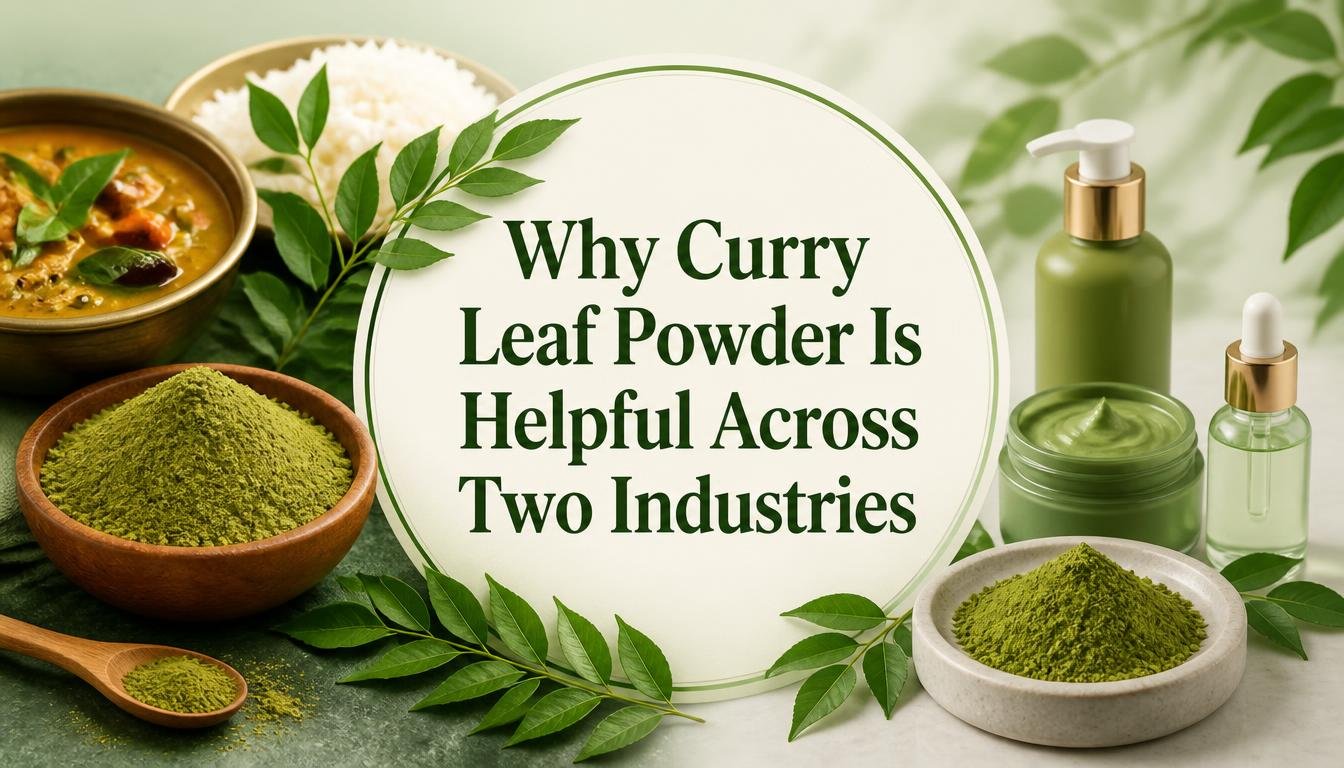
Curry leaf powder is helpful in a way most single-ingredient spices aren’t: it serves two genuinely separate manufacturing industries at once. In food, it’s a concentrated, shelf-stable form of an ingredient central to South Indian tempering (tadka), delivering the same aromatic, citrusy depth as fresh leaves without the sourcing and spoilage challenges fresh curry leaves create for international buyers. In cosmetics, dried and powdered curry leaf is a widely used botanical ingredient in haircare formulations, prized for its nutrient content and long traditional use in Indian beauty rituals.
This guide covers both applications, and is honest about where the evidence is strong (culinary) versus where it’s mostly traditional and anecdotal (cosmetic/haircare claims).
What Curry Leaf Powder Actually Is
Curry leaf powder is made by drying and grinding the leaves of Murraya koenigii, a plant native to India and South Asia known for its warm, citrusy aroma. It’s worth noting explicitly: curry leaves are not the source of “curry powder,” the multi-spice blend — the two are entirely different products that share a name coincidentally, a point of confusion worth clarifying with any international buyer unfamiliar with the distinction.
1. A Genuine Solution to Fresh Curry Leaf’s Sourcing Problem
Fresh curry leaves have a short shelf life and don’t ship well internationally, which has historically limited their use outside South Asia and diaspora grocery channels. Dried, powdered curry leaf solves this directly — it retains the core aromatic profile in a stable, easily transported form, giving international food manufacturers and packaged food brands access to the ingredient without the cold-chain and spoilage constraints fresh leaves require.
2. Concentrated Flavor for Tempering and Spice Blend Applications
In South Indian cooking, curry leaves are bloomed in hot oil at the start of cooking (tempering, or tadka) to release their aromatic oils — a technique that curry leaf powder can replicate in a more shelf-stable, dosage-consistent form for manufacturers formulating packaged dal, sambar, chutney, and spice blend products. For a manufacturer targeting authenticity-focused packaged Indian food, curry leaf is often as functionally important to the flavor profile as any other spice in the blend.
3. A Natural Green Colorant Option
Curry leaf powder’s natural chlorophyll-driven green color gives it secondary functional value as a natural colorant for food applications wanting a green hue without synthetic dyes — an application that fits directly into the broader clean-label reformulation trend already discussed elsewhere in this content series, alongside spinach and other leafy green powders.
4. A Distinct Second Market: Cosmetics and Haircare
This is where curry leaf genuinely differs from most other ingredients in this catalog. Curry leaf powder is a common ingredient in cosmetic and haircare formulations — hair masks, oils, and powders — largely because of its long traditional use in Indian beauty rituals and its natural nutrient content, including beta-carotene and various plant compounds. Formulators building natural or Ayurvedic-positioned haircare lines frequently source curry leaf powder specifically for this application, separate entirely from any food use.
It’s important to be precise here: independent review of the clinical evidence behind curry leaf’s hair-growth and anti-greying claims has found the research base to be thin, with most support coming from traditional use and anecdotal reports rather than controlled studies. That doesn’t make the ingredient less commercially relevant for haircare formulation — traditional-use botanicals are a legitimate and growing cosmetics category — but any specific efficacy claim on a finished cosmetic product needs to be handled carefully and reviewed against your destination market’s cosmetic labeling regulations.
5. Shelf Stability Across Both Applications
Whether destined for a food or cosmetic formulation, properly dried and powdered curry leaf holds its aroma and nutrient profile for an extended period when stored in a cool, dry, moisture-protected environment — removing the sourcing urgency that fresh leaves would otherwise create for either industry.
6. A Genuine Supply Chain Efficiency for Multi-Category Buyers
A buyer sourcing curry leaf for both a food product line and a cosmetics line can potentially consolidate sourcing through a single well-vetted supplier, rather than managing separate ingredient relationships for what is functionally the same raw botanical processed to the same basic specification, with grind fineness adjusted for the specific end use.
Common Mistakes When Sourcing Curry Leaf Powder
- Confusing curry leaf with curry powder. These are entirely unrelated products — clarify this explicitly with any team member or partner unfamiliar with the distinction.
- Not specifying grind fineness for the application. Food tempering applications and cosmetic formulations often call for different particle sizes — confirm the spec matches your specific use case.
- Assuming cosmetic-grade and food-grade curry leaf powder are interchangeable. Processing and hygiene standards can differ between the two grades — confirm which grade you’re actually being quoted before ordering.
- Overstating haircare efficacy claims. The clinical evidence for curry leaf’s hair-growth and anti-greying effects is largely traditional and anecdotal rather than clinically established — any product claim needs separate regulatory review for your destination market.
- Not confirming moisture content for shelf-life planning. As with any dried leaf powder, moisture content directly affects shelf stability — request this on the spec sheet rather than assuming a standard figure.
How Shanti Sons Foods Supplies Curry Leaf Powder
We export curry leaf powder alongside our broader herbal powder and spice lines, and can advise on the grind specification appropriate for either food or cosmetic formulation use. If you’re formulating across categories, our pieces on why herbal powder is helpful and why spray dried vegetable powder is helpful cover the adjacent leaf and vegetable powder categories in the same supply chain.
The fastest way to confirm fit: specify whether you need food-grade or cosmetic-grade curry leaf powder, request the grind fineness that suits your application, and test a sample before scaling to a bulk order.
FAQ
Is curry leaf powder the same as curry powder? No — curry leaf powder is made from the leaves of Murraya koenigii, a specific South Asian plant, while curry powder is an unrelated multi-spice blend. The names are coincidentally similar but the products share no ingredients.
What’s the difference between food-grade and cosmetic-grade curry leaf powder? Processing and hygiene standards, and sometimes grind fineness, can differ between the two. Confirm explicitly which grade a supplier is quoting before ordering, especially if you’re sourcing for a cosmetic formulation.
Does curry leaf powder actually help with hair growth? Curry leaf has a long history of traditional use in Indian haircare, but independent review of the clinical evidence finds it largely anecdotal rather than backed by controlled studies. It remains a legitimate traditional-use botanical ingredient for formulation purposes, but specific efficacy claims need separate regulatory review.
How long does curry leaf powder last? Properly dried and stored in a cool, dry, moisture-protected environment, curry leaf powder holds its aroma and quality for an extended period, though exact shelf life varies by processing and packaging.
Can curry leaf powder be used as a natural food colorant? Yes — its natural green color makes it a viable option for food applications seeking a natural green hue, similar in function to spinach or other leafy green powders, though flavor contribution should be considered alongside color.
Reach out to GO 4 EXPORT INDIA for consultation regarding Import and Export from India.