Beetroot Powder Supplier in India: 6 Specs to Verify
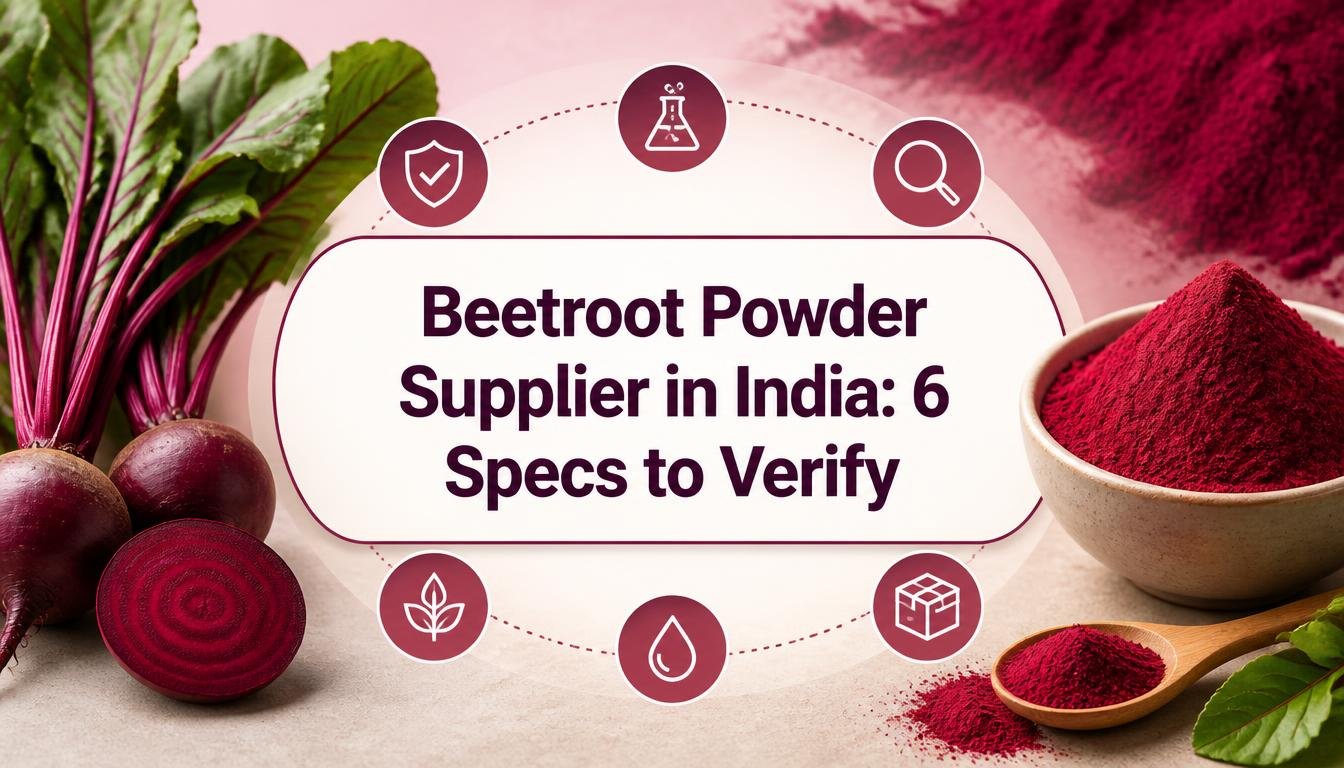
If you’re vetting a beetroot powder supplier in India, six specs actually determine fit for your formulation: nitrate content (if you’re in the sports nutrition category), betalain color value (if you’re using it as a natural colorant), mesh size, moisture content, whole-powder versus standardized-extract format, and certifications. Beetroot powder now serves two genuinely different buyer groups — natural food colorant formulators and nitrate-focused sports nutrition brands — and sourcing the wrong specification for your use case is the most common, avoidable mistake buyers make.
This guide covers what to check across both buyer profiles, and where whole beetroot powder differs from standardized beetroot extract.
<!– Insert Table of Contents block here (Rank Math TOC block or compatible plugin) –>
Two Different Buyer Profiles, One Ingredient Name
This is the detail to sort out before requesting quotes. “Beetroot powder” serves two distinct commercial purposes that call for different specifications:
- Natural colorant buyers — food and beverage manufacturers using beetroot powder’s betalain pigments for a natural red-purple hue, where color value and consistency matter most.
- Sports nutrition and functional beverage buyers — brands sourcing beetroot specifically for its dietary nitrate content, where a standardized nitrate percentage matters more than color intensity.
A supplier who doesn’t ask which of these you need, and quotes a single generic “beetroot powder” price, may not be thinking about your specification the way you need them to.
Spec 1: Nitrate Content (For Sports Nutrition and Functional Beverage Buyers)
Dietary nitrate from beetroot converts to nitric oxide in the body, a mechanism genuinely documented in nutrition research and tied to improved blood flow and oxygen delivery — which is exactly why beetroot has become a staple ingredient in pre-workout and endurance-focused sports nutrition formulations. For this application, whole beetroot powder isn’t always precise enough; many formulators specifically source standardized beetroot extract powder at a documented nitrate percentage (commonly around 25% nitrate in extract form) for formulation accuracy and batch-to-batch consistency.
If nitrate content is the reason you’re sourcing beetroot, request a certificate of analysis with the specific nitrate percentage for your batch, and confirm whether you’re being quoted whole beetroot powder (naturally occurring, lower and more variable nitrate levels) or a standardized extract (concentrated to a specific, guaranteed nitrate percentage).
Spec 2: Betalain Color Value (For Natural Colorant Buyers)
Beetroot’s characteristic pigments — betalains, including betanin — give it a reddish-purple hue in powder form that’s widely used as a natural alternative to synthetic red and purple food dyes, in applications spanning beverages, bakery, sauces, and even cosmetics. For colorant-focused buyers, ask for documented color value (often expressed as a specific measurement standard your supplier should be able to explain) rather than a general “vibrant red” description, and request a color-stability test across your product’s intended shelf life, since betalain color can fade under heat, light, or extended storage.
Spec 3: Whole Powder vs. Standardized Extract
This distinction matters enough to call out on its own. Whole beetroot powder retains betalains, fiber, and micronutrients in their naturally occurring ratio — appropriate for buyers wanting a “whole food” clean-label positioning. Standardized extract concentrates and controls one specific compound (typically nitrate) to a guaranteed percentage, at the cost of some of the whole-food positioning whole powder offers. Neither is inherently better — they serve different formulation goals, and buyers should be explicit about which one they’re requesting.
Spec 4: Mesh Size for Your Application
Beetroot powder’s particle size affects both how it behaves in a formulation and its visual appearance. Finer mesh disperses more smoothly in beverages and liquid formulations, while a coarser grind may be acceptable or even preferred for some capsule-filling or dry-mix applications. Confirm the specific mesh size on the spec sheet rather than assuming a standard grind fits every use case — reputable suppliers offer mesh size customization to match your formulation.
Spec 5: Moisture Content and Shelf Life
Properly processed beetroot powder, stored correctly, can hold quality for up to about 12 months, with some organic beet powders documented at similar shelf-life ranges when stored properly. Ask for the specific moisture percentage on the certificate of analysis, since excess moisture accelerates clumping and reduces shelf stability — a general “long shelf life” claim isn’t a substitute for the actual number.
Spec 6: Certifications and Export Documentation
At minimum, a credible beetroot powder supplier in India should provide:
| Certification/Document | What it confirms |
|---|---|
| FSSAI License | Baseline food safety compliance for the Indian exporter |
| APEDA Registration | Required for exporters of processed vegetable products |
| Certificate of Analysis (COA) | Batch-specific moisture, nitrate or color value, and microbial testing |
| Organic Certification (NPOP/USDA NOP/EU Organic) | Required only if sourcing certified organic beetroot powder |
| MSDS and Traceability Records | Increasingly required by US and EU buyers alongside standard export documentation |
Verify FSSAI licensing directly through the FoSCoS portal rather than relying on a supplier-provided certificate image, and note that beetroot powder shipments intended purely as a colorant may fall under a different HS code classification than nutritional or whole-food beetroot powder — confirm this with your supplier and customs broker to avoid shipment delays.
Where Beetroot Powder Is Used
- Sports nutrition and functional beverages: pre-workout and endurance formulations built around dietary nitrate content
- Natural food coloring: beverages, bakery, sauces, and dressings needing a red-purple hue without synthetic dyes
- Dietary supplements: capsules, tablets, and superfood blends
- Cosmetics: natural colorant applications, including some henna and hair color mix formulations
- Cereals, yogurt, and ice cream: color and mild flavor contribution in mainstream food applications
Common Mistakes When Sourcing Beetroot Powder
- Not specifying colorant versus nitrate-focused use. These call for different specifications and sometimes different products (whole powder versus standardized extract) — clarify this before requesting quotes.
- Assuming all beetroot powder has the same nitrate content. Naturally occurring nitrate levels in whole powder vary by growing conditions; standardized extract is the more reliable choice when a specific nitrate percentage matters for your formulation.
- Skipping a color-stability test. A vibrant sample at time of purchase doesn’t guarantee the color holds through your product’s full shelf life, especially under heat or light exposure.
- Overlooking HS code classification differences. Colorant-grade material may require different customs classification than standard dried vegetable powder — confirm this to avoid clearance delays.
- Not requesting batch-specific COA documentation. A one-time general quality certificate isn’t a substitute for per-batch testing of moisture, nitrate, or color value.
How Shanti Sons Foods Supplies Beetroot Powder
We produce beetroot powder alongside our broader spray-dried vegetable powder line, with mesh size and format (whole powder or extract-oriented) customized to whether you need it for color, nitrate content, or both. If you’re formulating a beverage, supplement, or natural-color application, our spray-dried powder sourcing guide and our piece on why spray dried vegetable powder is helpful cover the broader vetting process and functional benefits that apply here too.
The fastest way to confirm fit: specify whether you need colorant-grade or nitrate-focused beetroot powder, request the appropriate mesh size and batch-specific COA, and test a sample in your own formulation before scaling to a bulk order.
FAQ
What’s the difference between beetroot powder and beetroot extract? Whole beetroot powder retains the root’s naturally occurring nitrates, betalains, fiber, and micronutrients in their original ratio. Beetroot extract is concentrated and standardized to a specific compound — most often nitrate content — providing more precise, guaranteed potency for formulation accuracy.
How much nitrate does beetroot powder typically contain? Whole beetroot powder’s nitrate content varies naturally by growing conditions and isn’t a fixed number, while standardized beetroot extract is commonly available at a guaranteed concentration, such as 25% nitrate, specifically for formulation consistency.
Can beetroot powder replace synthetic red food coloring? In many applications, yes — beetroot’s betalain pigments provide a natural red-purple hue used as an alternative to synthetic dyes in beverages, bakery, and sauces, though color stability under heat and light should be tested for your specific formulation.
How long does beetroot powder last once packaged? Properly processed and stored beetroot powder commonly holds quality for up to about 12 months, though this depends on moisture content, processing method, and packaging.
Is beetroot powder suitable for organic certification claims? Only if sourced from certified organic beetroot and processed under an organic certification scheme like NPOP, USDA NOP, or EU Organic — confirm this certification explicitly with your supplier if your product requires an organic claim.
Reach out to GO 4 EXPORT INDIA for consultation regarding Import and Export from India.