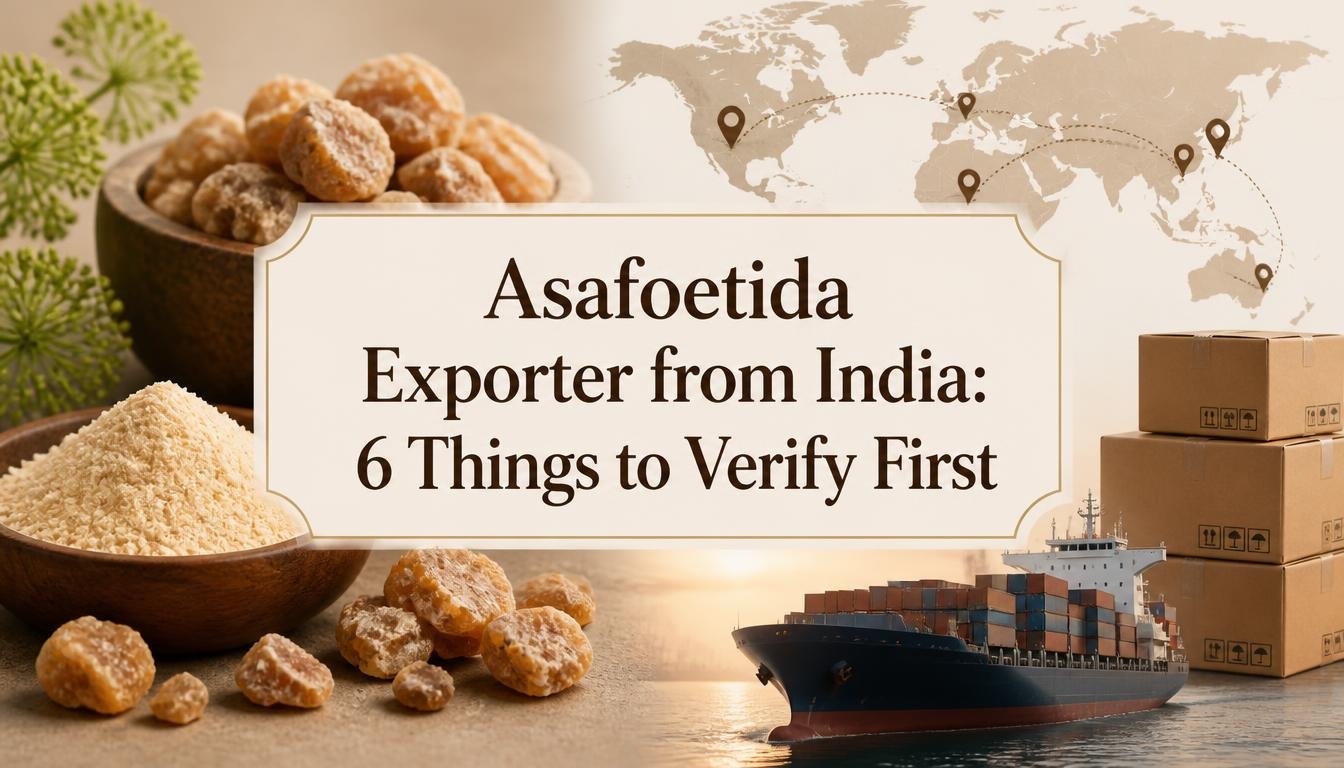
Asafoetida Exporter from India: 6 Things to Verify First
If you’re vetting an asafoetida exporter from India, six things actually determine whether your shipment clears customs smoothly and meets your destination market’s expectations: correct HS code classification, full ingredient declaration for compounded product, destination-specific documentation, packaging suited to hing’s strong odor, private-label capability if you need it, and a supplier who genuinely understands processing rather than just repackaging. India processes and exports the vast majority of the world’s asafoetida, but the category has enough documentation quirks that first-time buyers routinely lose time to avoidable customs issues.
This guide covers what to check before you place an order, and the specific compliance details that trip up buyers shipping to the US, Canada, and Australia.
Why India Dominates Asafoetida Export Despite Not Growing It
This is worth understanding before anything else. Asafoetida isn’t commercially cultivated in India at meaningful scale — raw resin is imported almost entirely from Afghanistan and Iran, and India’s role is processing: purifying, compounding, and packaging it into the export-ready product international buyers actually purchase. Indian exports grew from roughly $0.99 million in 2000–01 to approximately $10.7 million by 2022–23, and India now ships to more than 39 countries. That growth reflects processing expertise and export infrastructure, not raw material cultivation — a distinction that should shape how you evaluate a supplier.
Thing 1: Correct HS Code Classification
This is the single most common technical stumbling block in hing export. HS code 13019013 currently covers both raw asafoetida resin and compounded asafoetida, which makes precise trade data hard to segment and creates real room for misclassification errors at customs. A serious exporter should be able to explain exactly which code applies to your specific product form and confirm it matches what’s declared on your invoice and shipping documents — a mismatch here is a common, avoidable cause of customs delays.
Thing 2: Full Ingredient Declaration for Compounded Product
Because pure asafoetida resin is too potent for direct food use, it’s almost always sold “compounded” — diluted with rice flour, wheat flour, or gum arabic to a standardized flavor strength. This matters enormously for documentation: your invoice and product label need a clear ingredient declaration listing the specific carrier used, not just “asafoetida.” If wheat flour is the carrier, gluten and wheat need to be noted as allergens per your destination market’s labeling requirements — a detail that’s easy to overlook but creates real compliance exposure if missed.
Thing 3: Destination-Specific Documentation and Strategy
Different destination markets expect genuinely different things from an asafoetida shipment:
| Market | What Matters Most |
|---|---|
| USA | FDA-related import steps, clean labeling, ingredient transparency, consistent documentation |
| UAE | Bulk trade and redistribution capability — it functions as the Middle East gateway |
| Singapore & Malaysia | Reliable positioning as Southeast Asian distribution hubs |
| Nepal and other SAARC markets | High volume, strongly price-sensitive |
| Canada & Australia | Similar to the US — clean ingredient declaration, country-of-origin documentation, and food safety declarations based on buyer requirements |
A supplier who tailors documentation and packaging to your specific destination, rather than sending the same generic paperwork to every market, is a genuine signal of export maturity.
Thing 4: Packaging Suited to Hing’s Strong Odor
Asafoetida’s pungent aroma is exactly why buyers want it, but it also creates a genuine packaging challenge: the odor can transfer to and taint other products during shipping and storage if barrier packaging isn’t adequate. Ask your exporter specifically what barrier materials they use for export shipments — this matters more for hing than for most spices in a mixed consolidated shipment, since a packaging failure here can affect other cargo, not just the hing itself.
Thing 5: Private Label and Custom Labeling Capability
If you’re a distributor or emerging spice brand, confirm whether your exporter genuinely supports private labeling — custom label templates, your own branding, and packaging in the sizes you need (commonly ranging from small retail-ready packs up to 5kg–25kg bulk sacks for industrial buyers). Not every exporter offers this at a meaningful scale, so confirm it explicitly rather than assuming it’s standard.
Thing 6: Standard Export Certifications
Beyond the asafoetida-specific documentation above, confirm your exporter holds the baseline food export certifications any credible Indian food exporter should have:
| Certification | What it confirms |
|---|---|
| FSSAI License | Baseline food safety compliance for Indian food exporters |
| APEDA Registration | Required for exporters of processed food products |
| Certificate of Analysis (COA) | Batch-specific quality, moisture, and compounding ratio documentation |
| Country of Origin Certificate | Required by many buyers and customs brokers, especially in the US, Canada, and Australia |
Verify FSSAI licensing directly through the FoSCoS portal rather than relying on a certificate image, since this basic verification step catches a meaningful share of documentation problems before they become shipment delays.
Where Global Demand Is Growing
Demand for hing is expanding beyond traditional South Asian cooking, driven by growing interest in onion- and garlic-free cooking (relevant to Jain dietary practices and some vegan formulations) and clean-label, natural flavor enhancers more broadly. The USA, UK, UAE, Germany, Canada, and Australia are all active destination markets, and exporters who can offer consistent aroma, custom labeling, and clean compliance documentation are best positioned to serve this expanding buyer base.
Common Mistakes When Sourcing an Asafoetida Exporter
- Not confirming the exact HS code applies to your specific product form. Raw resin and compounded asafoetida both fall under the same code currently, which increases the risk of a documentation mismatch if your exporter isn’t precise about it.
- Accepting a generic “asafoetida” ingredient declaration. Compounded product needs the specific carrier (rice flour, wheat flour, or gum arabic) declared explicitly, with allergen notes where relevant.
- Assuming one document set works for every destination market. US, UAE, and Canadian buyers have different documentation and labeling expectations — confirm your exporter tailors paperwork accordingly.
- Overlooking odor-barrier packaging quality. Standard packaging without adequate barrier protection can taint adjacent products in a mixed shipment.
- Sourcing from a trader rather than a genuine processor. Given India’s unique role in this category — processing rather than growing — ask directly whether your supplier compounds and packages in-house or is simply reselling another processor’s product.
How Shanti Sons Foods Exports Asafoetida
We supply compounded asafoetida with documentation tailored to destination market requirements, alongside our broader spices and seasoning line. If you’re evaluating what makes hing genuinely useful as an ingredient before sourcing it, our piece on why asafoetida is helpful covers the functional side, and our spice import and vetting guide covers the certification checks that apply across our spice range.
The fastest way to confirm fit: specify your destination market, request the exact HS code and ingredient declaration for your product form, and confirm packaging and labeling support before scaling to a bulk order.
FAQ
What HS code applies to asafoetida exports from India? HS code 13019013 currently covers both raw asafoetida resin and compounded asafoetida, so confirm with your exporter exactly how your specific product form should be declared to avoid customs classification issues.
Why does the ingredient declaration matter so much for compounded hing? Compounded asafoetida is diluted with a carrier — commonly rice flour, wheat flour, or gum arabic — and this needs to be explicitly declared, with allergen labeling (such as gluten/wheat) where applicable, to meet destination market compliance requirements.
Which countries are the biggest markets for Indian asafoetida exports? The UAE, USA, Singapore, Malaysia, and Nepal are among the top destination markets, with India currently exporting to more than 39 countries overall.
Does India actually grow asafoetida? No — raw asafoetida resin is imported almost entirely from Afghanistan and Iran. India’s role is processing: purifying, compounding, and packaging the product for export, which is why evaluating a supplier’s processing capability matters more than any claim about growing origin.
What packaging sizes are typical for bulk asafoetida export? Bulk industrial orders commonly range from 5kg to 25kg sacks, while retail-ready and private-label packaging is also widely available for distributors and emerging spice brands — confirm which format your order needs.