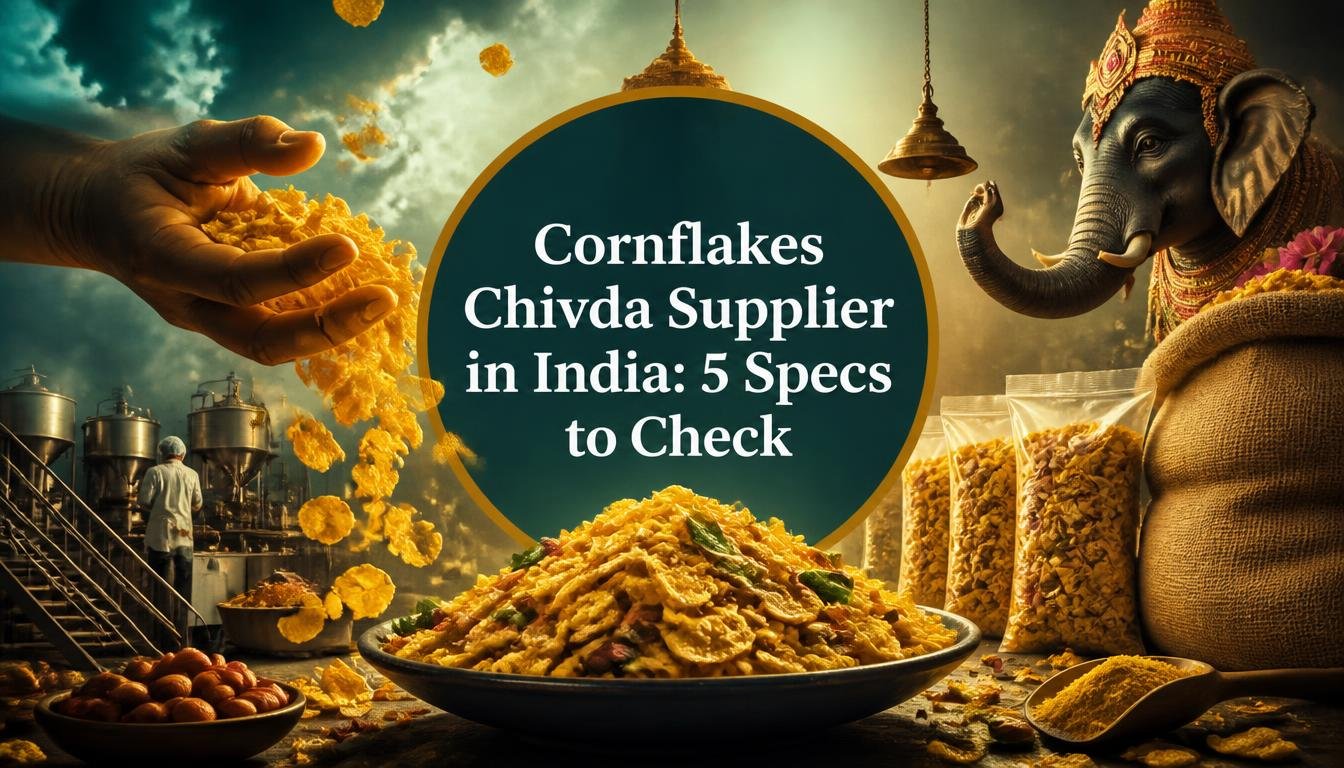
If you’re vetting a cornflakes chivda supplier in India, five things determine whether the shipment holds up through a long export journey: oil freshness and frying quality, ingredient composition (dry fruits, peanuts, and spice blend), packaging format built for oxidation resistance, documented shelf life, and standard food safety certifications. Cornflakes chivda — a light, crunchy namkeen built from corn flakes, roasted dry fruits, and a tempered spice blend — has moved well beyond a homemade festival snack into a genuine export category, and getting the sourcing details right matters as much for a bulk wholesale order as it does for a private label launch.
This guide covers what to check before you commit, and where this snack differs from other namkeen categories in terms of sourcing risk.
What Cornflakes Chivda Actually Is
Cornflakes chivda (also called cornflakes namkeen or makai chivda) is a savory Indian snack built around corn flakes as the base ingredient, combined with roasted peanuts, cashews, curry leaves, and a tempered spice blend typically including turmeric, red chili powder, and a touch of sugar for balance. The corn flakes are either lightly fried or roasted before being tossed with the spice mix, giving the finished product its signature light, crunchy texture — distinct from heavier, deep-fried namkeen categories.
Spec 1: Oil Freshness and Frying Quality
This is the single biggest quality risk for any fried or roasted namkeen shipped over a long distance. Because chivda contains fried or roasted components, oil quality directly determines how well the product holds its flavor and crunch through weeks of transit. Ask your supplier how frequently they change frying oil and what quality checks they run on oil freshness — a supplier using degraded oil produces a product that tastes stale well before its stated shelf-life date, even if the packaging is intact.
Spec 2: Ingredient Composition and Consistency
A quality cornflakes chivda balances corn flakes, dry fruits (typically peanuts, cashews, and sometimes raisins or coconut), curry leaves, and a spice blend in a specific ratio that affects both flavor and cost. Ask your supplier for the exact ingredient breakdown and confirm it stays consistent batch to batch — a supplier who varies the dry-fruit-to-corn-flake ratio between orders is delivering an inconsistent product that can affect your retail positioning and repeat customer experience.
Spec 3: Packaging Built for Oxidation Resistance
As with other fried namkeen, cornflakes chivda carries residual oil on its surface, which oxidizes and turns stale-tasting well before the product visibly spoils. For export orders specifically, ask whether your supplier uses nitrogen-flushed, multilayer pouches rather than standard single-layer packaging — this single packaging decision is often the actual difference between a product that holds its crunch and flavor for months versus one that goes soft or stale within weeks of shipping.
Spec 4: Documented Shelf Life
Shelf life for cornflakes chivda commonly ranges from a few months up to around six months depending on packaging quality and storage conditions, with better export-grade nitrogen-flushed packaging generally extending toward the longer end of that range. Ask for the specific shelf-life figure tied to the exact packaging format you’re ordering, rather than a general claim, since the packaging format has a direct and meaningful effect on how long the product actually stays fresh.
Spec 5: Certifications and Export Documentation
At minimum, a credible cornflakes chivda supplier in India should provide:
| Certification/Document | What it confirms |
|---|---|
| FSSAI License | Baseline food safety compliance for the Indian exporter |
| APEDA Registration | Required for exporters of processed food products |
| Certificate of Analysis (COA) | Batch-specific moisture and quality testing |
| Private Label / Custom Packaging Capability | Relevant if you’re building your own brand rather than reselling |
Verify FSSAI licensing directly through the FoSCoS portal rather than relying on a certificate image, since this basic step catches a meaningful share of documentation gaps before they affect your shipment.
Private Label and Custom Packaging
If you’re building your own snack brand rather than reselling under a manufacturer’s label, confirm whether your supplier genuinely supports private labeling for this specific product — custom packaging design, your own branding, and minimum order quantities that work for a trial run before scaling. Not every namkeen manufacturer offers this at a meaningful scale for every product in their range, so confirm it explicitly for cornflakes chivda specifically rather than assuming it applies uniformly across their catalog.
Where Cornflakes Chivda Fits in a Distributor’s Portfolio
Cornflakes chivda occupies a specific niche within the broader namkeen category: it’s lighter and less oil-heavy than traditional fried bhujia or sev-based snacks, which positions it well for health-conscious retail buyers and modern snacking trends without straying from authentic Indian flavor. For distributors already carrying heavier namkeen varieties, cornflakes chivda offers genuine portfolio diversification — a different eating occasion and a different consumer positioning within the same broad category.
Common Mistakes When Sourcing Cornflakes Chivda
- Not asking specifically about oil freshness and frying frequency. This affects flavor stability more than almost any other factor for this product category.
- Accepting standard packaging for an export order. Nitrogen-flushed, multilayer packaging is the difference between a product that survives transit well and one that doesn’t.
- Assuming ingredient ratios are fixed across suppliers. Dry fruit and corn flake proportions vary meaningfully — request the exact composition and a sample before committing to volume.
- Not confirming private label capability for this specific product. A supplier’s general private label claim doesn’t always extend to every item in their catalog.
- Overlooking a trial order before scaling. As with any namkeen category, request a smaller trial shipment and test shelf life against your own storage conditions before committing to a full container.
How Shanti Sons Foods Supplies Cornflakes Chivda
We export cornflakes chivda made from premium corn flakes, dry fruits, and spices, processed and packaged specifically for international markets to ensure freshness reaches your destination intact. If you’re evaluating our broader namkeen range, our bulk namkeen supplier guide and our piece on why bulk namkeen is helpful cover the broader vetting process and distributor economics that apply here too.
The fastest way to confirm fit: request a sample, confirm the ingredient ratio and packaging format, and test shelf life against your own storage conditions before scaling to a bulk order.
FAQ
How long does cornflakes chivda last once packaged? Shelf life commonly ranges from a few months up to around six months, depending heavily on packaging format — nitrogen-flushed, multilayer pouches generally extend shelf life meaningfully compared to standard packaging.
What are the main ingredients in cornflakes chivda? Corn flakes form the base, combined with roasted dry fruits (commonly peanuts and cashews), curry leaves, and a spice blend typically including turmeric, red chili powder, and a touch of sugar for balance.
Is cornflakes chivda fried or roasted? It can be prepared either way — some versions are lightly deep-fried for extra crunch, while others are roasted with minimal oil for a lighter, less oil-heavy final product. Confirm which preparation method your supplier uses if this matters for your positioning.
Can I get cornflakes chivda under my own private label? Many namkeen manufacturers offer private labeling, though availability and minimum order quantities vary by supplier and product — confirm this specifically for cornflakes chivda rather than assuming it matches a supplier’s general private label capability.
How is cornflakes chivda different from other namkeen varieties? It’s generally lighter and less oil-heavy than traditional fried bhujia or sev-based snacks, offering a different eating occasion and positioning — useful for distributors wanting to diversify beyond heavier, more traditional namkeen categories.
Reach out to GO 4 EXPORT INDIA for consultation regarding Import and Export from India.