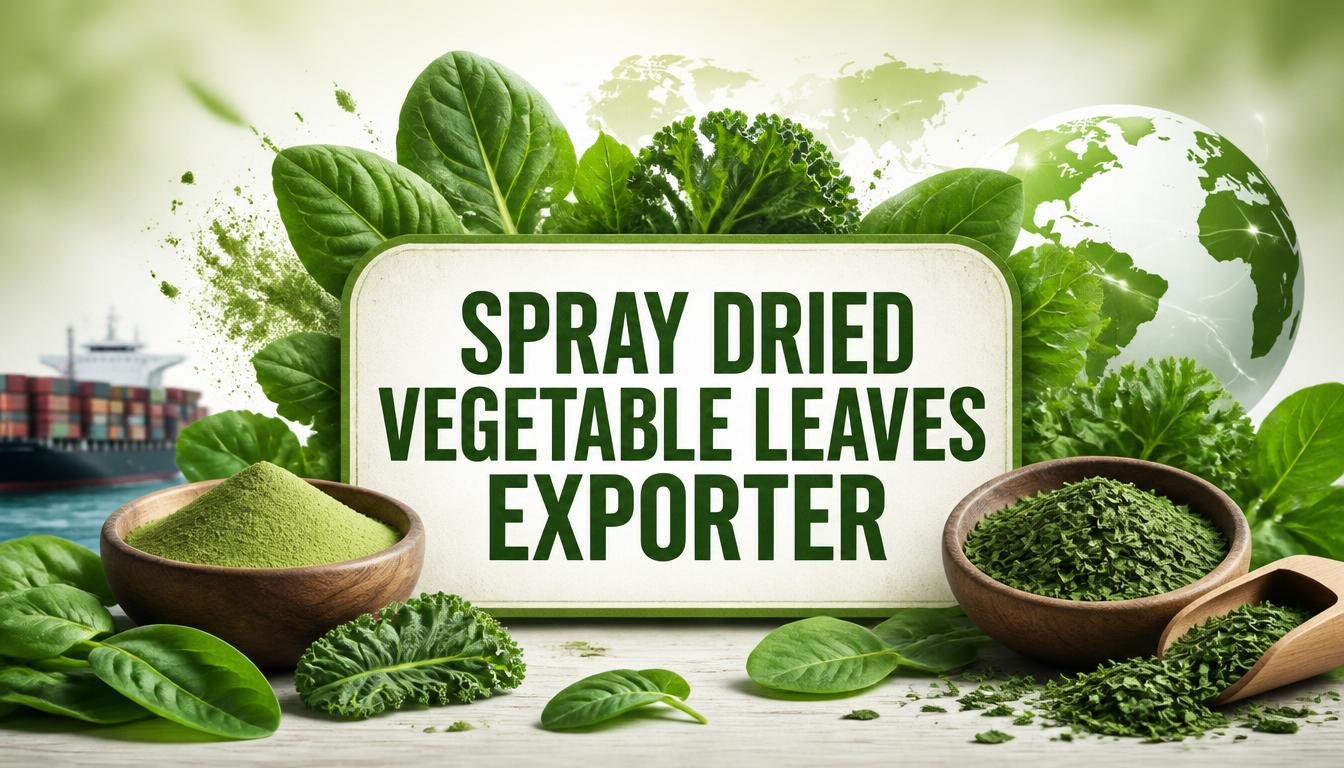
Every spray dried vegetable leaves exporter manufacturer working with Indian, Middle Eastern, South Asian, or broadly global cuisine products knows these ingredients — dried fenugreek leaves crushed into a butter chicken sauce base, powdered coriander leaf blended into a green seasoning mix, dehydrated mint flakes garnishing a ready meal container, dried spinach leaves adding colour and nutrition to an instant soup. They are the culinary herb and leaf ingredients that food processors, seasoning blenders, instant food manufacturers, and foodservice distributors use by the tonne.
And India — where most of these plants grow in abundance, where centuries of culinary tradition have made them standard ingredients in domestic cooking, and where dehydration processing infrastructure has matured significantly over the past two decades — is the world’s primary and most cost-competitive source for spray dried and hot air dried vegetable leaves in bulk.
This guide covers the complete range of spray dried and dehydrated vegetable leaves exported from India by Shanti Sons Foods: what each product is, who uses it and why, the quality parameters that separate premium from inferior material, how processing works, certifications required, and the sourcing steps that reduce risk for international buyers placing their first orders.
Spray Dried Leaves vs. Dehydrated Leaves vs. Leaf Powder: Understanding the Product Formats
Before examining individual products, it is important to understand that “spray dried vegetable leaves” is an umbrella category encompassing several distinct product formats — and the right choice depends entirely on your application:
Whole or Crushed Dehydrated Leaves
Fresh leaves are cleaned, dried at low temperature (typically 40–55°C in cabinet or tray dryers), and packed either whole or lightly crushed. This is the most traditional and widely used format — it closely resembles the dried herb a consumer would use at home, scaled to industrial supply volumes.
Best for: Restaurant and food service supply, retail ethnic herb product lines, garnish applications where visible leaf texture is desired, recipe kits and meal kits, traditional culinary seasoning blends.
Typical formats: Whole leaves, rubbed/crushed leaves (1–5mm pieces).
Spray Dried Leaf Powder
Fresh leaf juice or pulp is atomised through a spray dryer to produce a very fine, free-flowing powder. For leaves specifically, this typically involves blanching and pureeing the fresh leaf before spray drying.
Best for: Seasoning blends where uniform powder dispersibility is required, sauce and soup bases, instant noodle seasonings, applications where visible leaf pieces are undesirable, beverage and drink mix applications.
Typical formats: Fine powder (80–200 mesh).
Ground Dehydrated Leaf Powder
Dehydrated whole or crushed leaves are further ground to a fine or medium powder. Distinct from spray dried powder in texture and flavour intensity — spray drying produces a smoother, more soluble powder, while ground dehydrated leaf powder retains more of the leaf’s physical character.
Best for: Spice blend manufacturing, seasoning mixes, applications where visible green colour and leaf aroma is desired in powder form, ready meal seasoning.
| Format | Visual Appearance | Flavour Intensity | Dispersibility | Best Application |
|---|---|---|---|---|
| Whole/crushed leaves | Recognisable leaf pieces | Moderate | Low | Garnish, restaurant, retail |
| Ground leaf powder | Medium fine green powder | High | Medium | Seasoning blends, ready meals |
| Spray dried powder | Very fine, free-flowing | High | Excellent | Instant products, soups, beverages |
The Spray Dried Vegetable Leaves Exporter Range: A Buyer’s Guide by Product
Fenugreek Leaves — Kasuri Methi (Trigonella foenum-graecum)
Fenugreek leaves — known universally in the Indian food trade as Kasuri Methi (from the Kasur region of Punjab, historically the most famous fenugreek-growing area) — are arguably India’s most important exported culinary herb leaf. They are a foundational ingredient in North Indian cooking that has become globally significant as Indian restaurant cuisine has spread worldwide.
Why fenugreek leaves matter commercially: Kasuri Methi is the finishing herb that gives butter chicken, dal makhani, paneer dishes, and many North Indian curry and gravy preparations their characteristic slightly bitter, complex aromatic note that is immediately recognisable as “Indian restaurant flavour” to consumers worldwide. It is to North Indian cuisine what basil is to Italian cuisine — a defining aromatic herb that cannot be adequately substituted without changing the fundamental character of the dish.
Primary applications:
- Indian restaurant and food service supply worldwide (kasuri methi is used in virtually every North Indian restaurant kitchen globally)
- Ready meal and prepared food manufacturing for Indian cuisine product lines
- Curry sauce and paste manufacturing (fenugreek leaves are a standard ingredient in commercially produced butter chicken, tikka masala, and korma sauce bases)
- Seasoning blend manufacturing and masala powder blending
- Instant soup and noodle seasoning for Indian-flavoured products
- Retail ethnic herb and spice product lines targeting South Asian diaspora communities
Key quality parameters:
- Colour: bright, vivid green is the primary visual quality indicator — dull, yellowish, or brownish leaves indicate poor drying conditions, excessive heat, or old stock. High chlorophyll retention = better colour = higher commercial value
- Aroma: fenugreek leaves have a distinctive, slightly bitter, intensely aromatic fragrance — characteristic of their fenugreek (maple-like, slightly celery-adjacent) compound sotolon. Flat, weak aroma indicates old stock or inadequate processing
- Moisture: below 7% for whole leaves; below 5% for powder — high moisture causes mould and premature quality deterioration
- Stem content: premium grades specify maximum stem percentage — pure leaf (minimal stem) commands a price premium for applications where texture and appearance matter
- Foreign matter: below 1%
- Mesh size (powder): typically 60–100 mesh for standard seasoning blend applications; 100–200 mesh for fine seasoning powder and sauce base applications
- Microbial: TPC, Yeast/Mould, E. coli (absent), Salmonella (absent)
- Pesticide residues: mandatory for EU market supply; fenugreek leaves are a monitored category under EU MRL regulations
Kasuri Methi: whole leaves vs. powder — which to source: The whole/crushed leaf format is the standard specification for restaurant and food service supply and for retail spice product lines — the recognisable leaf texture is part of the product’s culinary identity and consumer appeal. The powder format is preferred for sauce and ready meal manufacturing applications where uniform dispersibility matters more than visual texture.
Available in both formats:
- Fenugreek Leaves — whole/crushed dehydrated leaves
- Fenugreek Leaves Powder — ground or spray dried powder
Coriander Leaves — Dried Cilantro (Coriandrum sativum)
Dried coriander leaf — known as dried cilantro in North American and Latin American markets and as dried dhania patta in South Asian markets — is one of the most globally used culinary herb leaves, with applications spanning Indian, Mexican, Southeast Asian, Middle Eastern, and Central American cuisine categories.
India is the world’s largest coriander producer (primarily for the seed), with substantial coriander leaf (fresh herb cilantro) cultivation across Punjab, Rajasthan, Gujarat, and Madhya Pradesh supporting a significant dehydrated leaf export supply chain.
Primary applications:
- Seasoning blends for Mexican, Indian, Thai, and Middle Eastern cuisine product lines
- Ready meal and prepared food manufacturing (coriander leaf is a finishing garnish in hundreds of internationally produced Indian, Thai, and Mexican-style ready meals)
- Restaurant and food service supply — coriander leaf is one of the most universally used fresh-herb-equivalent dried ingredients in commercial kitchens worldwide
- Instant noodle and cup soup garnish (dehydrated coriander leaf pieces are a standard cup noodle inclusion in Asian-market instant products)
- Dry seasoning blends and herb salt formulations
- Retail ethnic herb product lines
Key quality parameters:
- Colour: bright, saturated green — coriander leaf loses chlorophyll rapidly with excessive heat or extended storage; vivid colour is the primary freshness indicator
- Aroma: characteristic fresh, citrusy, slightly soapy coriander aroma (the compound responsible is a mix of linalool and decenals) — this aroma is highly volatile and degrades with age; flat or musty aroma indicates poor quality
- Stem content: maximum stem percentage should be specified for premium grades — leafy material without excessive stem gives better texture and more consistent flavour per gram
- Moisture: below 7% for whole leaf; below 5% for powder
- Foreign matter: below 1%
- Microbial: standard food manufacturing panel including Salmonella and E. coli
Available in both formats:
- Coriander Leaves — whole/crushed dehydrated leaves
- Coriander Leaves Powder — ground leaf powder
Mint Leaves — Dried Pudina (Mentha spicata / Mentha arvensis)
India is the world’s largest producer of mentha (mint), with approximately 75–80% of global menthol supply originating from the Mentha arvensis cultivation concentrated in Uttar Pradesh’s Barabanki, Lucknow, and Rampur districts. This extraordinary production base makes India the natural global source for dehydrated mint leaves in bulk at every quality tier.
Dried mint leaves occupy a distinct commercial position from spray dried mint powder — both are derived from the same plant but serve different applications and buyer profiles.
Primary applications for dried mint leaves:
- Herbal tea blending (mint tea is one of the top-selling herbal tea varieties globally — dried mint leaves are a primary ingredient across private label and branded herbal tea product lines)
- Middle Eastern and North African cuisine supply (dried mint is a fundamental ingredient across Lebanese, Turkish, Moroccan, and Persian cooking — demand from this region is substantial and consistent)
- Indian cuisine applications — raita seasoning, chutney powder blends, biryani spice mixes
- European herbal tea and wellness product manufacturing
- Ready meal garnish and seasoning
- Confectionery flavouring when in leaf/crushed format rather than pure extract
Key quality parameters:
- Menthol content and volatile oil %: this is the primary commercial quality specification for mint leaves and the driver of price differentiation between grades. Higher volatile oil content = stronger, more persistent mint aroma = higher commercial value. Request volatile oil content on the COA; minimum 1.5 ml/100g for standard grade, 2.0+ ml/100g for premium grade
- Colour: vibrant green — menthol compounds (which drive flavour) and chlorophyll (which drives colour) both degrade together with age and poor processing; vivid colour is the most accessible visual proxy for fresh volatile oil content
- Aroma: sharp, clean, intensely cooling mint aroma is the definitive quality indicator. Flat, musty, or hay-like aroma confirms old stock or inadequate processing regardless of what the COA reports
- Leaf-to-stem ratio: premium grades specify high leaf percentage; stems contribute less flavour and aroma per gram and dilute volatile oil content
- Moisture: below 8% for whole leaf; below 6% for powder
- Microbial: standard food manufacturing panel
Species note: Two mint species are commonly used in Indian dehydrated mint export — Mentha arvensis (field mint, the dominant species grown for menthol extraction in Uttar Pradesh) and Mentha spicata (spearmint, sweeter, less aggressively cooling). Confirm species in your RFQ if your application is sensitive to flavour profile differences between the two.
Available in both formats:
- Mint Leaves — whole/crushed dehydrated leaves
- Mint Leaves Powder — ground or spray dried powder
- Mint Powder — finely processed spray dried mint powder for beverage and seasoning applications
Spinach Leaves — Dehydrated Palak (Spinacia oleracea)
Dehydrated spinach leaves are one of the most universally demanded vegetable leaf ingredients in global food manufacturing. India’s extensive spinach cultivation across Punjab, Haryana, and Uttar Pradesh supports a reliable supply of export-grade dehydrated spinach leaves across the calendar year.
What distinguishes dehydrated spinach leaves from spinach powder: Dehydrated spinach leaves are dried pieces of the leaf with visible texture — they rehydrate to resemble cooked spinach. Spinach powder is ground from these same dried leaves to a fine green powder. Both have distinct applications:
- Dehydrated spinach leaves: instant soup garnish, cup noodle vegetable inclusions, dried vegetable blend components, pasta and bakery colour inclusions where visible texture contributes to product authenticity, foodservice supply as a dried garnish ingredient
- Spinach powder: beverage and health drink colouring, baby food formulation, sauce and soup base colouring, supplement capsule filling, instant noodle seasoning where powder dispersibility is required
Primary applications for spinach leaves:
- Instant soup and cup noodle manufacturing (spinach is one of the most common dehydrated vegetable inclusions in Asian-market cup noodle and instant soup products)
- Ready meal vegetable component supply
- Pasta and noodle manufacturing (dehydrated spinach leaves add visible green colour and nutrition to pasta products claiming spinach as an ingredient)
- Frozen meal and prepared food manufacturing where a dried spinach component is needed that can survive the manufacturing process
- Ethnic food retail supply — spinach is a standard ingredient in numerous South Asian, Italian, and global cuisine product lines
Key quality parameters:
- Colour: vivid emerald green is the defining quality indicator for spinach leaves — chlorophyll retention during drying is the primary processing challenge, as heat degrades chlorophyll rapidly, shifting colour from bright green to olive or yellowish-brown
- Texture: after rehydration in warm water (1–2 minutes), premium-grade dehydrated spinach should substantially resemble cooked fresh spinach in texture and colour — leathery, dark, or poor-rehydrating product indicates excessive drying temperature or very old stock
- Iron content: spinach is commercially significant as an iron source; relevant for baby food and nutritional fortification applications; verify through COA if making nutritional claims
- Moisture: below 7% for leaf format; below 5% for powder
- Microbial: spinach has inherently higher baseline microbial exposure as a leafy vegetable grown close to the ground — confirm sterilisation method (steam sterilisation preferred) and request a full microbial panel including E. coli O157:H7 and Listeria for markets where these are required (US, EU premium food manufacturing)
- Pesticide residues: spinach is on the EU monitoring programme for certain pesticide actives; EU-bound shipments must include pesticide residue testing
Available in both formats:
- Spinach Leaves — dehydrated leaf format
- Spinach Powder — ground or spray dried powder
Spring Onion — Dehydrated Scallion (Allium fistulosum)
Dehydrated spring onion (scallions) is a staple inclusion in Asian instant food manufacturing — one of the most recognisable vegetable inclusions in cup noodle products globally — and a widely used ingredient in global food service supply for garnishing and finishing applications.
Primary applications:
- Cup noodle and instant noodle manufacturing (spring onion/scallion flakes are a standard vegetable inclusion in virtually every Asian-style cup noodle product globally — this is the largest single application category by volume)
- Instant soup seasoning and vegetable garnish sachets
- Asian restaurant and food service supply (spring onion is used as a table condiment and garnish across Japanese, Chinese, Korean, and Southeast Asian restaurant concepts)
- Ready meal finishing ingredient
- Dry seasoning and rice seasoning blends
- Retail ethnic herb and garnish product lines
Key quality parameters:
- Colour: the white bulb and green leaf portions of spring onion dehydrate to distinctive white/cream and bright green respectively — well-made dehydrated spring onion shows clear colour contrast between these two portions; uniformly brown or grey-green product indicates poor processing or old stock
- Piece size and format: specify whether you require uniform sliced rings (most common for cup noodle applications — typically 3–5mm ring slices), chopped pieces, or irregular flakes; consistent piece size matters for portion accuracy in sachet filling operations
- Aroma: mild, characteristically onion-family aroma without strong sulphur off-notes
- Moisture: below 7%
- Microbial: standard food manufacturing panel; Salmonella and E. coli absent
How Dehydrated Vegetable Leaves Are Processed in India
Understanding the processing chain allows buyers to ask more precise questions during supplier qualification and to identify where quality shortcuts are commonly taken.
Step 1 — Sourcing and Selection
Raw leaves are sourced from contract farms or regional wholesale markets. Quality starts at raw material selection — leaves harvested at the correct maturity (young, tender leaves for maximum colour and flavour; not overmature or yellowing) make substantially better dehydrated product than cost-optimised, late-harvest or second-grade leaf material.
Ask your supplier directly: do they cultivate own raw material or source from markets? What quality specifications do they apply to incoming raw leaf? Can they trace the raw material to a specific growing region?
Step 2 — Washing and Cleaning
Fresh leaves are washed in clean water — ideally potable water or food-grade sanitising solution — to remove soil, debris, insects, and surface microorganisms. Washing quality is one of the most significant variables affecting final microbial quality. Contaminated wash water is a common entry point for E. coli and Salmonella in leafy vegetable processing. Ask your supplier about their wash water source and any sanitisation treatments used.
Step 3 — Blanching (Where Applied)
Some leafy vegetables — particularly spinach — are briefly blanched (immersed in hot water or steam for 30–60 seconds) before drying. Blanching inactivates enzymes that cause colour degradation and flavour changes during storage, improving the shelf stability of the final dried product. However, blanching must be controlled — excessive blanching leaches water-soluble nutrients and can soften texture excessively.
For herbs like mint, coriander, and fenugreek leaves, blanching is typically not applied as it would damage the volatile aromatic compounds responsible for their commercial value.
Step 4 — Drying
The drying method used has the largest single impact on final product quality:
Cabinet / tray drying (40–55°C hot air): The industry standard for premium dehydrated herb leaves. Slow, controlled drying at low temperature preserves colour, volatile aromatic compounds, and nutritional quality. Produces the best quality whole/crushed leaf product. Slower throughput than drum drying.
Tunnel drying: Continuous hot air drying through a tunnel dryer — higher throughput than cabinet drying, similar quality outcome if temperatures are well-controlled.
Drum drying: Higher temperature, faster throughput, lower cost — but with greater colour degradation and volatile oil loss than cabinet or tunnel drying. Less suitable for premium-grade herb leaf intended for flavour-sensitive applications.
Spray drying: Used for producing fine leaf powder from fresh leaf juice/puree — not applicable to whole leaf format. Produces very fine, free-flowing powder with excellent dispersibility.
Freeze drying: Highest quality outcome — maximum colour, aroma, and nutritional retention. Premium price tier. Suitable for high-value applications where quality justifies the cost premium.
For whole/crushed herb leaf applications, always ask which drying method is used and at what temperature. Premium suppliers specify maximum drying temperature for their herb leaves — this is a reliable indicator of quality commitment.
Step 5 — Sieving, Cleaning, and Metal Detection
After drying, leaves are sieved to remove debris, fine dust, and oversized pieces. Metal detectors or X-ray inspection equipment are used by modern facilities to verify freedom from metal contamination — confirm that your supplier has this capability, particularly for any product destined for EU or US food manufacturing customers.
Step 6 — Quality Testing
Each production lot should be tested for moisture, volatile oil content (for mint and fenugreek), colour (spectrophotometric or visual grading), microbial parameters, and pesticide residues before packaging. Request the lot-specific COA for your batch.
Step 7 — Packaging
Dehydrated herb leaves are packed in moisture-barrier packaging to protect colour, aroma, and microbial quality during transit and storage:
| Format | Application |
|---|---|
| 500g / 1kg sealed foil pouches | Sample orders, premium retail repack |
| 5kg / 10kg multi-layer foil bags | Small-batch buyers, trial orders |
| 25kg multi-wall kraft bags with inner poly liner | Standard bulk export orders |
| 25kg HDPE cartons with poly liner | Maximum moisture protection for hygroscopic products |
| Custom retail packs with private label | Branded private label herb product production |
Properly packaged and stored dehydrated herb leaves have a shelf life of 18–24 months from production date under cool (below 25°C), dry, dark conditions. Volatile oil-bearing herbs (mint, fenugreek) should be stored away from other strongly aromatic products to prevent cross-contamination of aroma.
Quality Testing: What to Require on Every COA
| Test Parameter | Target | Why It Matters |
|---|---|---|
| Moisture % | Below 6–8% per product | Controls shelf life and microbial risk |
| Volatile oil content | Min 1.5 ml/100g (mint), per product (fenugreek) | Confirms aroma potency and freshness |
| Colour measurement | Vivid green (Lab* values per agreed standard) | Primary freshness and processing quality indicator |
| Leaf-to-stem ratio | Per grade specification | Affects flavour intensity and texture |
| Foreign matter % | Below 1% | Cleanliness standard |
| Total ash % | Below 12–15% | Indicator of foreign matter or mineral contamination |
| Heavy metals | Pb, Cd, Hg, As per destination market limits | Required for EU and supplement applications |
| Pesticide residues | EU MRL compliant | Mandatory for EU market; critical for leafy herbs |
| Microbial: TPC | Per food standard | General microbial safety |
| Microbial: Yeast & Mould | Per food standard | Shelf life stability |
| E. coli | Absent | Non-negotiable food safety |
| Salmonella | Absent in 25g | Non-negotiable food safety |
Certifications to Require
| Certification | What It Confirms | Who Needs It |
|---|---|---|
| FSSAI | Indian food safety compliance — mandatory | All buyers |
| ISO 22000 / FSSC 22000 | International food safety management system | EU, US, UK, Australian buyers |
| HACCP | Hazard analysis and critical control point compliance | All food buyers |
| Spices Board of India | Relevant for herb and leaf products classified as spices — confirms quality and export eligibility | All buyers |
| USDA Organic | Certified organic for US market | US buyers with organic herb product lines |
| EU Organic | Certified organic for European markets | EU buyers |
| Halal | Compliant for Muslim consumer markets | Middle East, Southeast Asia, UK buyers |
| Non-GMO | Verified non-GMO status | EU and US clean-label buyers |
| EU MRL Pesticide Compliance | Pesticide residues within EU maximum residue limits | Mandatory for EU market herb leaf supply |
| Phytosanitary Certificate | Pest and disease free confirmation | Required in most destination countries |
What to Include in Your RFQ
- Product name and botanical Latin name
- Format: whole leaves, crushed/rubbed leaves, or powder (specify mesh size)
- Grade: premium (high leaf-to-stem ratio, low foreign matter) or standard
- Organic or conventional
- Required certifications (list each explicitly)
- Key COA parameters: moisture %, volatile oil % (mint, fenugreek), colour specification, leaf-to-stem ratio, full microbial panel, pesticide residues, heavy metals
- Drying method preferred (cabinet/tray drying for premium whole leaf; spray drying for fine powder)
- Sterilisation method (steam sterilisation for EU-bound product)
- Packaging format and unit weight
- Destination country and port
- Target quantity: sample, trial order, or bulk
- Minimum remaining shelf life required on delivery
Red Flags When Evaluating Indian Herb Leaf Suppliers
Dull, yellowish, or brown leaf colour in samples. For any green herb leaf, this is the most immediate and reliable quality red flag — it indicates excessive drying temperature, old stock, or poor raw material quality. Fresh, well-processed dehydrated herb leaves should look almost artificially vivid green.
Flat or absent aroma. For fenugreek, coriander, and mint specifically, aroma is the primary commercial value. Open a sample and assess immediately — if the characteristic aroma is weak, flat, or replaced by a generic “green” or musty note, do not proceed without further investigation and independent testing.
Cannot confirm drying temperature or method. A supplier who cannot or will not specify their drying parameters is not operating with process documentation — this is a basic expectation from any food-grade manufacturer.
No pesticide residue testing for EU-bound product. Leafy herbs are in the highest-risk category for pesticide residue non-compliance in EU import testing. This is among the most common reasons for RASFF (Rapid Alert System for Food and Feed) notifications affecting Indian herb and spice exports. A supplier who cannot provide EU MRL-compliant pesticide testing is not EU-ready — period.
High stem content with no specification. Premium herb leaf buyers specify maximum stem content as a grade parameter. A supplier who treats leaf-to-stem ratio as unimportant is likely supplying mixed-quality material from uncleaned or incompletely processed raw harvest.
Generic, undated COA. As with all ingredients in this series: always demand a lot-specific COA linked to your specific production batch and dated within the last 12 months.
Step-by-Step: From Enquiry to First Shipment
1. Define your specification — product, format (whole leaf / crushed / powder), grade, organic/conventional, certifications, COA parameters, drying method preference, sterilisation requirement.
2. Send RFQs to 3–5 shortlisted suppliers verified by FSSAI registration and documented export experience with culinary herb leaf products specifically.
3. Request samples — 200–500g per product, matched to your specification, with the lot-specific COA. For aromatic herbs (mint, fenugreek, coriander), evaluate aroma immediately on opening the sample as a primary quality screen before lab testing.
4. Third-party test your samples — pesticide residue panel (especially for EU-bound product), moisture, and volatile oil content for mint and fenugreek.
5. Negotiate commercial terms — price, Incoterm (FOB/CIF), lead time, payment structure.
6. Place trial order — typically 100–500 kg per product before committing to container volumes.
7. Pre-shipment inspection — verify colour, aroma, moisture, and packaging quality before shipment.
8. Confirm full documentation:
- Lot-specific COA (all parameters)
- FSSAI Export Certificate
- Spices Board certificate (where applicable)
- Phytosanitary Certificate
- EU MRL pesticide compliance report (for EU buyers)
- Organic certificate (if applicable)
- Halal certificate (if applicable)
- Commercial Invoice and Packing List
- Bill of Lading
9. Customs classification: Dehydrated herb leaves typically classify under HS Code 0712 (dried vegetables) or 0909/0910 (spices and herb leaves classified as spices). Spring onion and spinach leaves typically fall under 0712; fenugreek, mint, and coriander leaves may fall under 0910 depending on the destination country’s tariff schedule. Confirm with your freight forwarder before shipment.
Related Products: Vegetable Powders from the Same Range
Buyers sourcing dehydrated herb leaves often also require the powder formats of the same or related products. All of the following are available from the same Shanti Sons Foods range:
- Fenugreek Leaves Powder
- Coriander Leaves Powder
- Mint Leaves Powder
- Mint Powder
- Spinach Powder
- Onion Powder
- Coriander Powder (seed-derived spice powder, distinct from coriander leaf powder)
Browse our full Spray Dried Vegetable Powder range → and Spices / Dehydrated Powder range →
Further Reading from Our Export Guide Series
- Bulk Spice Powders from India: Turmeric, Cumin, Cardamom & More
- Dehydrated Vegetable Powders from India: Spinach, Beetroot, Carrot & More
- Indian Curry Powder for Export: Mild, Hot & Regional Blends
Source Spray Dried Vegetable Leaves from Shanti Sons Foods
Shanti Sons Foods is a Mumbai-based Indian food manufacturer and exporter supplying dehydrated fenugreek leaves, coriander leaves, mint leaves, spinach leaves, spring onion, and their powder formats alongside a comprehensive range of spice powders, masala blends, vegetable powders, fruit powders, herbal powders, freeze dried fruits, and Indian snacks. We export worldwide and supply food manufacturers, instant food producers, seasoning blenders, foodservice distributors, and private label brands.
Get in touch with our export team:
📍 B/301, 3rd Floor, Neera Govind Society, Tambe Nagar Mulund West, Thane 400080, Mumbai, Maharashtra 📞 +91 9833023131 📧 jainishsukhadia26@gmail.com 💬 WhatsApp Us
View Fenugreek Leaves → View Coriander Leaves → View Mint Leaves → View Spinach Leaves → View Spring Onion → Browse All Dehydrated Leaves → Contact Us →
Published by Shanti Sons Foods | shantisonsfoods.com | Mumbai, India Exporting worldwide | Last updated: June 2026