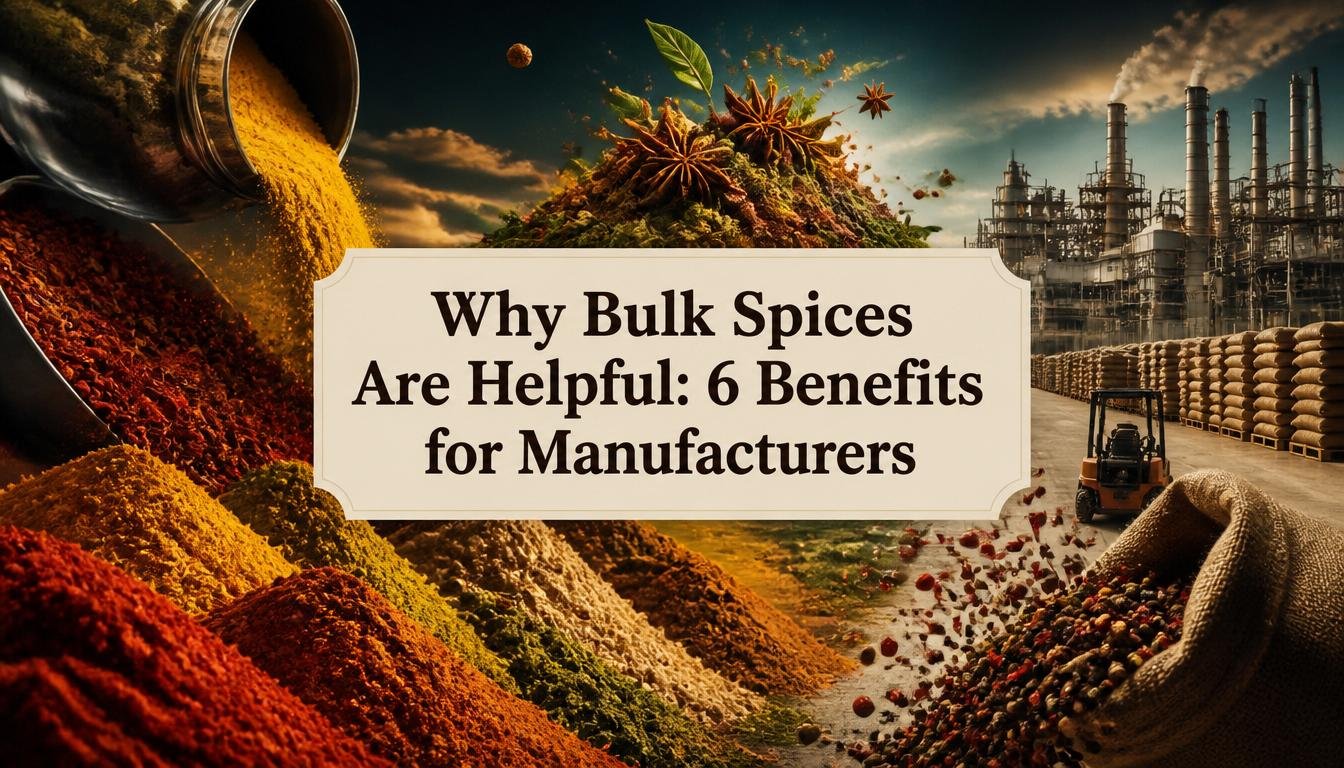
Bulk spices are helpful because they do far more than add flavor: dried at the right point and stored correctly, many spices act as natural preservatives, hold a shelf life measured in years rather than days, deliver batch-to-batch consistency fresh ingredients can’t match, and let manufacturers buy at scale without the spoilage risk fresh herbs and produce carry. For food manufacturers formulating anything from seasoning blends to shelf-stable sauces, that combination is why dried spices remain a foundational ingredient category rather than a commodity afterthought.
This guide covers the six specific benefits bulk spices bring to food manufacturing, with the research behind each one.
1. Natural Preservative Properties
This is the benefit most manufacturers underestimate. Many common spices carry genuine antimicrobial activity from their essential oil and bioactive compound content — clove, cinnamon, cumin, and black pepper among them — which has been documented in peer-reviewed research on spices as natural food preservatives. Cinnamon powder, for example, has been shown to inhibit the growth of certain foodborne pathogens, and several spices have a long, practical history of extending the usable life of preserved foods well before refrigeration existed.
For manufacturers working toward clean-label formulations, this matters directly: a spice blend can sometimes do double duty as flavor and a natural preservation aid, reducing reliance on synthetic preservative additives that many consumers now actively avoid on ingredient labels.
2. Long Shelf Life Without Special Storage
Dried spices, properly stored in airtight, moisture-protected conditions, hold quality for a genuinely long time — whole spices like cinnamon sticks, cardamom pods, and black peppercorns can retain quality for several years, since their outer structure protects the essential oils inside. Ground spices degrade faster once milled, typically holding peak quality for 6 months to a year, since grinding increases surface area exposure to oxygen.
For manufacturers, this shelf stability means spices can be purchased in bulk and held in inventory without the same spoilage pressure fresh herbs or produce create, simplifying both procurement planning and warehouse management.
3. Consistent Quality and Flavor at Scale
Fresh herbs and produce vary meaningfully in moisture content, flavor intensity, and nutritional density from batch to batch, largely driven by growing conditions and harvest timing. Dried spices, sourced from a quality-controlled supplier, provide standardized performance across production runs — a manufacturer can achieve close to the same flavor profile and intensity batch after batch, which matters enormously for maintaining a consistent finished product that customers recognize and expect.
This consistency is one of the more overlooked reasons large-scale food manufacturers rely on dried spice suppliers rather than fresh herb sourcing for standardized production, even when a recipe’s origin calls for fresh ingredients.
4. Lower Cost and Simpler Logistics
Dried spices weigh and cost less to transport than their fresh equivalents, since removing moisture eliminates most of the weight without reducing the usable flavor compound content. This reduces freight and storage costs meaningfully across long supply chains, and lets manufacturers buy in bulk during favorable market conditions without the immediate spoilage pressure that would come with bulk-purchasing fresh produce.
Fresh alternatives like fresh ginger, by comparison, tend to carry a higher cost and shorter usable window specifically because of their perishability — a trade-off dried spice sourcing avoids for applications where the fresh form isn’t essential to the finished product.
5. Support for Clean-Label Formulation Goals
Because dried spices typically involve minimal processing and no artificial additives, they align well with clean-label expectations that have become increasingly important to consumers scrutinizing ingredient lists. A manufacturer replacing a synthetic flavoring agent or preservative with a well-sourced dried spice or spice blend can often make a genuine clean-label claim while maintaining flavor and shelf-life performance — a combination that’s harder to achieve with many synthetic alternatives.
6. A Practical Waste-Reduction and Sustainability Angle
Dehydration and spice drying give processors a way to use seasonal harvests without the immediate pressure to sell or use the crop fresh, reducing spoilage-driven waste at the agricultural level. For manufacturers with sustainability commitments, working with suppliers who convert surplus harvest into shelf-stable dried spice product is a genuine, verifiable part of a broader waste-reduction story, not just a marketing claim.
Where Bulk Spice Sourcing Matters Most
- Seasoning blend manufacturers needing a consistent flavor base across large production runs
- Shelf-stable sauce and condiment producers relying on spice-driven flavor without fresh-ingredient spoilage risk
- Snack and bakery manufacturers using spice blends for coating, seasoning, or flavor inclusion
- Meat and processed food producers using spices for both flavor and their natural antimicrobial contribution
- Clean-label brands replacing synthetic additives with well-sourced natural spice ingredients
A Practical Limit Worth Knowing
Natural preservative activity from spices varies significantly by spice type, concentration used, and the specific microorganism or spoilage pathway involved — it’s a genuine, research-backed property, but it isn’t a guaranteed substitute for proper food safety controls or a validated shelf-life study for your specific formulation. Treat spice-driven preservation as a contributing factor to build into your food safety plan, not a stand-alone solution to rely on without testing.
How Shanti Sons Foods Supplies Bulk Spices
We export spices and seasonings alongside our herbal powder, spray-dried, and freeze-dried fruit and vegetable lines, applying the same certification and lab-testing standards across all of them. If you’re sourcing spices for a specific formulation, our spice import and vetting guide covers the certifications and specs to confirm before ordering, and our pieces on why herbal powder and why spray dried vegetable powder are helpful cover the adjacent categories in the same supply chain.
The fastest way to confirm a spice fits your formulation: request a sample batch, test flavor intensity and consistency against your own recipe, and confirm the moisture and volatile oil specs match what your process needs.
FAQ
Do dried spices actually act as preservatives, or is that just a flavor claim? Research has documented genuine antimicrobial activity in the essential oils and bioactive compounds of many common spices, including clove, cinnamon, and cumin. This is a real, studied property, though it varies by spice and shouldn’t replace validated food safety controls for a specific formulation.
How long do dried spices last compared to fresh herbs? Whole dried spices can retain quality for several years under proper storage, while ground spices typically hold peak quality for 6 months to a year. Fresh herbs, by comparison, generally last days to a few weeks even under refrigeration.
Why do ground spices lose flavor faster than whole spices? Grinding increases the surface area exposed to oxygen, which accelerates the oxidation that dulls flavor and aroma. Whole spices retain their essential oils behind a protective outer layer until they’re ground.
Are bulk dried spices suitable for clean-label formulations? Generally yes — dried spices typically involve minimal processing and no artificial additives, aligning well with clean-label goals, provided the specific product is sourced without added anti-caking agents or preservatives if a clean-label claim requires that.
What should I check before buying bulk spices for manufacturing? Confirm moisture content, volatile oil content, and third-party lab testing for pesticide residues and heavy metals, along with current FSSAI, APEDA, and Spices Board certification — covered in detail in our spice import guide.
GO 4 EXPORT INDIA for consultation regarding Import and Export from India.