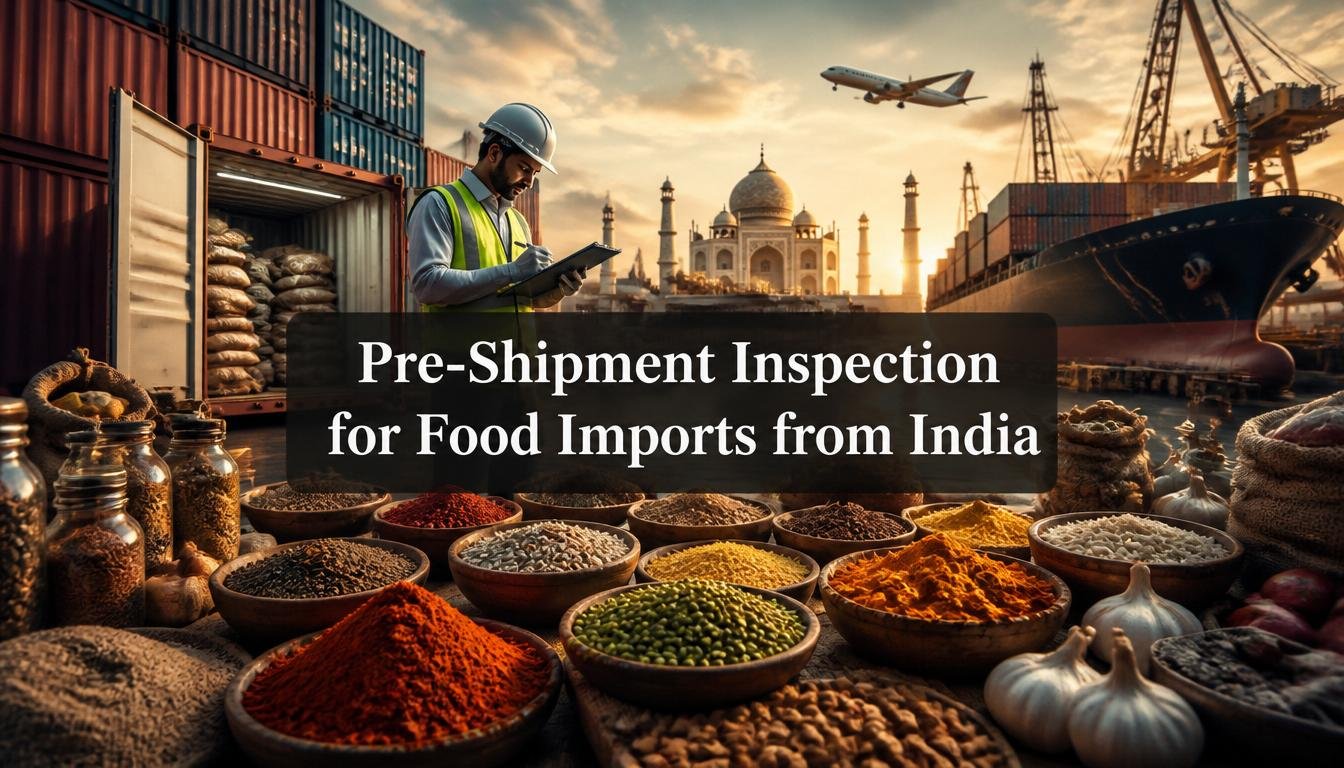
Pre-shipment inspection is the single most effective way to catch a bad batch before it becomes your problem instead of your supplier’s. A third-party inspector visits the factory or warehouse once your order is finished and mostly packed, checks quantity, packaging, labeling, and product condition against your specification using statistical sampling, and issues a report before the container leaves the port — giving you a chance to reject or renegotiate before your money and the goods are both in transit.
This guide covers who actually does these inspections, what they check, how sampling levels work, and what it typically costs and takes.
Why Pre-Shipment Inspection Matters More for Food
For most goods, a defect means a product that doesn’t perform as expected. For food, a defect can mean a shipment that gets rejected at customs, recalled after distribution, or worse, a safety issue that reaches a consumer. Combine that with the fact that you’re buying from a supplier you likely haven’t visited in person, and pre-shipment inspection stops being optional due diligence and becomes a basic cost of doing business.
It’s also one of the few checks that happens after your specification has actually been produced, rather than before — certifications and spec sheets tell you what a supplier is capable of; pre-shipment inspection tells you what actually got made this time.
Who Performs Pre-Shipment Inspection in India
Independent, internationally recognized inspection agencies handle most pre-shipment inspection for food exports from India. The major names are SGS, Bureau Veritas, Intertek, and QIMA, all of which operate extensively in India and are recognized by customs authorities and buyers worldwide.
Using a globally recognized agency carries real weight with your own downstream buyers or retail customers — a report from SGS or Bureau Veritas is broadly trusted in a way a smaller regional inspection firm’s report may not be, particularly if you’re supplying into retail chains with their own compliance requirements.
What Happens During the Inspection
The process generally runs through three stages.
1. Booking the Inspection
You or your supplier books the inspection once the order is finished production and mostly packed — ideally around 80% packed, which is the standard point most agencies use for their process. Booking too early means inspecting an incomplete batch; booking too late risks delaying the shipment if issues are found.
2. Physical Inspection and Sampling
Inspectors visit the facility and use AQL (Acceptable Quality Level) sampling — a statistically representative selection rather than a full unit-by-unit check — to review quantity, packaging integrity, labeling accuracy, expiry dates, and compliance with your order specification. For food specifically, they’ll also verify that phytosanitary certificates, halal certification, or other required documentation matches the shipment.
3. Reporting
The inspector delivers a detailed report covering findings, any defects, and recommendations, giving you the information needed to accept, reject, or renegotiate before the goods leave India.
Understanding AQL Sampling Levels
AQL sampling, standardized under ISO 2859-1, determines how large a sample the inspector checks relative to your total order size. There are three general levels — I, II, and III — plus special levels (S-1 through S-4) for smaller sample sizes.
Level II is the standard default, balancing thoroughness against cost and time. If a supplier has a strong, established quality track record with you, Level I can save on inspection time and cost for routine reorders. If a supplier is new, or has had recent quality issues, stepping up to Level III inspects a larger sample for stronger assurance — worth the extra cost on a new or high-risk relationship.
What Pre-Shipment Inspection Typically Costs
Pricing varies by agency and shipment size, but as a general reference point, inspection fees commonly run in the range of a few hundred to around $1,500 per inspection for standard-sized orders, with some agencies charging a percentage of FOB value (with a set minimum fee) rather than a flat rate. Get a specific quote based on your order size and product category rather than assuming a fixed number — inspection agencies price differently across product categories and order volumes.
As a general practice, the cost of arranging the inspection itself is typically the buyer’s responsibility, while the cost of presenting goods for inspection — unpacking, repacking, providing access — falls to the supplier, though this can be a point worth confirming directly in your agreement.
How This Fits with Letters of Credit
If you’re paying by Letter of Credit, ask whether the L/C requires an inspection certificate as one of the documents the seller must present. Banks reviewing an L/C presentation are checking for exact compliance with the specified documents — a missing or inconsistent inspection certificate can create a discrepancy that delays or blocks payment release, independent of whether the goods themselves are actually fine.
Common Mistakes First-Time Buyers Make
- Skipping inspection on early orders to save cost. This is precisely when you know the supplier least and have the least basis for trust — the inspection cost is small relative to the risk on a new relationship.
- Booking the inspection too early. Inspecting before the batch is substantially packed means checking an incomplete picture of what will actually ship.
- Using Level I sampling with a new, unproven supplier. Save the lighter sampling level for suppliers with a track record; start new relationships at Level II or III.
- Not specifying food-specific checks in the inspection scope. Make sure the inspection order explicitly includes labeling, expiry dating, and certificate verification, not just quantity and packaging — a generic inspection scope may not cover these by default.
- Assuming the inspection report is a substitute for lab testing. Pre-shipment inspection confirms quantity, packaging, and visible compliance; it isn’t the same as third-party lab testing for contaminants, pesticide residue, or microbial safety, which needs to be arranged separately.
How Shanti Sons Foods Works with Inspection Agencies
We accommodate third-party pre-shipment inspection as standard practice for buyers who request it, including coordinating access and packing timelines around your inspection booking. If you’re placing a namkeen order or working through Incoterms and payment terms for a first shipment, we’d recommend building inspection into your process from the first order rather than treating it as something to add once trust is established — it’s the step that actually establishes that trust.
The fastest way to build inspection into your process: confirm which agency you’ll use, agree on the AQL sampling level upfront, and specify food-specific checks explicitly in the inspection scope before the order ships.
FAQ
Who pays for pre-shipment inspection — the buyer or the supplier? Typically the buyer arranges and pays for the inspection itself, while the supplier is responsible for the costs of presenting goods for inspection, such as unpacking and repacking — though this division is worth confirming directly in your agreement.
How long does a pre-shipment inspection take? A single-day visit is typical for most standard-sized food orders, though this depends on order complexity and the sampling level used.
What’s the difference between Level I, II, and III AQL sampling? Level II is the standard default. Level I uses a smaller sample size to save time and cost, generally appropriate for suppliers with a proven track record. Level III uses a larger sample for stronger assurance, generally recommended for new suppliers or after recent quality issues.
Does pre-shipment inspection replace lab testing for food safety? No. Pre-shipment inspection checks quantity, packaging, labeling, and visible specification compliance. Testing for pesticide residues, heavy metals, or microbial contamination requires separate third-party lab testing, arranged independently.
Which inspection agencies are most commonly used for food exports from India? SGS, Bureau Veritas, Intertek, and QIMA are among the most widely used and internationally recognized inspection agencies operating in India.
GO 4 EXPORT INDIA for consultation regarding Import and Export from India.