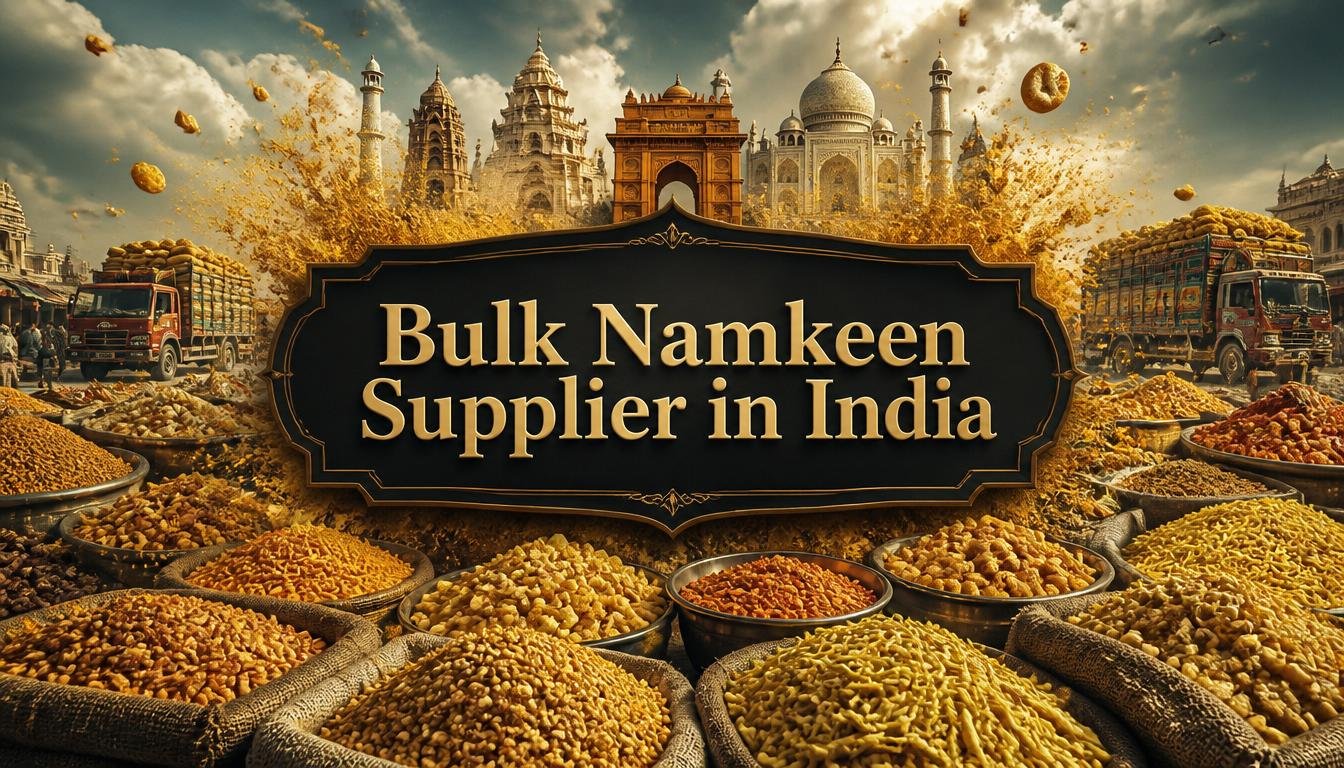
If you’re evaluating a bulk namkeen supplier in India for wholesale distribution or private label, six things determine whether the relationship works: verified shelf life claims, real packaging specs (not just “sealed for freshness”), current food-safety certifications, private label capability, minimum order flexibility, and export documentation experience. Skip any of these and you risk a container of stale, oily, or rejected stock.
This guide walks through what to check before you commit, plus the mistakes that catch first-time buyers off guard.
Why Wholesale Buyers Source Namkeen from India
India’s savory snack market is enormous and still growing quickly — industry estimates put the domestic namkeen and snacks market at well over ₹46,000 crore, expanding at close to 9% a year as both domestic demand and export demand rise. That scale means depth of supply: dozens of regional specialties, established manufacturing infrastructure, and increasing sophistication in export-grade packaging.
For international buyers, the appeal is straightforward. A reliable bulk namkeen supplier in India gives you access to authentic recipes — bhujia, sev, mixture, moong dal, makhana — at wholesale pricing that’s difficult to replicate by manufacturing locally, provided the supplier’s quality and export processes hold up under scrutiny.
Check 1: Actual Shelf Life, Not Marketing Copy
Most commercially packaged namkeen carries a shelf life of 4 to 6 months in standard packaging, extending toward 9–12 months with proper nitrogen-flushed, multilayer pouches. Ask your supplier for the specific shelf life of the exact product and packaging combination you’re ordering, not a general claim about the category.
If a supplier quotes “long shelf life” without a number, or without telling you which packaging format that number applies to, press for specifics before you commit to volume.
Check 2: Packaging Format and Nitrogen Flushing
Namkeen is fried, which means it carries residual oil on the surface. When that oil meets oxygen, it oxidizes — the flavor turns stale or metallic well before the product looks spoiled. This is the single biggest quality risk in long-distance namkeen shipping.
Ask specifically whether your bulk namkeen supplier in India uses nitrogen-flushed, multilayer pouches for export orders. This process replaces the oxygen inside the pack with inert nitrogen gas, which meaningfully slows oxidation and helps the product survive weeks of sea transit without going rancid or soft.
For large containerized shipments, also confirm the outer carton format — most export-grade suppliers use multi-ply outer cartons over the primary nitrogen-flushed pouch for a second layer of protection during handling.
Check 3: Food Safety Certifications
A serious bulk namkeen supplier in India should hold, at minimum:
| Certification | What it confirms |
|---|---|
| FSSAI Central License | Baseline food safety compliance for any Indian food exporter |
| APEDA Registration | Required for exporters of processed food products, which namkeen falls under |
| ISO 22000 or HACCP | A documented, auditable food safety management system |
| Halal or Kosher (where relevant) | Required for specific destination markets in the Middle East and beyond |
Verify these directly — check the FSSAI license on the FoSCoS portal and APEDA registration through APEDA’s official registration system — rather than trusting a certificate image alone.
Check 4: Private Label and Custom Packaging Capability
If you’re building your own brand rather than reselling under the manufacturer’s label, confirm private labeling is actually available, not just advertised. Ask specifically about:
- Minimum order quantity for private label runs
- Lead time for custom packaging design and approval
- Whether they can adjust spice level or recipe slightly for your target market
- Label compliance support for your destination country (ingredient declarations in the local language, nutrition panels, allergen statements)
Manufacturers that regularly work with international private label clients will have clear answers to all four. Vague answers on any of them usually mean it’s a service they offer occasionally, not a core competency.
Check 5: Minimum Order Quantities and Trial Runs
Before committing to a full container, request a smaller trial shipment and test it against your own criteria — taste, texture, oil rancidity after a simulated shelf period, and packaging integrity after transit. A confident supplier will accommodate a trial order without pushing you straight to a full-container minimum.
This step matters more for namkeen than for shelf-stable products like spices, because frying quality and oil freshness vary more between production batches.
Check 6: Export Documentation Experience
Ask how many export shipments the supplier has actually completed to your destination country, not just domestically. Namkeen exports need to satisfy both Indian FSSAI standards and the destination country’s own food regulations — FDA rules for the US, EFSA standards for the EU, and so on — and a supplier without direct experience in your market is more likely to trip over labeling or documentation requirements you won’t discover until customs flags the shipment.
Common Mistakes When Sourcing Bulk Namkeen from India
- Judging quality from a retail-size sample alone. Production consistency across a full container batch is a different question than one good sample bag — ask for batch-level quality control data.
- Ignoring the packaging film spec. Standard single-layer pouches and nitrogen-flushed multilayer pouches look similar in photos but perform very differently over a six-week sea transit.
- Assuming all “export-ready” suppliers are export-experienced. Ask for shipment history to your specific destination country, not just a general export claim.
- Skipping label compliance review. Foreign-language ingredient lists and allergen declarations are frequently the reason shipments get held at customs, not the product itself.
- Not asking about recipe or spice-level flexibility. If you’re targeting a market with different heat tolerance, this is worth raising before production, not after the first complaint.
How Shanti Sons Foods Approaches Bulk Namkeen Supply
Namkeen and snacks sit alongside our spices, spray-dried powders, and dehydrated fruit lines, and we run export orders through the same packaging and certification standards across all of them. If you’re already working with us on spray-dried fruit and vegetable powder or looking to import spices from India, namkeen is a natural addition to the same order — the certification and documentation process is shared across categories.
Whichever supplier you choose, the fastest way to separate a serious bulk namkeen supplier in India from the rest is to ask for the exact shelf life and packaging spec for your product, current certification numbers, and a trial shipment before the full order. Suppliers confident in their process answer all three without friction.
FAQ
What’s a typical minimum order quantity for bulk namkeen from India? This varies by manufacturer and product, often starting around a few hundred kilograms for a trial order and scaling to full container loads (roughly 15–20 metric tons) for ongoing wholesale supply — always confirm directly rather than assuming a standard figure.
How long does namkeen last with nitrogen-flushed packaging? Nitrogen-flushed, multilayer pouches can extend shelf life toward 9–12 months for many products, compared to roughly 4–6 months in standard single-layer packaging, though this varies by recipe and oil content.
Can I get namkeen packed under my own brand? Most established Indian namkeen manufacturers offer private labeling and custom packaging, typically subject to a minimum order quantity — confirm lead time and design approval process upfront.
Do namkeen exports need APEDA registration? Yes, on the exporter’s side — namkeen falls under APEDA’s processed food products category, and registration is required for the Indian exporter, not the overseas buyer.
Which countries import the most Indian namkeen? The United States, United Arab Emirates, United Kingdom, and Australia are among the largest destination markets for bulk Indian namkeen exports, driven by both diaspora demand and growing interest in Indian snack flavors more broadly.