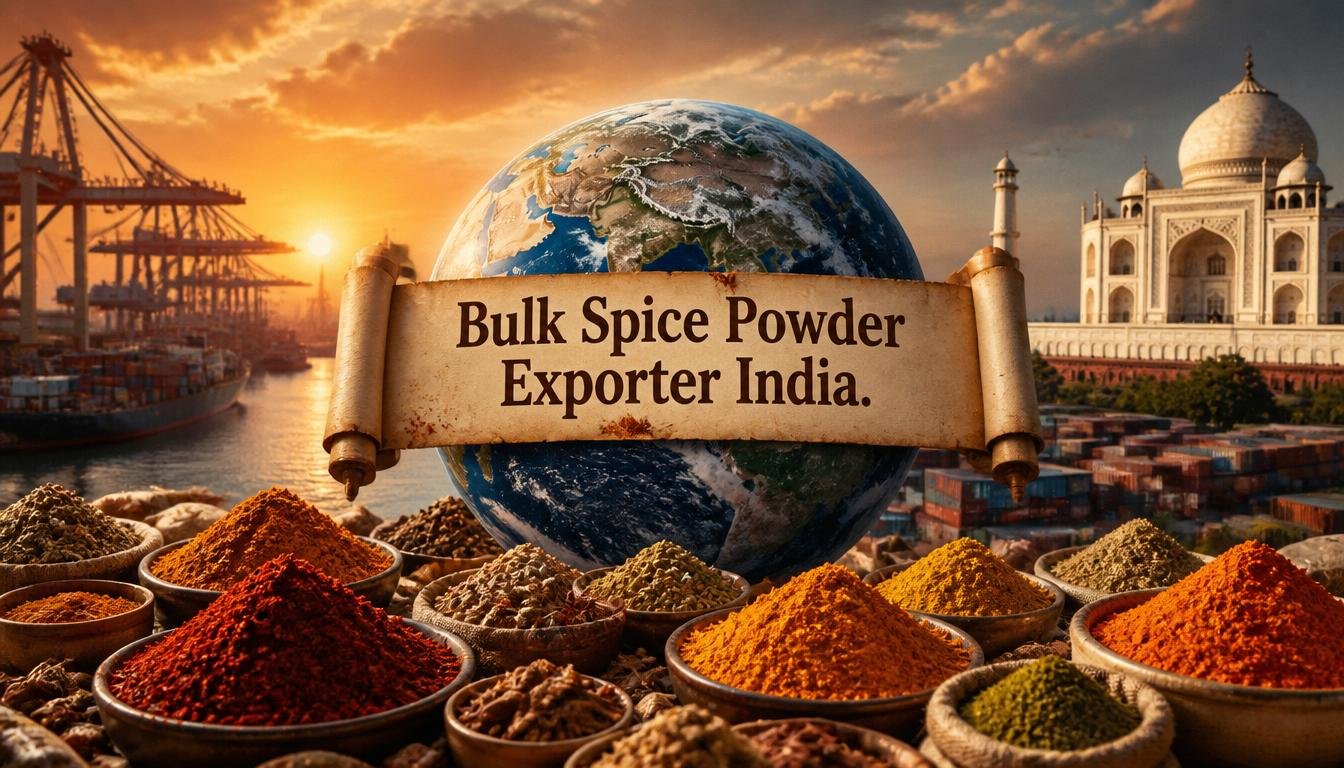
There are bulk spice powder exporter from India who supplies more than 75% of the world’s spices. From turmeric and cumin to cardamom, black pepper, garlic, ginger, coriander, cinnamon, and clove, the vast majority of the spice powders consumed by food manufacturers, spice blenders, restaurant chains, and retail brands worldwide originate from Indian farms and Indian processing facilities.
Yet for international buyers — especially those placing their first orders with an Indian spice exporter — the sourcing process can feel opaque. What constitutes a good quality specification? Which certifications are actually required? What are the real quality parameters that separate premium export-grade spice powder from commodity-grade material?
This guide answers all of those questions systematically. Whether you’re a food manufacturer sourcing spice powders as formulation ingredients, a private label brand building a retail spice range, a spice blender looking for a reliable Indian supplier, or a distributor supplying food service, this is the sourcing framework you need.
Why India Dominates Global Spice Supply
India’s position in the global spice trade is built on several compounding advantages that no other country currently matches in combination.
Agro-climatic diversity. India’s geography spans tropical coastlines, semi-arid plains, high-altitude hills, and humid deltas — producing ideal growing conditions for virtually every major spice. Turmeric thrives in Andhra Pradesh and Tamil Nadu. Cumin grows in Gujarat and Rajasthan. Cardamom is harvested in the Western Ghats of Kerala and Karnataka. Black pepper is cultivated in Kerala’s lush coastal forests. Each spice is grown in its natural ideal environment, producing the flavour profiles, colour intensity, and essential oil content that buyers require.
Centuries of processing expertise. India’s spice processing industry is not modern — it is ancient. Post-harvest cleaning, drying, milling, and blending knowledge has been refined over centuries. Modern Indian spice facilities layer industrial-scale precision onto this expertise.
Export infrastructure. India’s Spices Board — a government body under the Ministry of Commerce — actively certifies, regulates, and promotes Indian spice exports. APEDA (Agricultural and Processed Food Products Export Development Authority) provides additional oversight. This institutional infrastructure means that certification, documentation, and compliance processes are well-established and familiar to exporters.
Volume. India produces spices at a scale that few other countries can match. This means large orders can be fulfilled without supply disruption, and price points remain competitive even on premium certified product.
The Essential Spice Powders: Buyer’s Guide by Product
Turmeric Powder (Curcuma longa)
Turmeric is India’s single most exported spice and one of the most versatile ingredients in global food manufacturing. Its applications span food colouring, flavouring, nutraceutical formulations, functional beverages, cosmetics, and pharmaceutical intermediates.
Key growing regions: Andhra Pradesh, Telangana, Tamil Nadu, Odisha, Karnataka.
The critical quality parameter — Curcumin content: Curcumin is the primary bioactive and colour compound in turmeric. It is the specification that drives price, quality grade, and application suitability.
| Grade | Curcumin % | Primary Application |
|---|---|---|
| Standard food grade | 2–3% | Curry powders, food colouring, cooking spices |
| Mid-grade | 3–5% | Premium retail spice, food manufacturing |
| High-curcumin | 5–7% | Functional food and nutraceutical formulations |
| Standardised extract | 95% curcuminoids | Supplement capsules (this is an extract, not a powder) |
For most food manufacturing and spice blending applications, standard food-grade turmeric with 2–3% curcumin is appropriate and cost-effective. For functional food or health product applications, higher curcumin content is worth specifying.
Other quality parameters:
- Colour value (ASTA units): minimum 25–30 for standard grade, 40+ for premium
- Moisture content: below 10%
- Total ash: below 7%
- Lead content: must comply with destination market limits (EU maximum 3 mg/kg for spices)
- Microbial: TPC, Salmonella (absent), E. coli (absent)
Common adulteration to watch for: Synthetic colours (particularly Metanil Yellow) have historically been used to boost apparent colour in low-grade turmeric. Always request testing for artificial colour additives from your supplier’s COA, and run independent verification for your first order.
Cumin Powder (Cuminum cyminum)
Cumin is the world’s second most consumed spice after black pepper, and India is its dominant supplier — accounting for approximately 70% of global cumin production. The spice is foundational to South Asian, Middle Eastern, Latin American, and North African cuisines, making it one of the most universally demanded spice powder exports from India.
Key growing regions: Gujarat and Rajasthan account for nearly all Indian cumin production. Gujarat’s Unjha market is the world’s largest cumin trading hub.
What it is used for: Curry powders and masala blends, seasoning mixes for processed meats, taco and fajita seasoning, hummus and dip flavouring, ready meals, instant noodle seasoning, restaurant and catering spice supply.
Key quality parameters:
- Moisture content: below 10%
- Volatile oil content: minimum 2.5 ml/100g (higher volatile oil = stronger aroma)
- Total ash: below 9.5%
- Colour: uniform warm brown — pale or greyish colour indicates old stock or poor drying
- Foreign matter: below 0.5%
- Microbial: Salmonella absent, E. coli absent
Key specification question: Are you sourcing whole cumin seeds ground to order, or pre-milled powder? For maximum aroma freshness, grinding to order is preferable. Pre-milled powder is more convenient for high-volume continuous production but should have a shorter remaining shelf life specified at time of order (minimum 18 months recommended).
Cardamom Powder (Elettaria cardamomum)
Cardamom is often called the “Queen of Spices” and is one of the world’s most expensive spices by weight. India — specifically the Western Ghats region of Kerala and Karnataka — is the original home of green cardamom, and Indian cardamom is widely regarded as the highest quality in the global market.
Key growing regions: Idukki district (Kerala), Kodagu district (Karnataka), Nilgiris (Tamil Nadu).
What it is used for: Chai tea and masala tea blends (globally the largest application), desserts and sweet confectionery, bakery and biscuit flavouring, flavoured milk and dairy beverages, garam masala and spice blends, Middle Eastern coffee blends (cardamom coffee is a staple across Gulf countries), Scandinavian pastries.
Key quality parameters:
- Volatile oil content: minimum 4 ml/100g for premium grade (essential oil content drives aroma intensity — this is the primary quality measure)
- Moisture content: below 12%
- Colour: light green to greenish-cream (for green cardamom powder); bleached or white cardamom powder is a separate product processed differently
- Aroma: intensely sweet, floral, eucalyptus-like — flat or faint aroma indicates old stock or over-processing
- Microbial: standard food supplement panel including Salmonella and E. coli
Buyer’s note: Cardamom powder degrades significantly faster than other spice powders once ground, due to rapid volatile oil loss. Specify a minimum remaining shelf life of at least 12 months from delivery, and store sealed in a cool, dark environment. For high-aroma applications, consider sourcing cardamom seeds and grinding in-house if you have the capability.
Black Pepper Powder (Piper nigrum)
Black pepper is the world’s most traded spice, and India — particularly the state of Kerala — has been its primary historical producer for centuries. While Vietnam now leads in volume, Indian black pepper — especially from the Malabar coast — retains a strong reputation for superior aroma and piperine content that commands premium prices in international markets.
Key growing regions: Kerala (Malabar pepper), Karnataka, Tamil Nadu. Wayanad and Idukki districts in Kerala are the heartland of Indian black pepper cultivation.
What it is used for: Universal seasoning across all cuisines worldwide; spice blends, marinades, sauces, processed meat seasoning, snack seasoning, instant noodle flavouring, ready meal flavouring, pharmaceutical and nutraceutical applications (piperine as a bioavailability enhancer).
The critical quality parameter — Piperine content: Piperine is the alkaloid responsible for black pepper’s characteristic heat and pungency. It is also the compound that makes pepper valuable in nutraceutical applications as a bioavailability enhancer (often sold as BioPerine® in standardised extract form).
| Grade | Piperine % | Application |
|---|---|---|
| Standard food grade | 4–6% | General seasoning and food manufacturing |
| Premium Malabar grade | 6–9% | Premium retail, gourmet applications |
| Standardised extract | 95%+ piperine | Nutraceutical use as bioavailability enhancer |
Other key parameters:
- Volatile oil: minimum 2 ml/100g
- Moisture: below 12%
- Bulk density: relevant for industrial filling operations
- ASTA cleanliness specification: check for stem, stone, and foreign matter compliance
- Microbial: Salmonella absent, E. coli absent, aflatoxin tested
Also available: White Pepper — produced from the same berry with the outer skin removed, giving a milder flavour and light cream colour preferred in white sauces, light-coloured dishes, and European cuisine applications.
View Black Pepper Powder → View Black Pepper (whole) →
Coriander Powder (Coriandrum sativum)
Coriander powder is one of the most widely used spice ingredients in global food manufacturing. India is the world’s largest producer and exporter of coriander seed, and Indian coriander powder is the backbone of curry powders, masalas, spice blends, and seasoning mixes worldwide.
Key growing regions: Rajasthan, Madhya Pradesh, Andhra Pradesh, Gujarat.
What it is used for: Curry powders, Dhana Jeero masala blends, spice rubs for grilled meats, pickling spice blends, sausage and processed meat seasoning, vegetable dishes, lentil preparations, dry rub seasoning for snacks.
Key quality parameters:
- Volatile oil: minimum 0.3 ml/100g
- Moisture: below 10%
- Total ash: below 7%
- Colour: light yellowish-brown; darker colour may indicate old stock or poor storage
- Foreign matter: below 1%
- Microbial: standard food manufacturing panel
Ginger Powder (Zingiber officinale)
Ginger powder is produced from dried ginger rhizomes and is one of the highest-demand dehydrated spice powders globally, with applications ranging from food manufacturing and beverages to nutraceuticals, pharmaceuticals, and cosmetics.
Key growing regions: Kerala, Karnataka, Meghalaya, Himachal Pradesh, Uttarakhand. Kerala’s Wayanad region produces the variety most prized for high pungency.
What it is used for: Ginger tea and beverage concentrates, bakery and confectionery (gingerbread, biscuits, cake spice blends), curry powders and masala blends, health supplement formulations (digestive health, nausea, anti-inflammatory products), flavoured dairy and plant-based milk beverages, functional food products.
Critical quality parameter — Gingerol and Shogaol content: The pungency and bioactivity of ginger powder depend on its gingerol and shogaol content. Fresh ginger is high in gingerols; dried ginger converts some gingerols to shogaols, which are more heat-stable and more pungent. For nutraceutical applications, specify the gingerol/shogaol profile in your COA requirements.
Other key parameters:
- Total volatile oil: minimum 1.5 ml/100g
- Moisture: below 10%
- Starch content: relevant as an indicator of dilution or adulteration
- Total ash: below 8%
- Microbial: Salmonella absent, E. coli absent, aflatoxin tested (ginger is susceptible to aflatoxin in poor storage conditions)
Garlic Powder (Allium sativum)
Garlic powder is one of the most universally demanded spice ingredients in global food manufacturing. India is a major garlic producer and exporter, with Madhya Pradesh being the dominant cultivation state.
What it is used for: Seasoning blends, processed meat flavouring, snack seasonings, pasta sauce and condiment production, ready meal flavouring, garlic bread spice blends, marinades, restaurant spice supply.
Key quality parameters:
- Allicin content: the primary bioactive compound in garlic (relevant for nutraceutical applications)
- Moisture: below 6% (garlic powder is hygroscopic and clumps at higher moisture — this is critical for powder flow in industrial applications)
- Colour: cream to pale yellow — white or bleached colour may indicate blanching that reduces flavour intensity
- Granulation: specify mesh size for your application (coarser granules for visible texture, fine powder for uniform blending)
- Microbial: Salmonella absent, E. coli absent
Garlic powder vs. garlic granules: Both are dehydrated garlic products but differ in grind size and texture. Garlic powder (100 mesh and finer) disperses uniformly in liquid applications and seasoning blends. Garlic granules (20–40 mesh) give visible texture and slower flavour release — preferred in dry rubs and some seasoning mixes. Specify which you need in your RFQ.
Clove Powder (Syzygium aromaticum)
Clove powder is one of the most intensely aromatic spice powders in the global market, used in small quantities for powerful flavour impact. India imports cloves primarily from Madagascar, Tanzania, and Indonesia but adds value through cleaning, processing, and export.
What it is used for: Garam masala blends, chai tea and masala tea, baked goods and holiday spice blends, mulled wine and seasonal beverage preparations, meat marinades, dental and pharmaceutical applications (eugenol from cloves is a well-known analgesic).
Key quality parameter — Eugenol content: Eugenol is clove’s primary volatile compound and the driver of its characteristic aroma and flavour. Premium clove powder should have high eugenol content (minimum 72% of volatile oil). Whole cloves ground to order yield the highest eugenol content; pre-milled powder deteriorates faster.
Also available: Lavang Powder — the Indian name for clove powder, same product under the traditional name used in South Asian spice trade.
Cinnamon Powder (Cinnamomum verum / Cinnamomum cassia)
Cinnamon powder is globally used in bakery, beverages, confectionery, and spice blends. Buyers should be aware that “cinnamon” in the global market refers to two distinct species with different flavour profiles and coumarin content:
| Type | Species | Coumarin Level | Flavour Profile | Primary Use |
|---|---|---|---|---|
| True Cinnamon (Ceylon) | Cinnamomum verum | Very low (<0.04%) | Delicate, sweet, mild | EU compliant, nutraceuticals, premium blends |
| Cassia Cinnamon | Cinnamomum cassia / aromaticum | High (1–12%) | Bold, pungent, spicy | General food manufacturing, US and Asian markets |
EU buyers should note: The European Food Safety Authority (EFSA) has established a Tolerable Daily Intake for coumarin that effectively limits cassia cinnamon use in foods intended for regular consumption in the EU. True Ceylon cinnamon (Cinnamomum verum) is the compliant choice for EU-registered food products. Specify the species — not just “cinnamon powder” — in your RFQ.
Additional Spice Powders Available for Export
Beyond the core range covered above, Shanti Sons Foods exports a comprehensive selection of spice powders including:
- Cardamom Powder — sweet, floral, ideal for teas, desserts, and premium blends
- Bay Leaves Powder — aromatic herb powder for soups, stews, and seasoning blends
- Celery Seeds Powder — sharp, savoury seasoning for pickles, soups, and salad dressings
- Long Pepper Powder — traditional Indian spice with heat profile distinct from black pepper; growing interest from gourmet food brands
- Licorice Powder — natural sweetener and flavouring agent for confectionery, beverages, and herbal products
- Lemongrass Powder — citrusy aromatic powder for Asian cuisine applications, teas, and functional beverages
- White Onion Powder — milder, lighter colour alternative to standard onion powder for cream sauces and light-coloured applications
- Onion Powder — standard seasoning ingredient widely used across food manufacturing
- Red Chilli Powder — bold heat and colour for curry powders, spice blends, and food colouring applications
- Green Chilli Powder — fresh, sharp heat for speciality spice blends and seasoning applications
- Amchur Powder — dried raw mango powder widely used as a souring agent in Indian cuisine and increasingly popular in international condiments
Browse the full Spices / Dehydrated Powder range →
Certifications Required for Spice Powder Export from India
| Certification | What It Confirms | Who Needs It |
|---|---|---|
| FSSAI | Indian food safety compliance — mandatory for all food exporters in India | All buyers |
| Spices Board of India Certificate | Quality and authenticity certification from India’s official spice regulatory body | All spice importers; confirms origin and quality grade |
| ISO 22000 / FSSC 22000 | International food safety management system | EU, US, UK, Australian buyers |
| USDA Organic | Certified organic status for the US market | US buyers with organic spice lines |
| EU Organic | Certified organic for European markets | EU buyers with organic claims |
| HACCP | Hazard analysis and critical control point | All food buyers |
| Halal | Compliant for Muslim markets | Middle East, Southeast Asia, UK buyers |
| Kosher | Certified Kosher | Specialty and co-packing applications |
| EU MRL Compliance | Pesticide residue testing to EU Maximum Residue Limits | Mandatory for EU market supply |
| Phytosanitary Certificate | Pest and disease free confirmation | Required in most destination countries |
Important for EU buyers: The European Union applies strict Maximum Residue Limits (MRLs) for pesticides on spices. Indian spice exporters supplying the EU market must provide pesticide residue testing that confirms compliance with Regulation (EC) No 396/2005. Request this documentation as a standard requirement — not an optional add-on.
How Indian Spice Powders Are Processed for Export
Understanding the processing chain allows you to ask the right questions during supplier qualification.
Step 1 — Raw Material Procurement and Grading
Indian spice exporters either source directly from contract farmers, buy from regional wholesale markets (such as Unjha for cumin, Ernakulam for cardamom, Kochi for pepper), or maintain their own cultivation. Raw spices are graded for size, colour, moisture, and freedom from foreign matter before processing begins.
Step 2 — Cleaning and Sortex
Incoming spices go through mechanical cleaning to remove dust, stones, stalks, and foreign seeds. Modern facilities use electronic colour-sorting machines (Sortex machines) that optically reject discoloured seeds, mouldy material, and extraneous matter at high throughput rates. The quality of cleaning equipment is a reliable indicator of a facility’s overall capability.
Step 3 — Drying and Moisture Reduction
Most raw spices arrive with moisture levels that need to be reduced before grinding. Low-temperature drying (below 50°C for most spices) is used to bring moisture to target levels without damaging volatile oils, colour compounds, or heat-sensitive phytochemicals.
Step 4 — Sterilisation (Where Required)
Microbial sterilisation is increasingly required by food manufacturers in the EU, USA, and Japan. Two methods are commonly used:
Steam sterilisation — short exposure to pressurised steam followed by rapid drying. Effective against bacteria, yeast, and moulds without chemical residues. The preferred method for organic-certified products.
Ethylene oxide (EtO) treatment — a chemical sterilisation method that has been banned for food products in the EU since 2012. Confirm that your Indian supplier does not use EtO if you are supplying the European market — this is a common compliance failure point.
Irradiation — permitted in some markets but not others. Check your destination country’s regulations before specifying this method.
Step 5 — Grinding and Mesh Control
Cleaned, dried spices are ground in pin mills, hammer mills, or impact mills to the target mesh size. Temperature management during grinding is critical — heat generated during milling can volatilise essential oils and reduce aroma intensity. Cryogenic grinding (common for high-value spices like cardamom and pepper) uses liquid nitrogen to keep the milling chamber cool and preserve volatile compounds.
| Mesh Size | Application |
|---|---|
| 30–40 mesh | Coarse seasoning, visible texture, restaurant use |
| 60–80 mesh | Standard food manufacturing, curry powder blending |
| 100 mesh | Fine uniform blending for sauces, soups, ready meals |
| 150–200 mesh | Extra-fine for instant products, beverages, and pharmaceutical applications |
Step 6 — Quality Testing
Before packaging, each production lot is tested for:
- Moisture content
- Volatile oil content
- Colour value (ASTA units for turmeric, red chilli)
- Total ash and acid-insoluble ash
- Heavy metals (Pb, Cd, Hg, As)
- Pesticide residues (essential for EU market supply)
- Microbial profile (TPC, Yeast/Mould, Salmonella, E. coli, Aflatoxin for relevant spices)
- Specific bioactive markers where applicable (curcumin for turmeric, piperine for pepper, eugenol for clove)
Step 7 — Packaging for Export
Spice powders for export are packed in moisture-barrier multi-layer packaging to protect aroma, colour, and quality during sea freight:
| Format | Typical Use |
|---|---|
| 1 kg sealed foil pouches | Samples, premium retail repack |
| 5 kg / 10 kg multi-layer bags | Small-batch buyers, trial orders |
| 25 kg multi-wall kraft bags with inner poly liner | Standard bulk export orders |
| 25 kg HDPE drums | High-moisture-sensitivity spices (cardamom, long pepper) |
| Custom retail packs with private label | Branded private label spice range production |
Properly packed and stored spice powders have a shelf life of 18–24 months from production date in cool, dry, dark conditions.
What to Include in Your Spice Powder RFQ
Precise specifications reduce sourcing time and immediately separate serious exporters from general traders:
- Spice name and botanical Latin name
- Grade (standard food grade, premium, organic — specify USDA or EU)
- Curcumin / piperine / volatile oil % target (for turmeric, pepper, cardamom, etc.)
- Mesh size
- Moisture level maximum
- Certifications required (list each explicitly)
- COA parameters — specify every test and the maximum/minimum limit
- Sterilisation method (steam sterilisation preferred for EU)
- Pesticide residue testing required (EU MRL compliance, or target market specification)
- Packaging format and unit weight
- Destination country and port
- Target quantity and delivery timeline
- Minimum remaining shelf life required on delivery
Red Flags When Evaluating Indian Spice Exporters
No Spices Board of India registration. All Indian spice exporters are required to register with the Spices Board. Verify a supplier’s registration number on the Spices Board portal before proceeding.
Generic or undated COA. A COA without a specific lot number, production date, and named testing lab provides no meaningful assurance for your shipment.
Use of Ethylene Oxide. Ask directly about sterilisation method before ordering anything for the European market. EtO-treated spice products are banned in the EU — this is not a minor technicality.
Colour that looks “too good.” Unnaturally vibrant colour in turmeric or red chilli powder can indicate synthetic colour additives. Request testing for Sudan dyes in chilli powder and Metanil Yellow in turmeric.
Cannot confirm single-origin vs. blended. Premium buyers often require single-origin spices traceable to a specific growing region (e.g., Alleppey turmeric, Malabar pepper, Coorg cardamom). If origin traceability matters to your brand or buyers, confirm this capability before selecting a supplier.
Price significantly below market. Quality-tested, certified spice powders have a cost floor. Prices well below market typically indicate mixing with lower-grade material, old stock, or substandard processing.
Step-by-Step: From Enquiry to First Shipment
1. Define your specifications completely before reaching out — spice, grade, organic/conventional, mesh size, certifications, sterilisation method, COA requirements.
2. Send RFQs to 3–5 shortlisted suppliers. Shortlist based on Spices Board registration, export experience, and ability to supply a sample COA at enquiry stage.
3. Request samples — 200g–500g per spice, matching your target specification. Request the COA for the specific sample batch.
4. Third-party test your samples independently. For EU-bound spices, always run a full pesticide residue panel on your first order — this is the compliance step most buyers skip and then regret.
5. Negotiate commercial terms — price, Incoterm (FOB / CIF), lead time, payment structure, and documentation package.
6. Place a trial order — 100–500 kg is typical per product for a first commercial order. Tests production consistency, lead time, and documentation quality before committing to container volumes.
7. Pre-shipment inspection — arrange third-party inspection or video walkthrough of packed goods before shipment for initial orders.
8. Confirm your full documentation package:
- Lot-specific Certificate of Analysis (with all required tests)
- Spices Board of India Export Certificate
- FSSAI Export Certificate
- Phytosanitary Certificate
- Pesticide residue test report (for EU buyers)
- Organic certificate (if applicable)
- Halal Certificate (if applicable)
- Commercial Invoice and Packing List
- Bill of Lading
9. Customs classification: Most spice powders fall under HS Code 0910 (ginger, saffron, turmeric, thyme, bay leaves, and other spices) or 0908–0909 depending on the specific spice. Confirm with your freight forwarder based on the exact product and destination market.
Also from Shanti Sons Foods: Masala Blends Using These Spices
If you are sourcing spice powders as raw materials for your own blending, you may also be interested in Shanti Sons Foods’ range of ready-made masala and curry powder blends — formulated and exported directly:
- Mild Curry Powder — balanced blend for mild heat applications
- Hot Curry Powder — bold heat profile for international curry applications
- South Africa Curry Powder — formulated specifically for South African market taste preferences
- Turkey Curry Powder — formulated for Turkish market preferences
- Kitchen King Masala — all-purpose masala for everyday cooking applications
- Dhana Jeero Masala — classic coriander-cumin blend, foundational in South Asian cooking
- Chat Masala — tangy, complex blend for snack and street food applications
- Tea Masala — aromatic blend for chai tea production
Browse the full Spices & Seasoning range →
Further Reading
If you are also sourcing herbal and Ayurvedic powders alongside your spice range, these guides from Shanti Sons Foods cover the related categories in similar depth:
- Moringa Powder from India: What Nutraceutical Brands Need to Know Before Sourcing
- Ashwagandha, Brahmi & Giloy: Complete Buyer’s Guide to Ayurvedic Herbal Powders from India
Source Bulk Spice Powders from Shanti Sons Foods
Shanti Sons Foods is a Mumbai-based Indian food manufacturer and exporter with a comprehensive range of spice powders, masala blends, Ayurvedic herbal powders, spray-dried fruit and vegetable powders, freeze-dried fruits, and Indian snacks for international markets. We export worldwide and supply food manufacturers, spice blenders, private label brands, distributors, and food service companies.
GO 4 EXPORT INDIA for consultation regarding Import and Export from India.
Get in touch with our export team:
📍 B/301, 3rd Floor, Neera Govind Society, Tambe Nagar Mulund West, Thane 400080, Mumbai, Maharashtra 📞 +91 9833023131 📧 jainishsukhadia26@gmail.com 💬 WhatsApp Us
View Turmeric Powder → View Cumin Powder → View Cardamom Powder → Browse All Spice Powders → Contact Us →