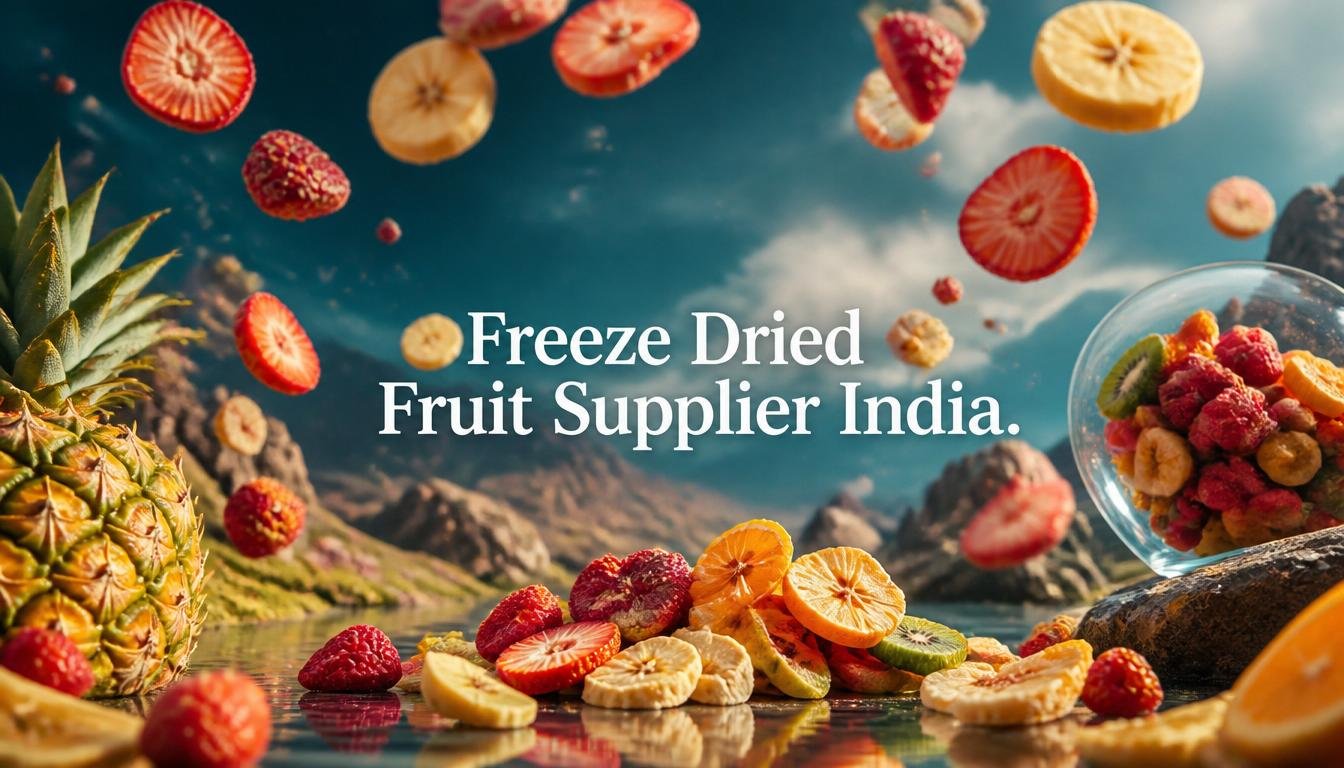
Freeze Dried Fruit Supplier India is the gold standard of fruit preservation. It is the method behind the intensely flavourful strawberry pieces in premium muesli, the perfectly light and crispy mango chunks in trail mix, the vibrant blueberry inclusions in luxury granola, and the concentrated fruit pieces used in premium supplement formulations worldwide. Nothing else comes close to it for preserving colour, flavour, texture, and nutritional profile in a shelf-stable format.
And in a market increasingly dominated by consumers and brands demanding clean labels, real fruit ingredients, maximum nutrition, and sensory authenticity, freeze dried fruit is no longer a niche premium ingredient — it is a fast-growing category being adopted across breakfast cereals, snack bars, baked goods, instant porridges, confectionery, infant nutrition, premium supplements, and functional food.
India — the world’s largest or second-largest producer of several of the most commercially valuable tropical fruits, including mango, guava, jackfruit, and jamun — is emerging as one of the most compelling sources for freeze dried fruit globally. The combination of native fruit diversity, growing freeze drying processing capacity, competitive pricing, and established food export infrastructure makes India a strategically important supply origin for global buyers.
This guide covers everything a B2B buyer needs to understand: what freeze drying actually does and why it matters, which Indian tropical fruits are commercially most interesting in freeze dried form, what quality parameters govern purchase decisions, how to evaluate Indian freeze dried fruit suppliers, and how the sourcing process works from first enquiry to shipment.
What Freeze Drying Does — and Why It Matters for Buyers
Before evaluating suppliers or products, understanding the freeze drying process itself is essential. It explains why freeze dried fruit commands a premium, what buyers are actually paying for, and what quality parameters to demand.
The Freeze Drying Process (Lyophilisation)
Freeze drying — technically called lyophilisation — removes moisture from fruit through sublimation rather than evaporation. Here is how it works in an industrial food processing context:
Step 1 — Preparation: Fresh ripe fruit is selected, washed, peeled, sliced, diced, or halved depending on the final product format and market specification. Uniformity of cut size is important for consistent drying and attractive finished product presentation.
Step 2 — Freezing: The prepared fruit pieces are frozen rapidly to temperatures typically between -40°C and -50°C. Rapid freezing is critical — it creates small ice crystals that cause less cellular damage than slow freezing, which means better texture and appearance on rehydration.
Step 3 — Primary Drying (Sublimation): The frozen fruit is placed in a vacuum chamber at very low pressure. At this pressure, ice converts directly from solid to vapour — bypassing the liquid phase entirely. A heating element gently raises the product temperature to accelerate sublimation while keeping it below the melting point. This phase removes approximately 95% of the moisture and takes the majority of total drying time.
Step 4 — Secondary Drying (Desorption): Temperature is raised slightly under continued vacuum to remove the remaining bound moisture, bringing final moisture content to below 2–3%.
Step 5 — Packaging: Dried product is packed immediately in a controlled environment — typically nitrogen-flushed into moisture-barrier, light-blocking packaging — to prevent re-absorption of atmospheric moisture.
Why Freeze Drying Outperforms Other Methods
The unique physics of sublimation — moisture leaving as vapour without going through a liquid phase — means that the fruit’s cellular structure is preserved almost intact. The ice crystals leave behind microscopic channels when they sublimate, resulting in the characteristic light, porous, crunchy texture that is unique to freeze dried fruit.
| Quality Parameter | Freeze Dried | Hot Air Dried | Spray Dried | Sun Dried |
|---|---|---|---|---|
| Colour retention | Excellent — near fresh | Moderate — dulled | Good in powder form | Poor — significant browning |
| Flavour retention | Excellent — intensified | Moderate | Good | Poor–Moderate |
| Nutrient retention | Excellent — 90–97% | Moderate — 50–75% | Good — 70–85% | Poor — 40–60% |
| Texture on rehydration | Excellent — near fresh | Leathery | N/A (powder) | Chewy/tough |
| Texture as dried snack | Light, crispy, crunchy | Chewy, dense | N/A | Chewy |
| Moisture content | Below 3% | 8–15% | Below 5% | 15–25% |
| Shelf life (sealed) | 18–25 years in ideal conditions; 2–3 years commercially | 1–2 years | 18–24 months | 6–12 months |
| Relative cost | High | Low | Medium | Very low |
The critical implication for buyers: freeze dried fruit is not simply dehydrated fruit at a higher price. It is a fundamentally different product with a different sensory profile, different nutritional yield, different shelf life, and different application capabilities. The premium it commands reflects a genuine and measurable quality difference — not marketing.
Why India Is an Increasingly Important Source for Freeze Dried Fruit
Unmatched Native Fruit Diversity
India’s tropical and subtropical geography produces fruit varieties that are either unavailable or prohibitively expensive to source from other regions. Alphonso mango — widely regarded as the world’s finest mango variety — grows only in Maharashtra’s Konkan region. Black jamun (Indian blackberry) is native to the Indian subcontinent and barely cultivated commercially elsewhere. Chikoo (sapodilla) is a tropical fruit primarily grown in India and Mexico. These unique origin stories have significant commercial value for premium and artisan food brands.
Beyond the exotic varieties, India also produces massive volumes of more universal fruits — guava (India produces approximately 45% of global output), pineapple, strawberry, and jackfruit — giving buyers access to both rare specialty varieties and large-volume commodity-grade freeze dried fruit from a single origin.
Growing Processing Capacity
India’s freeze drying processing sector has expanded significantly over the past decade, driven by export demand and domestic health food market growth. Indian freeze drying facilities now operate industrial-scale lyophilisation chambers capable of processing hundreds of tonnes of fruit per year, with cold chain infrastructure supporting quality from harvest through to export dispatch.
Competitive Pricing vs. European and American Sources
Freeze dried fruit processed in India is significantly more cost-competitive than equivalent product from European, North American, or Japanese processors — reflecting lower raw material, energy, and labour costs without compromising on equipment capability or quality. For buyers sourcing freeze dried fruit as a food manufacturing ingredient at scale, India’s price point enables meaningful formulation cost reduction.
Seasonal Planning and Year-Round Availability
India’s diverse climate means staggered harvests across different fruit varieties and different growing regions throughout the year. Unlike single-harvest-window origins, experienced Indian freeze dried fruit exporters can plan production across a broader calendar, reducing the risk of seasonal stock gaps.
The Freeze Dried Fruit Range: A Buyer’s Guide by Product
Freeze Dried Mango (Mangifera indica)
Freeze dried mango is one of the most commercially successful freeze dried fruit products globally — and one where India has the strongest competitive position of any sourcing origin. India produces approximately 40–45% of the world’s mangoes, and the Alphonso variety from Maharashtra’s Ratnagiri and Sindhudurg districts is internationally renowned for its extraordinary sweetness, saffron-orange colour, and richly complex flavour.
Product forms available:
- Slices and halves (for premium snack and cereal applications where visual presentation matters)
- Diced chunks (5mm × 5mm, 10mm × 10mm — standard for muesli, granola, and trail mix applications)
- Powder (freeze dried mango ground to fine or coarse powder — retains more flavour compounds than spray dried)
Primary applications: Premium muesli and granola inclusions, health snack bars and trail mix, breakfast cereal inclusions, confectionery and chocolate coatings, premium instant porridge, infant and toddler snacks, functional food and health products, high-end food service and restaurant dessert components.
Key quality parameters:
- Moisture content: below 3% — the most critical single parameter; moisture above 3% risks clumping, stickiness, and accelerated microbial growth
- Water activity (Aw): below 0.3 — a more sensitive indicator of microbiological stability than moisture % alone; this is the parameter freeze dried food manufacturers monitor most closely
- Colour: vibrant golden-yellow to deep amber for standard mango; vivid saffron-orange for Alphonso grade — pale, whitish, or browning product indicates poor raw material selection, slow freezing, or oxidation
- Brix: minimum 65–72° Brix (total soluble solids) in the pre-dried fruit — higher Brix input produces more intensely flavoured, sweeter freeze dried product
- Texture: light, crispy, and crunchy when dry; rehydrates smoothly and quickly — dense, leathery, or waxy texture signals inadequate freeze drying (incomplete drying or thermal damage)
- Appearance: uniform pieces, no discolouration, no visible browning at edges, no adhesion between pieces
- Heavy metals: Pb, Cd, Hg, As per destination market limits
- Microbial: TPC, Yeast/Mould, E. coli (absent), Salmonella (absent)
- Pesticide residues: full residue panel for EU market; mango is flagged for some pesticide actives under EU MRL monitoring
Variety specification note: For premium applications, specify Alphonso variety mango explicitly if the variety is a marketing claim or influences your product positioning. Alphonso freeze dried mango commands a price premium over general variety freeze dried mango but delivers meaningfully superior colour intensity, sweetness, and flavour complexity that is immediately apparent in the finished product.
Freeze Dried Strawberry (Fragaria × ananassa)
Freeze dried strawberry is one of the highest-volume freeze dried fruit products globally, used across virtually every major food category — from breakfast cereals and granola to confectionery, bakery, dairy, baby food, and premium supplements. India’s strawberry cultivation has grown substantially, particularly in Maharashtra (Mahabaleshwar region), Himachal Pradesh, and Uttarakhand.
Product forms available:
- Whole freeze dried strawberries (premium visual impact for artisan products and gifting)
- Halves (standard for cereal and granola applications)
- Slices (thin cross-sections for visual layering in premium products)
- Diced (4mm × 4mm, 8mm × 8mm — standard ingredient format for bars and baked goods)
- Powder (intense red, high-anthocyanin content)
Primary applications: Breakfast cereals and granola inclusions, chocolate and confectionery (freeze dried strawberry pieces in dark chocolate are a growing premium confectionery segment), premium muesli, health bars and trail mix, strawberry-flavoured yogurt and dairy products, infant food and toddler snacks, freeze dried fruit snack bags, bakery decoration, premium instant porridge.
Key quality parameters:
- Moisture content: below 2.5% — strawberry is particularly hygroscopic after freeze drying; tight moisture control is essential
- Water activity: below 0.3
- Colour: vivid, bright red to deep crimson — strawberry’s intense red colour is its primary visual appeal; pale pink, orange-tinged, or brown product indicates oxidation, poor raw material selection, or heat damage during processing
- Anthocyanin content: relevant for supplement and functional food applications where antioxidant positioning is a claim; higher anthocyanin = deeper red colour and stronger functional positioning
- Brix: minimum 55–65° Brix in fresh input fruit
- Texture: very light and crispy when dry — strawberry has high water content (approximately 90%) which, when removed by freeze drying, leaves a dramatically light, airy structure
- Piece uniformity: specify piece size tolerance (e.g. ±2mm) for industrial applications where consistent sizing affects portion accuracy
View Freeze Dried Strawberry →
Freeze Dried Jackfruit (Artocarpus heterophyllus)
Freeze dried jackfruit is one of the most commercially exciting emerging categories in the global freeze dried fruit market. India produces more jackfruit than any other country — accounting for over 50% of global output — making it the natural primary source for this product.
Jackfruit’s commercial momentum has been driven largely by the plant-based food movement (ripe jackfruit has a unique meaty texture that makes it popular as a meat alternative), but freeze dried ripe jackfruit has a completely different proposition: it is intensely sweet, tropical, and aromatic — a confectionery-adjacent ingredient rather than a savoury one.
Product forms available:
- Chunks (the most common format; the natural fibrous structure of jackfruit creates distinctive textured pieces)
- Slices
- Powder (freeze dried jackfruit ground to coarse or fine powder)
Primary applications: Premium trail mix and mixed fruit snack blends, tropical muesli and granola inclusions, exotic confectionery and artisan chocolate inclusions, health food and natural snack products, gourmet food service applications, plant-based and clean-label product lines, Asian specialty food brands targeting diaspora consumers.
Key quality parameters:
- Moisture: below 3%
- Water activity: below 0.3
- Colour: golden yellow to deep amber — jackfruit’s ripe colour should be vibrant and warm; pale or greenish tones indicate unripe fruit selection
- Aroma: intensely sweet, tropical, slightly bubblegum-like aroma is characteristic of ripe jackfruit — faint or flat aroma signals underripe raw material or processing problems
- Brix: minimum 22–28° Brix in fresh ripe jackfruit
- Texture: jackfruit’s natural fibrous structure creates a uniquely textured freeze dried piece — specify whether chunky, textured pieces are appropriate for your application, or whether uniform diced format is required
- Seed and core-free: confirm that pieces are from the edible bulb only, with seeds and white core material removed
Freeze Dried Guava (Psidium guajava)
India is the world’s largest guava producer, accounting for approximately 45% of global guava output. Guava is nutritionally exceptional — it contains more Vitamin C per gram than most citrus fruits, along with significant dietary fibre, lycopene (in pink-fleshed varieties), and polyphenol antioxidants. Freeze dried guava delivers these nutrients in a shelf-stable, portable, intensely flavoured format.
Product forms available:
- Slices (cross-sections showing characteristic seed centre — visually distinctive and premium)
- Diced chunks (seed-free for uniform ingredient applications)
- Powder
Primary applications: Vitamin C and immunity supplement formulations (guava is a compelling natural Vitamin C source for supplement brands looking for plant-based alternatives to synthetic ascorbic acid), premium trail mix and fruit snack blends, tropical muesli inclusions, health bars, infant and toddler nutrition, exotic confectionery.
Key quality parameters:
- Vitamin C content: this is freeze dried guava’s primary nutritional differentiator; request Vitamin C (ascorbic acid) content on COA — good-quality freeze dried pink guava can retain 1,500–2,500 mg Vitamin C per 100g after freeze drying, significantly higher than most other fruit powders
- Colour: pink-fleshed guava = vibrant pink interior with pale cream-green exterior (slices); white-fleshed guava = cream to pale yellow throughout
- Lycopene content: relevant for pink guava specifically; a natural source of lycopene with antioxidant positioning
- Moisture: below 3%
- Water activity: below 0.3
- Seeds: confirm whether product is seed-inclusive (whole slices) or seed-free (diced from seedless sections or seeded varieties)
Freeze Dried Jamun (Syzygium cumini)
Freeze dried jamun — Indian blackberry — is one of the most distinctively Indian freeze dried fruit products available from any sourcing origin. Black jamun is a small, deep purple-black berry native to the Indian subcontinent, with an intensely astringent, tart flavour and extraordinary anthocyanin pigment content that produces deep, saturated purple colour.
Jamun has significant traditional Ayurvedic significance as a blood sugar management herb — the fruit, seeds, and leaves are all used — and this heritage translates directly into commercial demand for freeze dried jamun as a functional, health-positioned ingredient in global supplement and functional food markets.
Product forms available:
- Whole freeze dried jamun (whole small berries — visually striking and unique)
- Halves or pieces
- Powder (intensely pigmented deep purple powder)
Primary applications: Blood sugar support and diabetic wellness supplement formulations (jamun is one of the best-documented Ayurvedic fruits for this application), antioxidant and polyphenol supplement blends, premium trail mix and exotic fruit snack blends (jamun’s unique appearance and intensely tart flavour create strong differentiation), natural purple food colouring for clean-label products, functional food and nutraceutical ingredient for Ayurveda-positioned brands.
Key quality parameters:
- Anthocyanin content: jamun is extraordinarily rich in anthocyanins — the pigment responsible for the deep purple-black colour and primary antioxidant activity; request anthocyanin content per 100g for supplement applications; premium freeze dried jamun can contain 2,000–4,000 mg anthocyanins per 100g
- Colour: intensely deep purple-black — arguably the most dramatic colour of any freeze dried fruit product; any lightening to reddish-purple or brown signals anthocyanin degradation during processing
- Flavour: distinctively tart and astringent — this is characteristic and correct; flat or sweet flavour signals unripe fruit or adulteration
- Moisture: below 3%
- Water activity: below 0.3
Freeze Dried Pineapple (Ananas comosus)
India is one of the leading pineapple producers in Asia, with major cultivation in West Bengal, Assam, Kerala, and Karnataka. Freeze dried pineapple is a universally appealing product — sweet, tangy, tropical, and visually vibrant — with applications across virtually every premium food category.
Product forms available:
- Rings or round slices (dramatic visual presentation for premium products)
- Tidbits and chunks (standard ingredient format for muesli, granola, and bars)
- Crushed / irregular pieces (for baked goods and confectionery applications)
- Powder
Primary applications: Tropical muesli and granola inclusions, premium trail mix and fruit snack blends, confectionery and artisan chocolate (pineapple and dark chocolate is a well-established combination), health bars and energy bars, bakery inclusions and decoration, piña colada-themed products, tropical-flavoured instant porridge, infant and toddler snack pouches.
Key quality parameters:
- Moisture: below 3%
- Water activity: below 0.3
- Colour: bright golden-yellow — vivid, saturated colour indicates high-Brix ripe fruit and good processing; pale, washed-out yellow or brown edges signal heat damage or oxidation
- Brix: minimum 12–16° Brix in fresh pineapple input; higher Brix varieties (Kew, Queen) produce sweeter, more intensely flavoured freeze dried product
- Bromelain activity: relevant for buyers positioning freeze dried pineapple as a digestive enzyme or anti-inflammatory ingredient; bromelain is heat-sensitive and is well-preserved by freeze drying — verify through enzyme activity assay if making functional claims
- Texture: light, crispy, and retains characteristic pineapple fibre structure — dense or leathery texture indicates inadequate freeze drying
Freeze Dried Chikoo (Manilkara zapota — Sapodilla)
Chikoo — known internationally as sapodilla — is a tropical fruit grown primarily in India, Mexico, and Southeast Asia. In India, Gujarat and Maharashtra are the main producing states. The freeze dried form of chikoo offers something genuinely unusual in the global freeze dried fruit market: a caramel-brown, intensely sweet fruit with flavour notes reminiscent of brown sugar, vanilla, and pear — quite unlike any other tropical fruit.
Primary applications: Premium artisan trail mix and exotic fruit blends (chikoo’s unique flavour creates strong product differentiation), specialty confectionery and artisan chocolate inclusions, gourmet food service applications, premium Asian and Indian ethnic food brands, functional food and health product lines targeting South Asian diaspora consumers.
Key quality parameters:
- Moisture: below 3%
- Water activity: below 0.3
- Colour: medium caramel-brown to tawny — uniform, consistent colour indicates mature, ripe fruit selection
- Brix: minimum 18–22° Brix in fresh ripe chikoo; higher Brix produces more intensely sweet, concentrated freeze dried product
- Seed-free: chikoo seeds are hard, dark, and inedible — confirm all pieces are completely seed-free
- Texture: light and crunchy with a slightly grainy, sandy texture characteristic of chikoo — this is correct and desirable
Freeze Dried Fig (Ficus carica)
Figs have been one of the world’s most prized fruits for millennia, and the freeze dried format unlocks new applications for this traditionally dried fruit. While dried figs are a well-established product globally, freeze dried figs deliver something the conventional dried version cannot: a light, crispy texture that retains far more of the fresh fig’s complex flavour — honey-like sweetness, slight berry notes, and characteristic seed crunch — in a completely different eating experience.
Product forms available:
- Whole freeze dried figs (premium visual product for gifting and artisan food)
- Halves (showing the characteristic interior seed pattern — visually distinctive)
- Pieces and chunks (standard ingredient format)
Primary applications: Premium confectionery and artisan chocolate inclusions (freeze dried fig and dark chocolate is a growing premium combination), luxury muesli and granola, artisan cheese accompaniments, premium trail mix and dried fruit blends, gourmet food service applications, high-end gift food products, specialty bakery.
Key quality parameters:
- Moisture: below 3%
- Water activity: below 0.3
- Colour: exterior — light brown to golden; interior — pinkish-cream with visible seed arrangement — the interior colour is the primary quality indicator; deep caramel or brown interior signals over-ripe or heat-affected fruit
- Brix: minimum 20–25° Brix in fresh fig input
- Sugar crystallisation: figs have very high natural sugar content; improper freeze drying parameters can cause sugar crystallisation on the surface — this creates white deposits and is considered a quality defect
Product Format Options: Whole, Sliced, Diced, and Powder
For every freeze dried fruit, buyers should specify the product format clearly in their RFQ. Format choice affects application suitability, price, and minimum order quantity:
| Format | Typical Size | Applications | Notes |
|---|---|---|---|
| Whole | Full fruit or large piece | Premium snack packs, gifting, display products | Highest visual impact; highest price per kg |
| Halves | Cut through centre | Cereal topping, premium muesli | Good visual impact; moderate price |
| Slices | 3–8mm cross-sections | Cereal inclusions, chocolate decoration | Elegant visual presentation |
| Diced / Chunks | 5×5mm to 15×15mm | Muesli, granola, bars, bakery inclusions | Most versatile ingredient format |
| Irregular / Crumble | Varied | Bakery, confectionery, coating | Cost-effective; no shape specification |
| Powder | Below 0.5mm | Supplements, beverage powder, cosmetics | Maximum surface area; fastest flavour release |
Certifications to Require from an Indian Freeze Dried Fruit Supplier
| Certification | What It Confirms | Who Needs It |
|---|---|---|
| FSSAI | Indian food safety compliance — mandatory for all food exporters | All buyers |
| ISO 22000 / FSSC 22000 | International food safety management system | EU, US, UK, Australian buyers |
| HACCP | Hazard analysis and critical control point compliance | All food buyers |
| USDA Organic | Certified organic status for the US market | US buyers with organic claims |
| EU Organic | Certified organic for European markets | EU buyers with organic claims |
| Halal | Compliant for Muslim consumer markets | Middle East, Southeast Asia, UK buyers |
| Non-GMO | Verified non-GMO | US and EU clean-label buyers |
| Vegan | No animal-derived processing aids used | Vegan-positioned products |
| Phytosanitary Certificate | Pest and disease free confirmation | Required in most destination countries |
| EU MRL Pesticide Compliance | Pesticide residues within EU limits | Mandatory for EU market; critical for fresh-fruit-derived products |
Packaging for Freeze Dried Fruit Export
Packaging is critically important for freeze dried fruit. The product is highly hygroscopic — it will re-absorb atmospheric moisture extremely rapidly if exposed to open air — which destroys the crispy texture, causes clumping and stickiness, and accelerates browning and flavour deterioration.
| Format | Application |
|---|---|
| 100g / 250g / 500g nitrogen-flushed sealed foil pouches | Sample orders and retail repack |
| 1 kg / 2 kg nitrogen-flushed sealed foil pouches | Small batch buyers and trial orders |
| 5 kg / 10 kg multi-layer foil bags with desiccant | Standard ingredient bulk orders |
| 25 kg cartons with inner nitrogen-flushed poly bags | Large bulk industrial orders |
| Custom branded retail packs with private label | Private label snack and cereal applications |
Non-negotiable packaging requirements:
- Nitrogen flushing — removes oxygen from the pack before sealing; prevents oxidation of colour compounds and volatile flavour molecules
- Moisture barrier laminate — the outer packaging must have an extremely low moisture vapour transmission rate (MVTR); standard kraft paper or single-layer poly bags are inadequate
- Desiccant sachets — silica gel or molecular sieve desiccant inside the pack provides secondary moisture protection for bulk formats
- Light-blocking outer layer — UV exposure degrades colour compounds; opaque or foil-laminate packaging is required
Properly packaged and stored freeze dried fruit has a commercial shelf life of 24–36 months at room temperature. Under ideal conditions (cool, dark, sealed), freeze dried fruit can remain shelf-stable for significantly longer — this extraordinary shelf life is one of freeze drying’s major commercial advantages over all other preservation methods.
Quality Testing Table: What to Require on Every COA
| Test Parameter | Target / Limit | Why It Matters |
|---|---|---|
| Moisture content % | Below 2.5–3% | Critical for texture, shelf life, and microbial stability |
| Water activity (Aw) | Below 0.3 | Primary microbiological stability indicator |
| Total soluble solids (Brix) | Per product specification | Indicates raw fruit ripeness and flavour concentration |
| Colour measurement | Lab* values per product standard | Confirms colour quality and consistency |
| Texture (hardness/crispiness) | Assessed per product standard | Key quality parameter; dense or leathery = inadequate drying |
| Piece size / uniformity | Per specified format (±2mm tolerance) | Important for industrial portion accuracy |
| Foreign matter | Below 0.1% | Seeds, stems, peel where not expected |
| Heavy metals | Pb, Cd, Hg, As per destination market limits | Mandatory for supplement applications |
| Microbial: TPC | Per destination market food standard | General microbial safety |
| Microbial: Yeast & Mould | Per destination market standard | Shelf life stability |
| E. coli | Absent | Food safety requirement |
| Salmonella | Absent in 25g | Food safety requirement |
| Pesticide residues | EU MRL compliant | Mandatory for EU market |
| Functional markers | Per product (Vitamin C for guava, anthocyanins for jamun/strawberry, bromelain for pineapple) | Confirms nutritional positioning claims |
What to Include in Your Freeze Dried Fruit RFQ
- Fruit type and variety (e.g. Alphonso mango, not just “mango”)
- Product format: whole, halves, slices, diced (specify size), or powder
- Grade: premium / standard / organic
- Required certifications (list each explicitly)
- Packaging format and unit weight
- COA parameters required (list each test and target value)
- Destination country and port
- Target quantity: sample (200–500g), trial order, or FCL
- Minimum remaining shelf life required on delivery
Red Flags When Evaluating Indian Freeze Dried Fruit Suppliers
Dense, sticky, or leathery texture in samples. This is the most diagnostic quality failure in freeze dried fruit — it indicates incomplete drying, inadequate vacuum during the process, or thermal damage. There is no substitute for evaluating actual sample texture before committing to a purchase order.
Pale, dull, or brown colour. Freeze dried fruit from good raw material and good processing should look almost shockingly vibrant compared to conventional dried fruit. Pale, washed-out, or browned product signals poor raw material selection, slow freezing causing large ice crystal damage, or oxidation during processing or packaging.
Moisture above 3% or water activity above 0.35. Either of these readings in a COA should disqualify a batch. These are not minor deviations — they indicate a product that will clump, brown, and deteriorate within weeks of opening, regardless of outer packaging.
No nitrogen-flushed packaging. A freeze dried fruit supplier who cannot supply nitrogen-flushed packaging does not have the equipment or procedures for premium-quality export. This is not optional.
Cannot specify fruit variety. Premium freeze dried fruit buyers specify variety — Alphonso mango, Kew pineapple, etc. A supplier who treats all varieties as interchangeable is not operating at the quality tier that premium food and supplement brands require.
No pesticide residue testing. For EU-bound freeze dried fruit, this is a compliance requirement, not a premium add-on. Suppliers who cannot provide it are not EU-market ready.
Step-by-Step: From Enquiry to First Shipment
1. Define your specification — fruit, variety, format (whole/diced/powder), grade, certifications, COA parameters, packaging type.
2. Send RFQs to 3–5 shortlisted suppliers — verify FSSAI registration and export history specifically for freeze dried products (freeze drying requires capital equipment investment; not all dehydrated fruit suppliers have it).
3. Request samples — minimum 200–500g per fruit variety, in your specified format and packaging. Request the lot-specific COA for each sample.
4. Evaluate samples rigorously:
- Check moisture content and water activity from the COA
- Assess texture immediately on opening (should be crispy and light, not sticky or dense)
- Assess colour (should be vibrant and true-to-fruit)
- Taste and assess flavour intensity
- If packaging has been compromised or moisture ingress has occurred, request a replacement sample
5. Third-party lab test for your first order — particularly pesticide residues for EU-bound product and functional markers (anthocyanins, Vitamin C, bromelain) for supplement applications.
6. Negotiate commercial terms — price, Incoterm (FOB/CIF), lead time (freeze drying is a slower process than spray drying; allow 3–6 weeks production lead time after order confirmation), payment structure.
7. Place a trial order — 50–200 kg per variety is typical for first commercial orders given the premium price point.
8. Pre-shipment inspection — verify packaging integrity, seal quality, nitrogen flushing, and labelling before shipment.
9. Confirm full documentation:
- Lot-specific COA (all required parameters)
- FSSAI Export Certificate
- Phytosanitary Certificate
- Pesticide residue report (for EU buyers)
- Organic certificate (if applicable)
- Commercial Invoice and Packing List
- Bill of Lading
10. Customs classification: Freeze dried fruit typically classifies under HS Code 0813 (dried fruit) or 2008.99 (other prepared or preserved fruit) depending on the product form and destination country. Confirm with your freight forwarder before shipment.
Related: Spray Dried Fruit Powders from the Same Origin
If you are sourcing freeze dried fruit and also require spray dried fruit powder versions of the same varieties — for beverage, supplement, or food manufacturing applications where powder form is preferred — Shanti Sons Foods supplies both ranges from Indian-origin fruit:
- Mango Powder — spray dried
- Guava Powder — spray dried
- Black Jamun Powder — spray dried
- Pineapple Powder — spray dried
- Papaya Powder — spray dried
Browse our complete Spray Dried Fruit Powder range →
Further Reading from Our Export Guide Series
- Moringa Powder from India: What Nutraceutical Brands Need to Know
- Ashwagandha, Brahmi & Giloy: Buyer’s Guide to Ayurvedic Herbal Powders
- Bulk Spice Powders from India: Turmeric, Cumin, Cardamom & More
- How to Import Fruit Powders from India: Amla, Mango, Pomegranate & 30+ More
- Dehydrated Vegetable Powders from India: Spinach, Beetroot, Carrot & More
Source Freeze Dried Fruits from Shanti Sons Foods
Shanti Sons Foods is a Mumbai-based Indian food manufacturer and exporter supplying freeze dried tropical fruits — mango, strawberry, jackfruit, guava, jamun, pineapple, chikoo, and fig — alongside a comprehensive range of spray dried fruit powders, vegetable powders, herbal powders, spice powders, masala blends, and Indian snacks. We export worldwide and supply premium food brands, snack manufacturers, cereal companies, supplement producers, confectionery businesses, and private label buyers.
GO 4 EXPORT INDIA for consultation regarding Import and Export from India.
Get in touch with our export team:
📍 B/301, 3rd Floor, Neera Govind Society, Tambe Nagar Mulund West, Thane 400080, Mumbai, Maharashtra 📞 +91 9833023131 📧 jainishsukhadia26@gmail.com 💬 WhatsApp Us
View Freeze Dried Mango → View Freeze Dried Strawberry → View Freeze Dried Jackfruit → Browse All Freeze Dried Fruits → Contact Us →