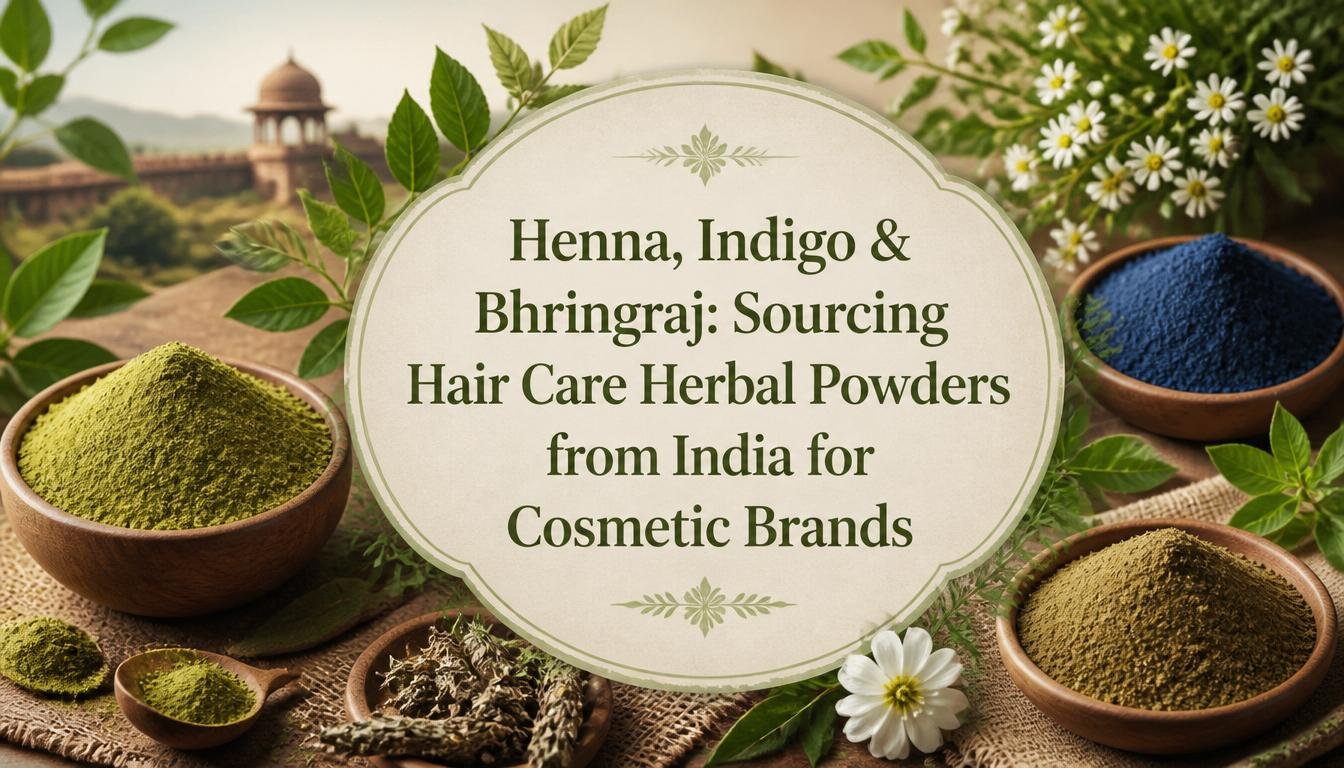
The global natural hair care market is in the middle of a structural shift — not a trend cycle. Consumers across Europe, North America, the Middle East, and Southeast Asia are moving away from synthetic chemical treatments, artificial dyes, and sulphate-heavy formulations toward botanical, plant-derived alternatives with verifiable origins and recognisable ingredient lists.
India stands at the centre of this shift as the world’s primary source for the most commercially important natural hair care herbal powders. Henna — the plant that produces the most widely used natural hair colourant in the world — is cultivated almost exclusively in Rajasthan’s Sojat region. Bhringraj, shikakai, and brahmi, the foundational herbs of traditional Indian Ayurvedic hair care, grow natively across the subcontinent. Indigo, the plant used to produce blue-to-black tones in natural hair dyeing, has centuries of cultivation history in India.
For cosmetic brands, personal care manufacturers, hair care product developers, and private label businesses looking to source these ingredients in bulk, India is not simply one of several options — for most of these products, it is effectively the only origin that matters at commercial scale.
This guide covers every ingredient in the hair herbal powder category systematically — what each product is, what it does, what quality specifications define premium versus compromised material, the compliance requirements for cosmetic applications, and how to source reliably from Indian suppliers.
Why Cosmetic Buyers Source Hair Herbal Powders from India
The Only Meaningful Origin for Most Ingredients
For several of the most commercially important hair herbal powders, India is not merely the preferred source — it is the origin where the plants are cultivated at meaningful commercial scale:
Henna (Lawsonia inermis) is primarily cultivated in India’s Rajasthan state, particularly the Sojat region near Pali district, which accounts for the overwhelming majority of the world’s natural henna leaf production. While henna also grows in parts of North Africa, Pakistan, and the Middle East, Indian henna — particularly Sojat henna — commands a global reputation premium for lawsone content and dyeing quality that competitors from other origins consistently struggle to match.
Bhringraj (Eclipta prostrata / Eclipta alba) grows naturally across India’s tropical and subtropical regions and is harvested from both wild and cultivated sources primarily in Andhra Pradesh, Tamil Nadu, and Maharashtra. Commercial cultivation at meaningful scale is almost exclusively Indian.
Shikakai (Acacia concinna) pods are harvested from trees growing extensively across central and southern India. Thailand produces some commercial quantities but Indian shikakai retains the dominant market position for export-grade powder.
Indigo (Indigofera tinctoria) — the natural hair dye plant — is cultivated in Tamil Nadu, Andhra Pradesh, and Gujarat. India’s indigo export infrastructure, developed through centuries of cultivation history, makes it the most reliable large-volume source globally.
Natural Cosmetic Market Growth Creates Consistent Demand
The broader natural and organic cosmetics market has maintained consistent above-average growth rates, driven by consumer demand for ingredient transparency, free-from formulation positioning, and alignment with sustainability and clean beauty values. Hair care has been one of the fastest-moving subcategories within natural cosmetics — consumers who start questioning synthetic ingredients in skincare quickly extend that scrutiny to the products applied to their hair and scalp.
This trend is particularly pronounced in the EU and UK, where regulatory pressure on certain synthetic hair dye chemicals has accelerated formulator interest in natural botanical alternatives, and in the Middle East, where traditional henna culture creates deep native consumer familiarity and brand resonance for herbal hair care formulations.
The Key Hair Herbal Powders: A Buyer’s Guide by Product
Henna Powder (Lawsonia inermis)
Henna is the foundational natural hair colourant and has been used for thousands of years across South Asia, the Middle East, and North Africa for hair dyeing, body art, and scalp conditioning. In the modern cosmetic ingredient market, henna powder is used both in its traditional pure form and as a base ingredient in formulated natural hair colour products.
The active compound — Lawsone: Henna’s colouring ability comes from lawsone (2-hydroxy-1,4-naphthoquinone), a natural dye molecule that binds to the keratin in hair protein through a process called oxidative coupling. The lawsone content of henna powder is the single most important commercial quality specification — it directly determines the strength, depth, and durability of the colour produced.
Commercial henna powder grades:
| Grade | Lawsone Content | Colour Result | Primary Application |
|---|---|---|---|
| Standard body art / hair dye grade | 1.8–2.2% lawsone | Medium orange-red | General retail and hair colour formulations |
| Premium Sojat grade | 2.5–3.5% lawsone | Deep, rich orange-red | Professional hair colour products, premium retail |
| Triple-sifted / filtered grade | 2.5%+ lawsone, <1% stem/bark | Finest texture, maximum colour | Professional salon applications, luxury brands |
Key quality parameters:
- Lawsone content (%): the primary commercial specification — always request tested lawsone percentage on the lot-specific COA, not a generic species-level estimate
- Mesh size: finer mesh (200 mesh and above) is essential for smooth, even application in hair paste and cosmetic formulations; coarser mesh (60–100 mesh) is acceptable for industrial dyeing applications
- Colour (dye release test): perform a standard henna dye release test on a sample before ordering — the depth and speed of colour release on a white linen or paper test confirms lawsone activity in practice
- Stem and bark content: premium hair colour applications require minimal stem and bark — specify maximum stem/bark percentage in your RFQ
- Moisture: below 10%
- Heavy metals: mandatory for cosmetic ingredient applications — Pb, Cd, Hg, As per EU Cosmetics Regulation (EC) No 1223/2009 limits
- Microbial: TPC, Yeast/Mould, E. coli (absent), Salmonella (absent) — critical for any product applied to skin and scalp
- Pesticide residues: EU Cosmetics Regulation requires compliance; Rajasthan henna is predominantly naturally grown but verify per lot
Critical compliance note for EU cosmetic buyers: Natural henna (Lawsonia inermis leaf powder) is permitted as a cosmetic ingredient in the EU. However, products marketed as “black henna” or “neutral henna” are distinct — black henna typically contains para-phenylenediamine (PPD), a regulated substance associated with severe allergic reactions, and is subject to strict EU restrictions. Pure natural henna powder produces orange-red tones only; deep brown-to-black tones require the addition of indigo (see below) or other botanicals, not PPD. Cosmetic formulators must clearly distinguish these in labelling and formulation documentation.
Indigo Powder (Indigofera tinctoria)
Indigo powder from Indigofera tinctoria is the natural botanical ingredient used to shift henna-dyed hair from orange-red toward brown, dark brown, and eventually near-black tones — depending on the ratio of henna to indigo used in the formulation and the number of application passes. Understanding this relationship is fundamental to working with natural hair colour systems commercially.
How henna and indigo work together: Natural hair colouring with botanical ingredients typically follows a two-step process in professional applications: a first pass with pure henna to deposit lawsone and open the hair cuticle, followed by an indigo application to add the blue-purple pigment layer that shifts the overall tone. The ratio determines the final colour — high henna / low indigo produces auburn, balanced ratios produce chestnut brown, and low henna / high indigo produces near-black. Many commercial “natural black” hair colour formulations are precisely calibrated henna-indigo combinations.
The active compound — Indigotin: Indigo’s colouring ability comes from indigotin (the indigo dye molecule), which is not present in the fresh plant but develops during a specific fermentation or oxidation process after grinding. This is a critical processing detail: properly processed indigo powder that will produce good hair colour requires controlled post-grinding conditioning — not all suppliers understand or apply this consistently.
Key quality parameters:
- Indigo dye content (indigotin %): the primary commercial specification — a standard dye content test (typically using reduction/oxidation colorimetry) should be included on the COA
- Colour: dark blue-black powder is the expected appearance of well-processed indigo; greenish or pale blue-grey indicates lower dye content or poor processing
- Mesh size: typically 100–200 mesh for cosmetic hair colour applications — fine, even particle size is essential for smooth, consistent application
- Freshness: indigo powder’s dye activity diminishes with age — always specify minimum remaining shelf life and request production date on every batch; ideally use within 12 months of production
- Moisture: below 10%
- Heavy metals: Pb, Cd, Hg, As per EU Cosmetics Regulation limits
- Microbial: standard cosmetic ingredient safety panel
Formulation note for cosmetic brands: Pure indigo powder does not produce meaningful colour on unprimed hair — it requires prior henna application or an alkaline pre-treatment to function effectively. Cosmetic formulators developing “one-step” natural dark colour products typically use pre-conditioned or specially processed indigo combined with henna in a single-mix formulation to simplify the application process for consumers.
Bhringraj Powder (Eclipta prostrata / Eclipta alba)
Bhringraj — literally “king of hair” in Sanskrit — is considered the most important Ayurvedic herb specifically for hair care, holding a position in traditional Indian hair therapy comparable to what ashwagandha holds for general wellness. Its traditional applications span hair growth promotion, prevention of premature greying, scalp health improvement, and treatment of hair fall — a comprehensive set of claims that maps almost exactly onto the most commercially active concerns in the contemporary natural hair care supplement market.
What it is used for: Bhringraj powder is used both topically in hair care formulations and as an oral supplement in hair health and Ayurvedic beauty product lines:
Topical applications: Hair oil formulations (bhringraj oil is one of India’s most traditional and beloved hair care products, made by infusing the herb in sesame or coconut oil), hair mask powders, scalp treatment powders, herbal hair pack formulations, shampoo and conditioner active ingredients, and leave-in treatment products.
Ingestible applications: Hair, skin, and nail supplement capsules and tablets (the “beauty from within” category), general wellness and Ayurvedic supplement formulations, hair-focused nutraceutical blends.
The active compounds: Bhringraj’s key bioactive constituents include ecliptine, wedelolactone, and various flavonoids that have been associated with hair follicle stimulation and melanocyte activity in traditional and preliminary scientific research.
Key quality parameters:
- Plant part: whole plant including aerial parts is standard; root may be included in some specifications
- Colour: deep olive-green to dark green powder — dull yellowish or brownish colour suggests excessive heat during drying or degraded raw material
- Aroma: characteristic mildly bitter, slightly earthy, grassy aroma — flat or off-aromas indicate poor quality or old stock
- Moisture: below 8%
- Heavy metals: Pb, Cd, Hg, As — required for both cosmetic and ingestible applications; specify the applicable regulatory standard (EU Cosmetics Regulation for topical, food supplement limits for ingestible)
- Microbial: standard cosmetic/food safety panel depending on application
- Pesticide residues: required for EU cosmetic ingredient supply
Dual-use compliance note: Bhringraj powder used in ingestible supplement applications (capsules, tablets) falls under food supplement regulation in most markets, while the same powder used in topical hair care formulations falls under cosmetics regulation. The regulatory frameworks — and therefore the specific heavy metal limits, microbial limits, and documentation requirements — differ between these applications. Buyers sourcing bhringraj for both applications should confirm with their supplier that the product meets the more stringent of the two applicable standards, and verify that the COA documents parameters relevant to both.
Shikakai Powder (Acacia concinna)
Shikakai — meaning “fruit for hair” in Hindi — is the dried pod of the Acacia concinna plant, ground to a fine powder. It is India’s most beloved traditional natural hair cleanser and has been used as a shampoo alternative across the Indian subcontinent for centuries. Its global commercial relevance has grown significantly as the “no-poo” and low-sulphate hair care movement has expanded beyond niche natural beauty enthusiasts into mainstream consumer markets.
Why shikakai is commercially significant: Shikakai pods contain naturally occurring saponins — plant-based surfactants that produce a mild lathering action and cleansing effect without the harshness of synthetic sulphate detergents (SLS, SLES). This positions shikakai as a genuinely functional natural alternative to synthetic surfactants for hair cleansing, not merely a “botanical extract” ingredient added for marketing purposes.
What it is used for: Natural shampoo bars and liquid shampoo formulations, co-washing (conditioner-only washing) hair care products, scalp detox and cleanse powder treatments (used dry or as a paste), combination herbal hair pack formulations (typically combined with bhringraj, amla, and neem for a multi-herb scalp treatment), conditioner bar formulations, and hair rinse concentrates.
Key quality parameters:
- Saponin content: the primary functional specification — higher saponin content means better natural lathering and cleansing performance; request saponin content on the COA for formulation-grade applications
- pH: shikakai powder paste has a naturally low pH — typically 3.5–5.5 — which is actually beneficial for hair health (the slightly acidic pH closes the hair cuticle and adds shine) but must be considered in formulation compatibility
- Mesh size: finer mesh (100–200 mesh) for smooth, even application in hair paste and liquid formulations; coarser mesh for bar soap applications where texture is acceptable
- Colour: tan to medium brown powder — very dark or almost black colour may indicate over-processing or mixing with stem and bark material
- Moisture: below 10%
- Heavy metals and microbial: standard cosmetic ingredient safety panel
Hibiscus Powder (Hibiscus rosa-sinensis)
While hibiscus powder (covered in our export trends guide as a functional beverage and natural colorant ingredient) is discussed more frequently in food and beverage contexts, the Hibiscus rosa-sinensis variety has deep traditional significance specifically in Indian Ayurvedic hair care — and the cosmetic hair care application is one of the fastest-growing commercial uses of hibiscus powder globally.
Hair care applications: Hibiscus powder is used in hair pack formulations for conditioning and shine enhancement, scalp health treatments for reducing hair fall (hibiscus has traditional Ayurvedic evidence for supporting scalp circulation and reducing excessive hair shedding), natural hair rinses for adding body and lustre, and combination herbal hair mask formulations where it contributes both conditioning benefits and natural pigment.
Commercial appeal for brands: Hibiscus’s vivid pink-red colour makes it one of the most visually attractive ingredients in natural hair care formulations — products containing hibiscus powder have an immediately appealing visual identity that photographs well for social media and e-commerce platforms, which is a non-trivial commercial consideration for brands operating in visually-driven channels.
Key quality parameters:
- Colour: deep pink to vivid red — consistent, saturated colour indicates fresh, well-processed hibiscus with good anthocyanin retention
- Anthocyanin content: hibiscus’s primary bioactive and natural pigment — relevant for brands making antioxidant or colour-related claims
- Mesh size: 100–200 mesh for smooth hair pack applications
- Moisture: below 10%
- Heavy metals and microbial: standard cosmetic ingredient safety panel
Rose Petal Powder (Rosa damascena / Rosa centifolia)
Rose petal powder — made from dried, ground rose petals — is one of the most universally beloved natural cosmetic ingredients, with applications spanning hair care, skincare, and fragrance. In hair care specifically, rose petal powder is used in scalp-soothing and conditioning formulations, natural colour-enhancing treatments for brunette and auburn hair, luxury hair mask blends, and fragrance-contributing botanical combinations.
What it is used for: Conditioning hair mask formulations (rose’s natural tannins contribute a gentle tightening and conditioning effect on the hair cuticle), scalp soothing treatments for sensitive or irritated scalps, luxury herbal hair pack blends combining rose with bhringraj, hibiscus, and amla, natural fragrance contributor in botanical hair care formulations where synthetic fragrance is not appropriate, and dry hair rinse powders.
Key quality parameters:
- Colour: light pink to medium pink — natural rose petal powder retains gentle pink pigmentation from anthocyanins; brown or beige colour indicates oxidation or poor processing
- Aroma: genuine, recognisable rose fragrance — faint or flat aroma indicates old stock, poor processing, or inferior petal quality
- Species: Rosa damascena (Damask rose, primarily from Turkey and Bulgaria) and Rosa centifolia (cabbage rose, primarily from Morocco) are the two most used species; Indian-origin rose powder is primarily from cultivars grown in Rajasthan and Uttar Pradesh
- Moisture: below 8%
- Heavy metals and microbial: standard cosmetic ingredient safety panel
Manjistha Powder (Rubia cordifolia)
Manjistha — Indian madder root — occupies a distinctive position in the hair care ingredient category as both a traditional Ayurvedic blood-purifying herb and a natural red-orange pigment source. In hair care applications specifically, it is used in natural colour-enhancing formulations for red and auburn tones, scalp detox treatments, and Ayurvedic hair care products where its traditional “blood-purifying” and anti-inflammatory positioning adds holistic wellness messaging.
Hair care applications: Natural red tone enhancement in combination with henna (manjistha contributes reddish-orange pigment that deepens and warms henna colour), scalp circulation and detox formulations, Ayurvedic luxury hair oil infusion, combination herbal mask blends.
Sheesham Powder (Dalbergia sissoo)
Sheesham — Indian rosewood — powder is used in traditional Ayurvedic hair care for scalp conditioning and as a component of herbal hair pack formulations. While less internationally recognised than bhringraj or shikakai, sheesham powder is an ingredient with consistent demand from Ayurvedic product manufacturers and traditional hair care formulators.
Cosmetic Compliance Requirements: What Buyers Must Know
This section addresses the regulatory and compliance requirements specific to sourcing herbal powders for cosmetic applications — which differ meaningfully from the food and supplement compliance frameworks covered in other blogs in this series.
EU Cosmetics Regulation (EC) No 1223/2009
The European Union Cosmetics Regulation is the primary compliance framework for cosmetic ingredients sold into the European market. Key requirements relevant to hair herbal powder sourcing:
Heavy metal limits: The EU Cosmetics Regulation specifies maximum levels for heavy metals in cosmetic products. While the limits are typically stated at the finished product level, ingredient suppliers are expected to provide documentation demonstrating that their raw materials will not cause the finished product to exceed these limits. Request heavy metals testing against EU Cosmetics Regulation Article 17 limits for all herbal powder ingredients destined for EU cosmetic formulations.
Microbial limits: The EU Cosmetics Regulation specifies microbiological quality criteria for cosmetic products. For raw material documentation, request microbial testing conforming to ISO 21149 (bacteria) and ISO 16212 (yeasts and moulds) methods for all hair care herbal powder ingredients.
INCI naming: The International Nomenclature of Cosmetic Ingredients (INCI) system defines the standard ingredient names used in cosmetic labelling across most regulated markets. When requesting documentation from Indian suppliers, confirm the correct INCI name for each ingredient — for example, henna is listed as “Lawsonia Inermis Leaf Powder” in INCI nomenclature. Having the INCI name confirmed by the supplier simplifies your regulatory documentation significantly.
Prohibited and restricted substances: Ensure that no prohibited substances are present in herbal hair powder ingredients — particularly relevant for indigo powder (verify freedom from synthetic dye adulteration) and henna powder (confirm the product is pure Lawsonia inermis without PPD or other synthetic additives).
UK Cosmetics Regulation (Post-Brexit)
Following Brexit, the UK has maintained a parallel cosmetics regulation framework broadly equivalent to EU requirements but administered separately by the Office for Product Safety and Standards (OPSS). UK-destined cosmetic ingredients require UK-specific product notification (via the UK Cosmetic Product Notification Portal) and UK REACH compliance in addition to EU documentation. Buyers supplying both EU and UK markets should confirm supplier documentation covers both frameworks.
US FDA Cosmetics Regulations
In the United States, cosmetic ingredients are regulated under the FDA’s authority as updated by the Modernization of Cosmetics Regulation Act (MoCRA) enacted in 2022. Key requirements:
- Facility registration with FDA is required for cosmetic manufacturers
- Good Manufacturing Practice (GMP) compliance is required
- Product and ingredient safety substantiation documentation
- Adverse event reporting requirements
For buyers sourcing Indian hair herbal powders for US cosmetic formulations, confirm that your Indian supplier’s facility is FDA-registered (or that you as the formulator are taking responsibility for safety substantiation of the raw material) and request any available safety data or toxicology documentation.
Quality Testing: What to Require on Every COA for Cosmetic Ingredient Applications
| Test Parameter | Specification | Why It Matters for Cosmetics |
|---|---|---|
| Heavy metals: Lead (Pb) | EU Cosmetics Reg limits | Scalp absorption risk — strict limits mandatory |
| Heavy metals: Cadmium (Cd) | EU Cosmetics Reg limits | Toxicity risk — mandatory for EU cosmetic compliance |
| Heavy metals: Mercury (Hg) | EU Cosmetics Reg limits | Regulatory non-negotiable |
| Heavy metals: Arsenic (As) | EU Cosmetics Reg limits | Regulatory non-negotiable |
| Microbial: TPC | Max 10² CFU/g (near-eye products) or 10³ CFU/g (other) | Scalp application safety |
| Microbial: Yeast & Mould | Max 10² CFU/g | Product stability and consumer safety |
| E. coli | Absent | Mandatory |
| Salmonella | Absent | Mandatory |
| Staphylococcus aureus | Absent | Scalp-contact product safety requirement |
| Pseudomonas aeruginosa | Absent | Scalp-contact product safety requirement |
| Pesticide residues | EU MRL compliant | Required for EU cosmetic market supply |
| Moisture content | Below 8–10% per product | Shelf life and microbial stability |
| Active compound content | Lawsone % (henna), indigotin % (indigo), saponin % (shikakai) | Confirms functional performance |
| INCI name confirmed | Per ingredient specification | Regulatory labelling compliance |
Note on microbial testing for cosmetic ingredients: The microbial testing panel for cosmetic ingredient applications is more extensive than for food applications — it includes Staphylococcus aureus and Pseudomonas aeruginosa as specific pathogens that are particularly relevant for skin and scalp contact products. Ensure your COA request explicitly includes these organisms if you are sourcing for cosmetic formulation.
Certifications to Require for Hair Herbal Powder Cosmetic Applications
| Certification | What It Confirms | Who Needs It |
|---|---|---|
| FSSAI | Indian food safety compliance (relevant even for cosmetic ingredients as baseline quality certification) | All buyers |
| ISO 22716 (Cosmetic GMP) | Good Manufacturing Practice for cosmetic ingredients specifically — the cosmetic-sector equivalent of ISO 22000 | EU, US, UK cosmetic buyers |
| EU Cosmetics Regulation compliance declaration | Supplier confirmation that the ingredient meets EU Cosmetics Regulation requirements including heavy metals and microbial limits | All EU cosmetic buyers |
| COSMOS / ECOCERT Organic | Certified organic for natural/organic cosmetic formulations — recognised by the leading EU natural cosmetic certification bodies | Natural/organic-certified cosmetic brands (COSMOS Organic, COSMOS Natural, NATRUE) |
| USDA Organic | Certified organic for US market | US brands with organic claims |
| Halal | Cosmetic Halal compliance — increasingly required for Middle East and Southeast Asia cosmetic markets | Middle East, Southeast Asia cosmetic buyers |
| Cruelty-free / Vegan | No animal testing, no animal-derived ingredients or processing aids | Vegan-positioned cosmetic brands |
| Non-GMO | Verified non-GMO status | EU and US clean-label cosmetic brands |
Packaging Options for Cosmetic Hair Herbal Powder Export
| Format | Application |
|---|---|
| 1 kg sealed foil pouches | Sample orders, small-batch cosmetic development |
| 5 kg / 10 kg multi-layer foil bags | Trial orders, small production batches |
| 25 kg multi-wall kraft bags with inner poly liner | Standard bulk export for cosmetic manufacturers |
| 25 kg HDPE drums | For moisture-sensitive ingredients (henna, indigo) requiring maximum protection |
| Custom retail consumer packs (100g / 200g / 500g) | Private label consumer hair care product production |
Packaging note: Henna powder and indigo powder are particularly sensitive to moisture and light exposure — both factors degrade lawsone activity and indigotin dye content respectively. Specify opaque, moisture-barrier packaging and store in cool, dark conditions. Well-packaged henna and indigo powder should have a minimum shelf life of 18 months from production date; request this minimum when placing orders.
What to Include in Your Hair Herbal Powder RFQ
A precise RFQ for cosmetic ingredient applications should include the following — more detailed than standard food ingredient RFQs given the specific regulatory requirements:
- Product name and botanical Latin name
- Intended application: topical cosmetic (hair care) or ingestible supplement (or both)
- Required certifications (list each explicitly including ISO 22716 if required)
- COA parameters: list every test including INCI name confirmation, active compound content, full heavy metals panel, full cosmetic microbial panel including Staphylococcus aureus and Pseudomonas aeruginosa, and pesticide residues
- Mesh size
- Moisture maximum
- Organic or conventional
- Destination market (EU, US, UK, Middle East — each has specific compliance implications)
- Packaging format and unit weight
- Target quantity: sample, trial order, or bulk
- Minimum remaining shelf life required on delivery
- INCI name documentation required: yes/no
Red Flags When Evaluating Indian Hair Herbal Powder Suppliers
Cannot provide cosmetic-grade microbial testing including Staphylococcus aureus and Pseudomonas aeruginosa. Standard food microbial panels do not include these organisms. A supplier who can only provide food-grade COAs is not operating to cosmetic ingredient standards and cannot adequately support your regulatory documentation for EU or US cosmetic applications.
No lawsone content testing for henna. This is the defining quality specification for henna powder in commercial colour applications. Suppliers who cannot provide tested lawsone percentage are selling henna on a commodity basis without functional quality assurance.
Unfamiliar with INCI naming. Any supplier regularly exporting to EU or US cosmetic manufacturers will be familiar with INCI nomenclature for their products. Inability to confirm INCI names suggests limited cosmetic export experience.
Cannot confirm absence of PPD in henna or synthetic dye addition in indigo. Adulteration of natural henna with para-phenylenediamine (PPD) is a known market problem. Pure natural henna produces orange-red tones only — suppliers claiming “black henna” from pure natural powder are describing a product that cannot exist without synthetic additions. Request a declaration of absence of PPD, synthetic dyes, and metallic salts for all henna and indigo orders.
Generic, undated COA not linked to your production lot. Cosmetic ingredient regulations require ingredient traceability. A COA without a specific lot number and production date cannot support your finished product regulatory documentation.
No ISO 22716 (Cosmetic GMP) certification or equivalent. For cosmetic ingredient applications specifically, GMP certification appropriate to the cosmetics sector is increasingly expected by EU and US cosmetic manufacturers. Food-grade GMP (ISO 22000) is a useful baseline but does not specifically address cosmetic ingredient requirements.
Step-by-Step: From Enquiry to First Cosmetic Ingredient Shipment
1. Define your full specification — product, botanical species, application (topical/ingestible), certifications, full COA parameter list including cosmetic microbial panel, mesh size, packaging, destination market regulatory framework.
2. Send RFQs to 3–5 shortlisted suppliers — verify cosmetic export experience specifically, not just general herbal powder export capability. Ask directly whether they have experience supplying EU or US cosmetic manufacturers and request example COA documentation before proceeding.
3. Request samples — 200g–500g per product, matched to your specification, with the lot-specific COA. For henna, request a small white linen or paper dye test swatch demonstrating actual colour release alongside the sample.
4. Third-party test your samples — at a cosmetics-accredited testing laboratory. For EU-destined ingredients, use a lab with experience in EU Cosmetics Regulation testing including the full cosmetic microbial panel. Verify lawsone content for henna and indigotin for indigo independently.
5. Conduct in-house formulation testing — for topical cosmetic applications, test the ingredient in your actual product formulation at intended use levels to assess performance, aesthetics (texture, colour contribution, aroma), and formulation stability before committing to production volumes.
6. Negotiate commercial terms — price, Incoterm (FOB/CIF), lead time, payment structure, and documentation package.
7. Place a trial order — typically 25–100 kg for cosmetic ingredient applications where development batch sizes are smaller than food manufacturing.
8. Confirm full documentation:
- Lot-specific COA (all parameters including cosmetic microbial panel)
- INCI name declaration
- ISO 22716 GMP certificate (if available)
- EU Cosmetics Regulation compliance declaration
- COSMOS/ECOCERT organic certificate (if applicable)
- Halal certificate (if applicable)
- PPD/synthetic dye absence declaration (for henna and indigo)
- FSSAI certificate
- Phytosanitary certificate
- Pesticide residue test report
- Commercial Invoice and Packing List
- Bill of Lading
9. Customs classification: Most hair herbal powders for cosmetic applications classify under HS Code 1211.90 (plants and parts of plants used in perfumery, pharmacy, or insecticidal/fungicidal purposes) or 3304.99 (beauty/make-up preparations) depending on how they are presented for export. Confirm with your freight forwarder.
The Complete Hair Herbal Powder Range from Shanti Sons Foods
Beyond the core products covered in detail above, Shanti Sons Foods supplies the following additional hair care herbal powders frequently requested by cosmetic brands building multi-ingredient natural hair care formulations:
- Amla Powder — Indian gooseberry; one of the most important Ayurvedic hair care herbs, used in combination with bhringraj for hair oil formulations and as a Vitamin C-rich conditioning ingredient
- Neem Leaves Powder — powerful scalp antimicrobial and anti-dandruff ingredient; widely used in medicated herbal shampoo formulations
- Brahmi Powder — Ayurvedic cognitive and hair care herb used in hair oil infusions and scalp treatment formulations
- Tulsi Leaves Powder — scalp antimicrobial and Ayurvedic hair care ingredient
- Fenugreek Leaves Powder — fenugreek seeds and leaves have traditional hair conditioning applications; also used in scalp treatment formulations
- Orange Peel Powder — natural vitamin C source and astringent used in scalp exfoliating and clarifying formulations
- Lemon Peel Powder — scalp brightening and clarifying ingredient
Browse the full Herbal Powder range →
Further Reading from Our Export Guide Series
- Ashwagandha, Brahmi & Giloy: Buyer’s Guide to Ayurvedic Herbal Powders from India
- Spirulina & Chlorella Powder from India: What Supplement Brands Must Know
- 10 Indian Herbal & Spice Powders Seeing the Fastest Global Export Demand in 2026
Source Hair Herbal Powders from Shanti Sons Foods
Shanti Sons Foods is a Mumbai-based Indian food manufacturer and exporter supplying henna powder, indigo powder, bhringraj powder, shikakai powder, hibiscus powder, rose petal powder, manjistha powder, and a comprehensive range of additional herbal powders for cosmetic, nutraceutical, and food applications worldwide. We supply cosmetic brands, hair care product developers, Ayurvedic product manufacturers, and private label buyers with export-grade ingredients supported by appropriate cosmetic compliance documentation.
Get in touch with our export team:
📍 B/301, 3rd Floor, Neera Govind Society, Tambe Nagar Mulund West, Thane 400080, Mumbai, Maharashtra 📞 +91 9833023131 📧 jainishsukhadia26@gmail.com 💬 WhatsApp Us
View Henna Powder → View Indigo Powder → View Bhringraj Powder → View Shikakai Powder → Browse All Herbal Powders → Contact Us →