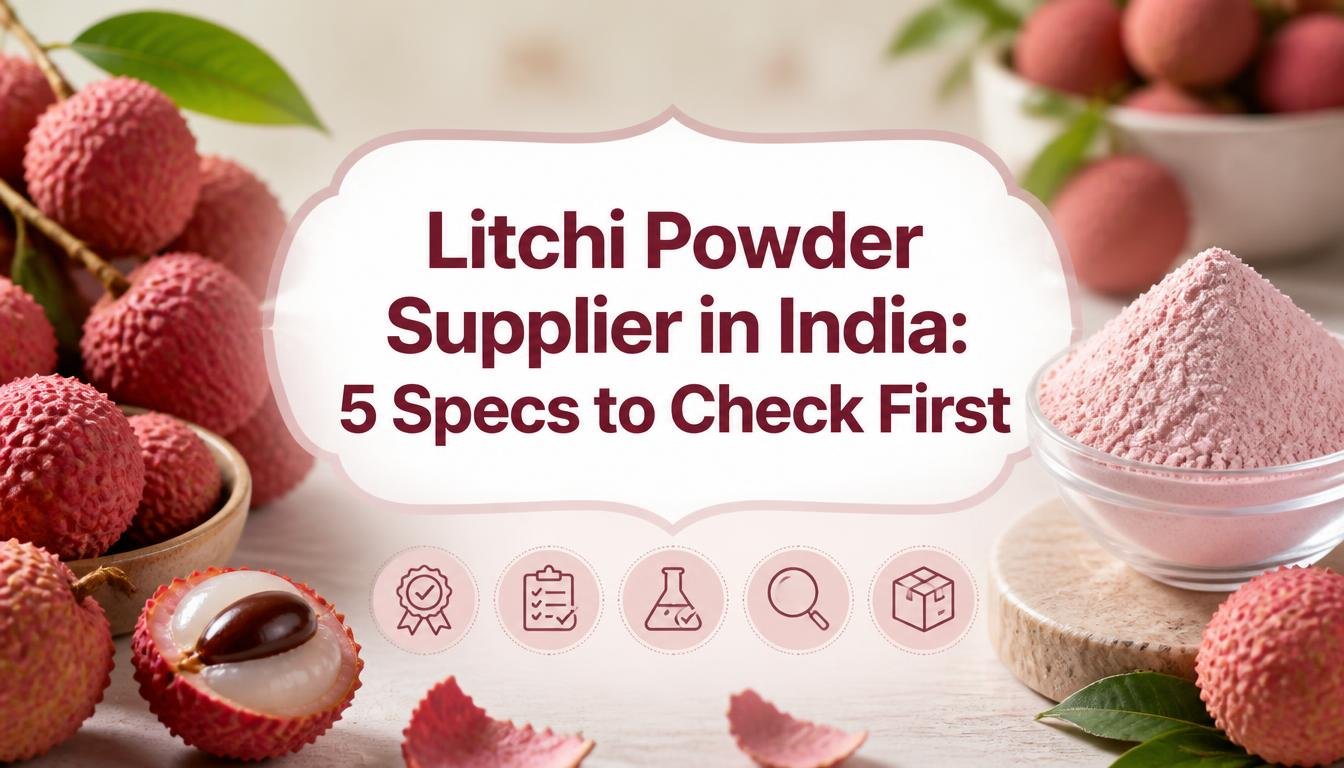
If you’re vetting a litchi powder supplier in India, five specs actually determine whether the powder performs in your formulation: moisture content, solubility and dispersion behavior, color stability over shelf life, vitamin C and polyphenol retention, and the certifications backing the batch. Litchi (lychee) powder has moved well beyond a novelty tropical flavor — it’s now a functional ingredient in beverages, supplements, and bakery applications specifically because it dissolves cleanly, holds its pink hue, and carries a genuine nutritional profile from the fresh fruit.
This guide covers what to check before you commit to a bulk order, and the mistakes that trip up first-time buyers of this specific ingredient.
What Litchi Powder Actually Is
Litchi powder is produced from fresh Litchi chinensis fruit, most commonly through spray drying, which atomizes the fruit’s juice or pulp into a hot air chamber to flash-evaporate moisture while retaining much of the original flavor, aroma, and nutrient content. The result is a fine, typically light pink to white powder that carries litchi’s distinctive sweet, floral flavor without the fruit’s short fresh shelf life or the bulk and weight of fresh or frozen litchi.
Why Buyers Source Litchi Powder from India
India is among the world’s leading litchi-producing countries, with the Bihar-grown Shahi litchi variety carrying a Geographical Indication tag and international recognition for its distinctive sweetness and aroma. That established growing base, combined with a maturing spray-drying processing industry, has positioned Indian exporters as a credible source for buyers who previously had to rely on Chinese or Southeast Asian supply for this ingredient.
Spec 1: Moisture Content and Shelf Stability
As with any spray-dried fruit powder, moisture content is the single most important number on the spec sheet — finished litchi powder should sit at a low enough moisture level to prevent clumping and microbial growth over its shelf life. Ask your supplier for the documented moisture percentage on the certificate of analysis for your specific batch, not a general “shelf-stable” claim. Properly processed and packaged litchi powder commonly carries a shelf life in the range of 12 months when stored in a cool, dry, moisture-protected environment.
Spec 2: Solubility and Dispersion Behavior
This is the property that determines whether litchi powder actually works in your application. A well-processed powder should be free-flowing and dissolve instantly and completely in liquid, without leaving grit or requiring extended mixing — a property that matters enormously for beverage, smoothie, and drink-mix manufacturers where any undissolved residue is an immediate quality defect. Request a sample and test it directly in your own formulation’s base liquid rather than relying on a supplier’s general solubility claim.
Spec 3: Color Stability Over Shelf Life
Litchi powder’s light pink hue is a genuine visual selling point for finished beverages and desserts, but that color can fade or shift over time if the powder isn’t processed and packaged correctly. Ask your supplier how they’ve tested color retention across the product’s full stated shelf life, not just at the point of manufacture — a powder that looks vibrant on day one but fades by month six creates a real problem for a finished product relying on that color for shelf appeal.
Spec 4: Vitamin C and Polyphenol Retention
Fresh litchi is a genuine source of vitamin C and plant polyphenols, and a well-processed powder retains a meaningful share of both — this is part of why nutraceutical and functional food manufacturers source litchi powder specifically, not just for its flavor. Ask for lab documentation of vitamin C content on the certificate of analysis if your formulation is making any nutritional claim tied to this, rather than assuming a generic percentage applies to every batch.
Spec 5: Certifications and Documentation
At minimum, a credible litchi powder supplier in India should provide:
| Certification/Document | What it confirms |
|---|---|
| FSSAI License | Baseline food safety compliance for the Indian exporter |
| APEDA Registration | Required for exporters of processed fruit and vegetable products |
| Certificate of Analysis (COA) | Batch-specific moisture, vitamin C content, and microbial testing |
| HACCP or ISO 22000 | A documented, auditable food safety management system |
Verify FSSAI licensing directly through the FoSCoS portal rather than relying on a certificate image, and request a batch-specific COA for every shipment rather than a one-time general quality certificate.
Where Litchi Powder Is Used
- Beverages and smoothie mixes: a common inclusion rate is around 5–10% of formulation, prized for instant solubility and natural sweetness without added sugar
- Dietary supplements and wellness powders: capsules, tablets, and antioxidant-positioned blends
- Bakery: cakes, muffins, and cookies for natural litchi flavor and light color
- Ready-to-mix formulas: instant drink mixes and dessert bases
- Confectionery fillings: where both flavor and texture benefit from the powder’s free-flowing, non-grainy character
Common Mistakes When Sourcing Litchi Powder
- Not requesting a color-stability test across the full shelf life. A vibrant sample at time of purchase doesn’t guarantee the color holds for 12 months — ask for accelerated shelf-life or real-time stability data.
- Assuming all litchi powders are processed identically. Spray-dried and conventionally dehydrated litchi powder can differ meaningfully in solubility and texture — confirm which process your supplier uses.
- Skipping a solubility test in your own formulation’s base liquid. A powder that dissolves cleanly in water may behave differently in a dairy-based or high-acid beverage base — test directly rather than assuming.
- Overlooking carrier agent disclosure. Like most spray-dried fruit powders, litchi powder often requires a carrier agent (commonly maltodextrin) to dry properly — confirm this for clean-label formulations.
- Not confirming batch-specific vitamin C testing. If your product makes any nutritional claim tied to litchi’s vitamin C content, request documentation per batch rather than relying on a generic published figure.
How Shanti Sons Foods Supplies Litchi Powder
We produce spray-dried litchi powder alongside our broader spray-dried fruit and vegetable powder line, applying the same certification, moisture testing, and color-stability documentation across our full range. If you’re formulating a beverage, supplement, or bakery product, our spray-dried powder sourcing guide covers the broader vetting process, and our piece on why spray dried fruits are helpful covers the functional benefits that apply here too.
The fastest way to confirm fit: request a sample, test solubility and color in your own formulation, and confirm batch-specific COA documentation before scaling to a bulk order.
FAQ
What’s the difference between litchi powder and litchi extract? Litchi powder is the whole fruit’s juice or pulp, spray-dried into a powder retaining its natural flavor and nutrient profile. An extract is typically a more concentrated preparation isolating specific compounds, used where higher potency per gram matters more than whole-fruit character.
How much litchi powder is typically used in a beverage formulation? A common starting point is around 5–10% of the formulation, though the exact usage rate depends on the desired flavor intensity, sweetness, and color in the finished product — testing in your own formulation is recommended.
Does litchi powder contain added sugar? No — properly processed litchi powder derives its sweetness naturally from the fruit itself, without added sugar, which is part of why it fits clean-label formulation goals.
How long does litchi powder last once packaged? Properly processed and stored in a cool, dry, moisture-protected environment, litchi powder commonly holds quality for around 12 months, though this varies by processing method and packaging.
Is Indian litchi powder different from Chinese litchi powder? The underlying fruit and process can be similar, but sourcing from India’s Bihar-grown Shahi litchi variety — which carries a Geographical Indication tag — offers buyers a distinct, traceable origin story, alongside a maturing Indian spray-drying processing industry as an alternative to traditional Chinese and Southeast Asian supply.
Reach out to GO 4 EXPORT INDIA for consultation regarding Import and Export from India.