Moringa oleifera has quietly become one of the most sought-after raw ingredients in global nutraceuticals, functional food formulations, and clean-label supplements. Brands across the United States, Europe, the Middle East, and Southeast Asia are sourcing it from the same place — India, the world’s largest producer of moringa.
If you’re a supplement brand, private label manufacturer, food processor, or bulk ingredient importer, this guide walks you through exactly what to evaluate before placing an order for moringa powder from India — from quality parameters and certifications to processing methods, packaging formats, and the supplier red flags that cost buyers money.
Why India Is the Leading Source for Moringa Powder
India’s dominance in moringa supply is not accidental. The country’s agro-climatic conditions — especially across southern and central states — create ideal growing environments for Moringa oleifera year-round. This gives Indian exporters a structural advantage most other producing countries cannot replicate:
Year-round availability. Unlike some producing regions that depend on a single harvest window, India’s moringa cultivation supports consistent supply across all twelve months. For buyers working on tight production schedules, this predictability matters.
Scale. India’s moringa cultivation network ranges from small contract farms to large commercial plantations. Whether you need 50 kg for a product trial or a 20-tonne container for full-scale production, Indian exporters can accommodate the volume without scrambling.
Processing infrastructure. Established Indian exporters operate temperature-controlled drying units, industrial grinders, micronisers, and quality testing labs in-house. This means buyers can specify mesh size, moisture level, and microbial requirements — and have those specifications met consistently.
Price competitiveness. India’s cost of moringa cultivation and processing is significantly lower than in Europe or North America. This allows importers to source verified, lab-tested moringa powder at price points that support healthy finished-product margins.
What Makes a High-Quality Moringa Powder — and How to Verify It
Moringa powder quality varies widely between suppliers. Most sourcing problems come not from dishonest suppliers but from vague buyer specifications. Here is exactly what to evaluate and how.
Colour: Your First Visual Quality Signal
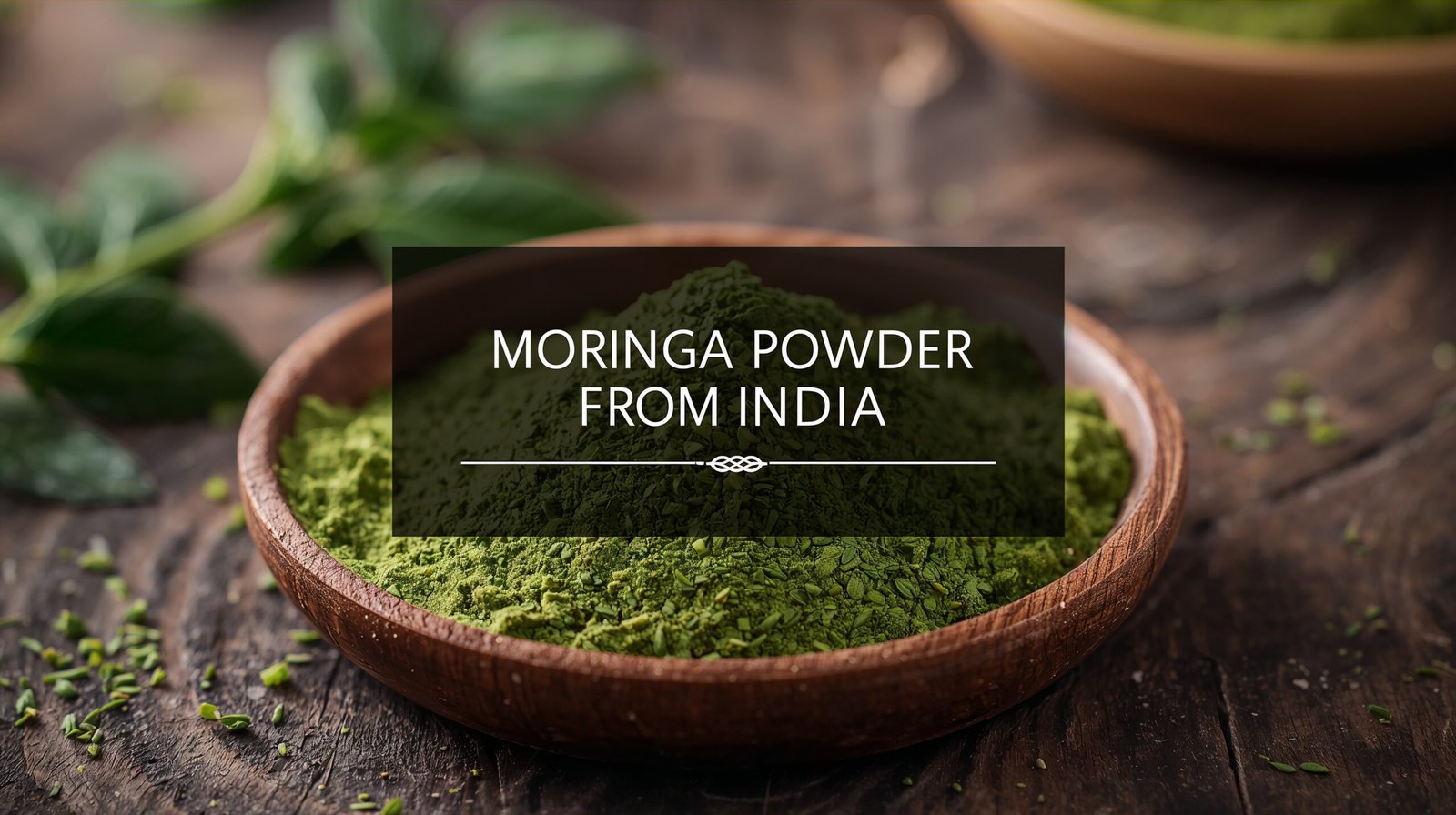
Premium moringa leaf powder is bright, vibrant green. This colour indicates fresh leaves processed quickly at low temperature. A dull, olive, or yellowish colour tells you one of three things has gone wrong: over-drying, oxidation during storage, or leaves harvested too late in the growth cycle.
Always ask suppliers for photographs of the actual production batch — not stock imagery or catalogue photos. Colour consistency across batches is a sign of controlled sourcing and processing.
Protein Content: The Key Nutritional Benchmark
Moringa powder is widely marketed for its protein density, but actual protein levels vary based on how and when plants are harvested.
- Standard food-grade moringa powder: 18–22% protein
- Premium nutraceutical grade (young leaves, controlled height plants): 24–27% protein
Suppliers who keep their plants under 4–5 feet in height concentrate more protein and chlorophyll in the leaves. Taller, older trees distribute nutrients across a larger biomass — the leaves contain less per gram. Ask your supplier directly about their cultivation method, and verify protein percentage through a Certificate of Analysis (COA) from an accredited third-party lab.
Moisture Content: A Non-Negotiable Safety Parameter
Target moisture for export-grade moringa powder should be below 8%. Higher moisture content creates conditions for mould, microbial growth, and premature degradation — particularly during long ocean freight journeys in varying humidity.
Every credible Indian moringa exporter will include moisture percentage on their COA. If a supplier cannot provide this figure for your specific batch, that is a red flag.
Mesh Size: Match to Your Application
Mesh size determines how finely the powder has been ground, which directly affects how it performs in your formulation:
| Mesh Size | Best Application |
|---|---|
| 60 mesh | Capsule filling, tablet compression |
| 80–100 mesh | Protein powder blending, smoothie sachets |
| 150–200 mesh | Instant beverages, fine dispersibility, cosmetic blends |
Specify your required mesh size in your RFQ (Request for Quotation). Most Indian exporters can accommodate custom grinding on order.
Heavy Metal Testing: The Highest-Risk Parameter
Moringa plants are known bioaccumulators — they absorb heavy metals from soil more readily than many other crops. This is not a reason to avoid Indian moringa; it is a reason to require proper testing.
Request test results for all four primary heavy metals on every batch:
- Lead (Pb)
- Cadmium (Cd)
- Mercury (Hg)
- Arsenic (As)
Results should conform to EU Commission Regulation 2023/915 limits for food supplements, or USP <232> limits if supplying the US market. Do not accept a single annual test report — ask for lot-specific results that correspond to the batch you’re purchasing.
Microbial Profile: Required for Any Food or Supplement Use
Standard microbial testing for moringa powder should include:
- Total Plate Count (TPC)
- Yeast and Mould
- E. coli (should be absent per gram)
- Salmonella (should be absent in 25g sample)
These are not optional parameters. Any credible Indian food exporter will provide these as standard in their pre-shipment documentation.
Certifications to Request Before Placing an Order
| Certification | What It Confirms | Who Needs It |
|---|---|---|
| FSSAI | Indian food safety compliance — mandatory for all food exporters in India | All buyers |
| ISO 22000 / FSSC 22000 | International food safety management system | EU, US, UK buyers |
| USDA Organic | Certified organic status for the US market | US brands with organic claims |
| EU Organic | Certified organic status for European markets | EU brands with organic claims |
| HACCP | Hazard analysis and critical control point compliance | All buyers |
| Halal | Permissible for Muslim consumers and markets | Middle East, Southeast Asia, UK buyers |
| Phytosanitary Certificate | Confirms plant-derived product is free from pests and disease | Required in most destination countries |
One critical caution: never accept photocopied certificates without cross-checking against the issuing body’s public registry. Certificate fraud — particularly for USDA Organic and Halal — is a known problem in the herbal ingredient supply chain. Verify directly with the issuing authority before finalising your supplier.
How Indian Manufacturers Process Moringa Powder
Understanding the processing chain allows you to ask sharper questions during supplier qualification — and spot shortcuts that compromise quality.
Step 1 — Cultivation and Harvest
Moringa plants grown for premium powder production are kept at controlled heights, typically under 4–5 feet. Young leaves from controlled plants are harvested before the plant invests nutrients into flowering or fruiting. This is when protein and chlorophyll density is at its highest.
Harvesting is primarily done by hand in the early morning, minimising heat exposure to freshly picked leaves.
Step 2 — Washing
Freshly harvested leaves are washed in clean water to remove dust, soil, and surface contaminants. Ask suppliers about their wash water quality standards. Contaminated wash water is one of the most common entry points for microbial problems in herbal powders.
Step 3 — Drying
How moringa is dried has the single largest impact on its final nutritional quality.
Shade drying is the traditional method — slow, low-temperature airflow drying that preserves chlorophyll and heat-sensitive nutrients. This is the preferred method for premium grades.
Low-temperature forced air drying is the modern industrial alternative. It speeds up production while maintaining quality, provided temperatures stay below 60°C.
Avoid suppliers using high-heat drum dryers or spray drying for moringa leaf powder. Heat above 60°C degrades vitamins, volatile compounds, and enzymatic activity that buyers in the nutraceutical space are specifically paying for.
Step 4 — Grinding and Sieving
Dried leaves are ground to the specified mesh size using industrial pin mills or hammer mills. Premium suppliers use cryogenic grinding (chilling the grinding chamber with liquid nitrogen) to eliminate heat generation during the milling process. This preserves volatile aromatic compounds and prevents oxidation of heat-sensitive nutrients.
The ground powder is then sieved for uniformity before quality testing and packing.
Step 5 — Quality Testing and Lot Assignment
Responsible exporters test each production batch independently and assign a unique lot number. The lot-specific COA documents protein content, moisture, heavy metals, microbial results, and physical characteristics for that exact batch.
Always request the COA that corresponds to your specific lot number — not a generic document.
Step 6 — Packaging and Sealing
Export-grade moringa powder is sealed in moisture-barrier multi-layer packaging to protect quality during long sea freight journeys. Common formats include:
| Packaging | Use Case |
|---|---|
| 1 kg vacuum-sealed foil pouch | Samples, premium retail repack |
| 5 kg / 10 kg sealed foil bags | Small production batches |
| 25 kg multi-wall kraft bags with inner liner | Standard bulk orders |
| 25 kg HDPE drums | High-moisture-sensitivity applications |
| 500 g / 1 kg branded retail pouches | Private label production |
Properly sealed and stored moringa powder has a shelf life of 24 months at room temperature, away from direct light and moisture.
What to Include in Your Moringa Powder RFQ
A well-written RFQ shortens your sourcing timeline and filters out suppliers who cannot meet your standard. Include the following in every enquiry:
- Intended application (supplement capsule, functional beverage, food product, cosmetic)
- Required mesh size
- Organic or conventional
- Certifications required (list specifically)
- Target moisture level
- COA parameters required (protein %, moisture %, heavy metals, microbial)
- Packaging format and weight per unit
- Destination country and preferred port
- Target quantity (sample order, trial order, or FCL)
- Required minimum remaining shelf life on delivery
Suppliers who respond with a price-first email without addressing your specifications are not export-ready operations. Genuine exporters welcome technical enquiries — it tells them you’re a serious buyer.
Red Flags When Evaluating Indian Moringa Suppliers
Watch for these warning signs during supplier qualification:
No lot-specific COA. A supplier who can only offer a generic annual test report — not linked to your specific production batch — cannot guarantee what’s in your shipment.
Price well below market rate. Export-grade, lab-tested moringa powder with proper certifications has a production cost floor. Prices significantly below the market average typically indicate uncertified product, contaminated raw material, or adulteration with cheaper plant powders.
Cannot name their testing lab. Any credible supplier can tell you exactly which NABL-accredited or internationally recognised lab tested their product. Vague answers like “our in-house lab” without supporting documentation should raise concern.
Refuses factory audit or video walkthrough. Reputable Indian exporters welcome qualified buyers to visit or arrange a remote video walkthrough of processing facilities before committing to large orders.
Inconsistent colour across quoted samples. If sample batches look different from each other, it signals inconsistent raw material sourcing, storage, or processing.
Only sells through intermediaries. Traders without manufacturing evidence cannot guarantee the provenance, processing conditions, or certification authenticity of the product they’re selling.
Step-by-Step: From First Enquiry to Shipment
1. Send a detailed RFQ to 3–5 shortlisted suppliers using the parameters above.
2. Request samples — 200–500 g matched exactly to your target mesh size, grade, and organic/conventional preference.
3. Test samples independently at an accredited lab in your country. Do not rely solely on the supplier’s own COA for your first order.
4. Negotiate commercial terms — price, Incoterm (FOB Nhava Sheva / CIF destination port), lead time, payment structure (typically 30–50% advance, balance before shipment for first orders).
5. Place a trial order — typically 100–500 kg — before committing to container volumes. This tests production consistency, lead time accuracy, and documentation quality.
6. Pre-shipment inspection — arrange a third-party inspection (SGS, Bureau Veritas, Intertek) or request a video walkthrough of your packed order before it ships.
7. Confirm your documentation package:
- Lot-specific Certificate of Analysis
- FSSAI Export Certificate
- Phytosanitary Certificate
- Halal Certificate (if applicable)
- Commercial Invoice
- Packing List
- Bill of Lading
8. Customs clearance — moringa leaf powder typically classifies under HS Code 1212.21 (dried moringa leaves) or 2106.90 depending on processing and destination market. Confirm with your freight forwarder before shipment.
Also Available: Moringa Seeds Powder
For buyers working on cold-press oil production, seed meal applications, water purification formulations, or specialised nutraceutical applications, Shanti Sons Foods also exports Moringa Seeds Powder. Moringa seeds carry a distinct fatty acid and phytochemical profile from the leaf powder — request separate specifications for seed powder applications.
Explore Our Full Herbal Powder Range
If you’re building out a herbal ingredient portfolio, the following products from Shanti Sons Foods are frequently sourced alongside moringa powder:
- Ashwagandha Powder — India’s most exported adaptogen; widely used in stress, energy, and immunity formulations
- Spirulina Powder — high-protein blue-green algae for supplement and functional food applications
- Chlorella Powder — detox and greens category ingredient with high chlorophyll content
- Wheat Grass Powder — popular in greens blends, wellness shots, and juice bar concentrates
- Barley Grass Powder — alkalising ingredient used in detox and greens supplement formulations
- Tulsi Leaves Powder — holy basil, widely used in adaptogen, immunity, and Ayurvedic formulations
- Amla Powder — Indian gooseberry; one of the richest natural sources of Vitamin C and a staple in Ayurvedic export blends
- Giloy Powder — immunity-focused Ayurvedic herb with growing demand in global supplement markets
- Brahmi Powder — cognitive health herb used in nootropic and memory supplement formulations
Browse our complete Herbal Powder range for the full list of available products.
Source Moringa Powder from Shanti Sons Foods
Shanti Sons Foods is a Mumbai-based Indian food manufacturer and exporter specialising in herbal powders, spice powders, spray-dried fruit and vegetable powders, freeze-dried fruits, masalas, and Indian snacks for international markets. We export worldwide and work with nutraceutical brands, supplement manufacturers, food processors, and private label buyers.
GO 4 EXPORT INDIA for consultation regarding Import and Export from India.
Get in touch with our export team:
📍 B/301, 3rd Floor, Neera Govind Society, Tambe Nagar Mulund West, Thane 400080, Mumbai, Maharashtra 📞 +91 9833023131 📧 jainishsukhadia26@gmail.com 💬 WhatsApp Us
View Moringa Powder Product Page → Browse All Herbal Powders → Contact Us →