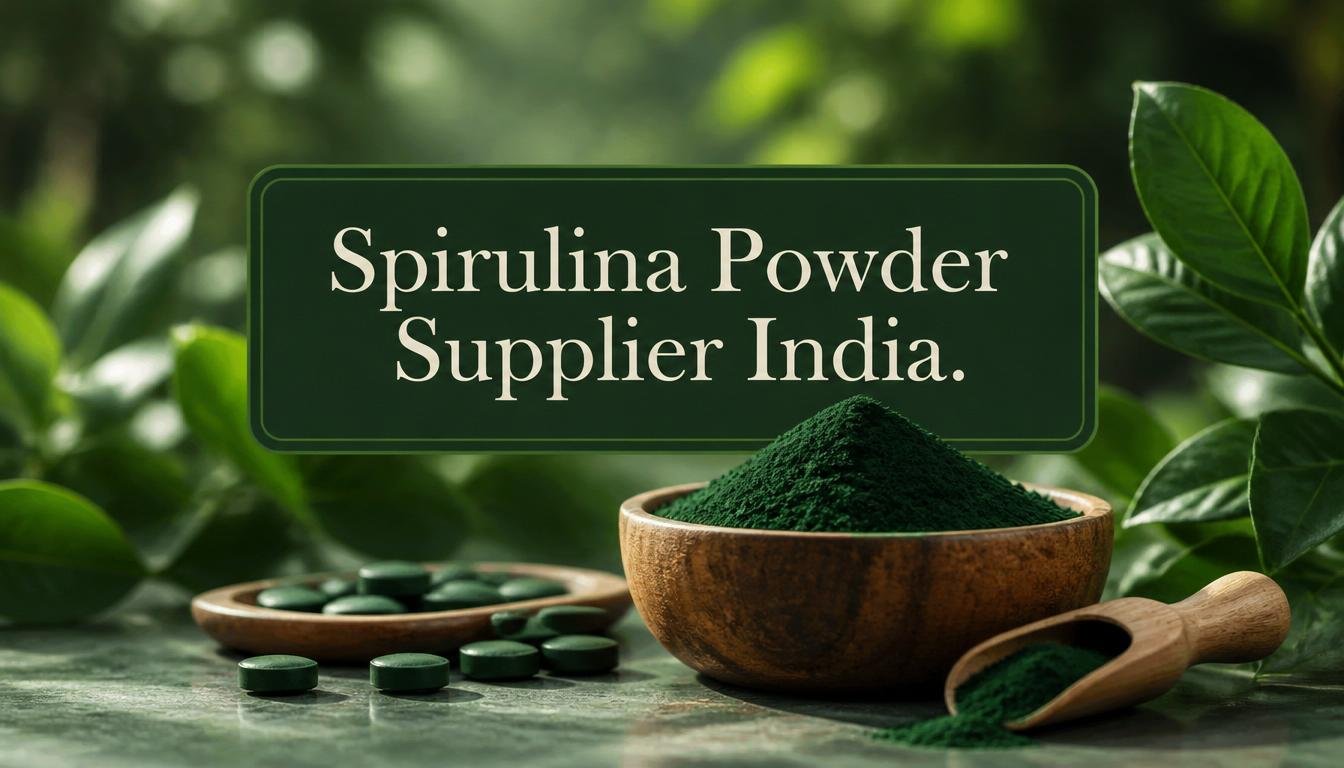
Few ingredient categories in the global supplement industry have grown as consistently as algae-based superfoods. Spirulina and chlorella — two distinct species of single-celled algae with very different cultivation methods, nutritional profiles, and commercial applications — now appear in everything from green smoothie powders and protein blends to multivitamin capsules, pet supplements, and even natural food colouring applications.
India has emerged as a genuine alternative to the traditional algae powder sourcing hubs of China and the United States, offering competitive pricing, growing cultivation infrastructure, and increasingly sophisticated processing capability. But algae powders are also among the most quality-sensitive ingredients a supplement brand can source — heavy metal contamination, microbial risk, and cell wall integrity issues can all silently compromise a product without obvious signs in a casual sample evaluation.
This guide gives supplement brands, nutraceutical manufacturers, and bulk ingredient buyers a complete framework for sourcing spirulina and chlorella powder from India — covering what each product actually is, the quality parameters that separate premium grade from compromised material, certifications required, processing methods, and the sourcing steps that protect buyers from the most common and costly mistakes in algae ingredient procurement.
Spirulina vs. Chlorella: Two Different Organisms, Two Different Products
Although frequently grouped together under the “blue-green algae” or “superfood algae” umbrella in marketing copy, spirulina and chlorella are biologically distinct organisms with meaningfully different production methods, nutritional profiles, and processing requirements. Understanding the difference is essential before sourcing either ingredient.
| Characteristic | Spirulina (Arthrospira platensis) | Chlorella (Chlorella vulgaris / pyrenoidosa) |
|---|---|---|
| Biological classification | Cyanobacteria (technically not a true algae, though commercially marketed as one) | True single-celled green algae |
| Cell wall | Soft, easily digestible — no cellulose cell wall | Tough cellulose cell wall — must be mechanically “cracked” for digestibility |
| Protein content | Very high — 55–70% protein by weight | High — 50–60% protein by weight |
| Colour | Deep blue-green (from phycocyanin pigment) | Deep forest green (from chlorophyll) |
| Cultivation method | Open pond or photobioreactor cultivation in alkaline water | Open pond or closed photobioreactor cultivation in freshwater |
| Key differentiating compound | Phycocyanin (blue pigment, strong antioxidant) | Chlorophyll (highest concentration of any food source) and Chlorella Growth Factor (CGF) |
| Primary commercial positioning | Complete protein source, B12 source, general superfood | Detoxification, heavy metal binding, chlorophyll/greens positioning |
| Cell wall cracking required | No | Yes — critical processing step |
This distinction matters enormously for sourcing decisions: spirulina and chlorella are not interchangeable products, they are not produced through the same process, and the quality red flags for each are different. Buyers sourcing both ingredients should treat them as entirely separate procurement processes with separate specification requirements.
Spirulina Powder: What Buyers Need to Specify
Why Spirulina Commands Such High Demand
Spirulina is one of the most nutritionally dense food sources available, with protein content rivalling or exceeding most animal protein sources by percentage weight, along with significant levels of B-vitamins, iron, and the unique blue pigment phycocyanin — a powerful natural antioxidant compound that has become a marketing differentiator in premium supplement formulations and even natural food colouring applications (phycocyanin extract is used as a natural blue colourant replacing synthetic dyes in some markets).
Primary applications: Protein supplement powders and green superfood blends, multivitamin and B12 supplement formulations, sports nutrition and post-workout recovery products, pet supplement formulations (spirulina is widely used in premium pet food and supplements), natural blue food colouring (phycocyanin extraction), functional beverage and smoothie mix formulations, immune support supplement blends.
Critical Quality Parameters for Spirulina
Protein content. This is the headline specification for virtually every spirulina buyer. Standard food-grade spirulina typically tests at 55–60% protein by weight. Premium nutraceutical-grade spirulina, produced under more controlled cultivation conditions, can reach 65–70% protein. Verify protein content through a Certificate of Analysis using the Kjeldahl or Dumas combustion method — these are the recognised standard testing methodologies for protein content claims.
Phycocyanin content. Phycocyanin is spirulina’s signature blue pigment and the compound most associated with its antioxidant positioning. Higher phycocyanin content correlates with a more vibrant blue-green colour and indicates a fresher, better-cultivated, and better-processed product. Premium spirulina typically tests at 12–18% phycocyanin by weight; standard grade may be lower. Request phycocyanin content on your COA, particularly for premium-positioned supplement products.
Colour. High-quality spirulina powder has a deep, saturated blue-green colour. Faded green, brownish, or dull colour is one of the most reliable visual indicators of quality problems — it typically signals either poor-quality raw cultivation, excessive heat during drying, prolonged exposure to light or air during storage, or simply old stock with degraded phycocyanin content.
Moisture content. Target below 7% for spray dried or sun-dried spirulina powder. Higher moisture creates conditions for microbial growth and accelerates phycocyanin degradation.
Heavy metals. This is the single most important safety parameter for spirulina sourcing, and it deserves particular attention. Spirulina, as an aquatic organism cultivated in open or closed water systems, can bioaccumulate heavy metals from its growing water source if that water is not properly controlled and tested. Request full heavy metals testing for every batch — Lead (Pb), Cadmium (Cd), Mercury (Hg), and Arsenic (As) — and verify the cultivation water source is tested and controlled, not just the finished product. This is the parameter where corner-cutting suppliers most commonly create risk for buyers.
Microcystin testing. Microcystins are toxins that can be produced by certain cyanobacteria species under specific growing conditions, particularly in poorly controlled or contaminated cultivation systems. While properly cultivated Arthrospira platensis spirulina should not contain meaningful microcystin levels, premium buyers — particularly those supplying the EU and US supplement markets — increasingly require microcystin testing as a standard COA parameter. This is an emerging but increasingly important specification; ask your supplier directly whether they test for it and request it explicitly if your target market or brand standards require it.
Microbial profile. Standard panel: Total Plate Count (TPC), Yeast and Mould, E. coli (absent), Salmonella (absent). Open pond cultivation systems carry somewhat higher baseline microbial exposure than closed photobioreactor systems — ask your supplier which cultivation method they use and request additional microbial verification accordingly.
Chlorella Powder: What Buyers Need to Specify
Why Chlorella Is Different — and Why Cell Wall Processing Matters
Chlorella is positioned very differently from spirulina in the global supplement market. While spirulina trades primarily on protein and overall nutrient density, chlorella’s commercial value rests heavily on its exceptionally high chlorophyll content — the highest of any commercially cultivated food source — and its traditional positioning as a detoxification ingredient, particularly for heavy metal binding and elimination support.
Primary applications: Detox and cleanse supplement formulations, chlorophyll and greens powder blends, heavy metal binding and elimination support products (a major commercial positioning for chlorella specifically), immune support supplement blends, gut health and digestive wellness products, natural green food colouring applications.
The Critical Processing Requirement: Cell Wall Cracking
This is the single most important technical fact buyers need to understand about chlorella sourcing, and it is the parameter most frequently overlooked by inexperienced buyers.
Chlorella has a tough, indigestible cellulose cell wall — fundamentally different from spirulina’s soft, easily digestible cell structure. In its natural state, the human digestive system cannot effectively break down this cell wall, meaning the nutrients inside the chlorella cell are largely unavailable for absorption regardless of how nutritionally dense the cell content is.
To make chlorella nutritionally bioavailable, the cell wall must be mechanically “cracked” or “broken” during processing — typically through high-pressure homogenisation, bead milling, or specialised pulverisation techniques. Uncracked or “whole cell” chlorella has dramatically lower nutritional bioavailability than properly broken cell wall chlorella, regardless of the raw nutrient content claimed on a generic specification sheet.
This is the single most important question to ask any chlorella supplier: is the cell wall broken, and what method is used?
Reputable suppliers will be able to clearly explain their cell wall cracking method and provide documentation of broken cell wall percentage — ideally verified through microscopic analysis showing cell wall rupture rate. A supplier who cannot answer this question clearly, or who is unfamiliar with the concept entirely, is either inexperienced in chlorella-specific processing or selling a product with significantly compromised nutritional value.
Critical Quality Parameters for Chlorella
Cell wall cracking rate. Request documentation of broken cell wall percentage — premium chlorella suppliers can typically demonstrate 95%+ cell wall rupture through microscopic verification. This is the single highest-priority specification for chlorella sourcing.
Chlorophyll content. Chlorella’s primary nutritional and marketing claim. Premium chlorella typically contains 3–5% chlorophyll by weight — among the highest of any food source. Verify chlorophyll content on the COA, particularly for products making greens or detox positioning claims.
Protein content. Standard chlorella tests at 50–60% protein by weight — slightly lower than spirulina but still exceptionally high relative to most plant-based protein sources.
Colour. Deep, vibrant forest green is the visual indicator of quality chlorella. Dull, brownish-green, or faded colour indicates degraded chlorophyll content from poor cultivation, excessive processing heat, or extended storage time.
Moisture content. Target below 7%.
Heavy metals. As with spirulina, heavy metal testing is critical for chlorella given its cultivation in water-based systems. This is particularly important given chlorella’s marketing positioning as a heavy metal binding/detox ingredient — there is an obvious credibility and safety issue if a chlorella product intended to help eliminate heavy metals from the body itself contains elevated heavy metal contamination from poor cultivation water control. Request comprehensive Pb, Cd, Hg, and As testing for every batch.
Microbial profile. Standard panel matching spirulina requirements: TPC, Yeast/Mould, E. coli (absent), Salmonella (absent).
How Spirulina and Chlorella Are Cultivated and Processed in India
Cultivation Methods
Open raceway pond cultivation is the most common and cost-effective method used by Indian algae producers. Shallow, paddle-wheel-stirred ponds are filled with nutrient-rich, controlled-pH water in which the algae culture grows under direct sunlight. This method is lower-cost but requires careful water source control, contamination monitoring, and weather-dependent management.
Closed photobioreactor (PBR) cultivation uses sealed tube or panel systems that fully control light exposure, nutrient delivery, temperature, and contamination risk. This method produces more consistent, higher-purity algae but at significantly higher capital and operating cost — reflected in a price premium for PBR-cultivated product.
For supplement-grade applications where contamination risk and consistency are critical, ask your supplier directly which cultivation method they use, and request documentation of their water source testing protocol regardless of method.
Harvesting and Initial Processing
Algae culture is harvested from the cultivation pond or reactor, typically through centrifugation or filtration that separates the algae biomass from the growing water. The resulting wet algae paste is then washed to remove residual growing medium before drying.
Drying Methods
Spray drying is the most common industrial method for both spirulina and chlorella — fast processing that helps preserve nutrient and pigment content, though some heat-sensitive degradation of phycocyanin (in spirulina) is inevitable at typical spray drying temperatures.
Drum drying is a lower-cost alternative used by some processors, though it generally results in greater nutrient and colour degradation than spray drying due to higher heat exposure.
Sun drying is used by smaller and traditional producers but introduces significant quality variability and contamination risk; it is generally not appropriate for export-grade nutraceutical applications and buyers should specifically confirm this is not the drying method used by their supplier.
Cell Wall Cracking (Chlorella Only)
As discussed above, chlorella requires an additional processing step beyond drying: mechanical cell wall disruption through high-pressure homogenisation, bead milling, or equivalent technology. This step is unique to chlorella processing and does not apply to spirulina.
Quality Testing and Lot Documentation
Responsible Indian algae powder processors test each production batch for protein content, pigment content (phycocyanin for spirulina, chlorophyll for chlorella), moisture, heavy metals, and microbial parameters before packaging. Each batch should be assigned a unique lot number with a corresponding Certificate of Analysis.
Certifications to Require from an Indian Spirulina or Chlorella Supplier
| Certification | What It Confirms | Who Needs It |
|---|---|---|
| FSSAI | Indian food safety compliance — mandatory for all food exporters | All buyers |
| ISO 22000 / FSSC 22000 | International food safety management system | EU, US, UK, Australian buyers |
| HACCP | Hazard analysis and critical control point compliance | All food buyers |
| USDA Organic | Certified organic status for US market | US buyers with organic claims |
| EU Organic | Certified organic for European markets | EU buyers |
| Halal | Compliant for Muslim consumer markets | Middle East, Southeast Asia, UK buyers |
| Kosher | Certified Kosher | Specialty supplement and co-packing applications |
| Vegan | Confirms no animal-derived processing aids | Vegan-positioned supplement brands (especially relevant given algae’s plant-based protein positioning) |
| Non-GMO | Verified non-GMO status | US and EU clean-label buyers |
Important note: Standard organic certification for algae products requires specific documentation around water source control and cultivation conditions, given the open or semi-open growing environment. Buyers requiring organic-certified spirulina or chlorella should confirm the certifying body and verify the certification number directly, as algae organic certification has specific additional requirements beyond standard agricultural organic certification.
What to Include in Your RFQ
For spirulina:
- Cultivation method (open pond or photobioreactor)
- Required protein % minimum
- Required phycocyanin % minimum (for premium/colour-critical applications)
- Microcystin testing requirement (specify if required)
- Organic or conventional
- Required certifications
- Full heavy metals and microbial COA parameters
- Mesh size / particle size
- Packaging format and unit weight
- Destination country and port
- Target quantity and minimum remaining shelf life
For chlorella, include all the above plus:
- Cell wall cracking method and verified rupture rate (mandatory — do not omit this)
- Required chlorophyll % minimum
- Whole cell vs. broken cell — confirm explicitly which product you are receiving
Red Flags When Evaluating Indian Algae Powder Suppliers
Cannot explain or document cell wall cracking for chlorella. This is the single most important red flag specific to chlorella sourcing. Any chlorella supplier who treats this as a non-issue, cannot describe their processing method, or cannot provide rupture rate documentation should be treated with significant caution — the product may have substantially compromised bioavailability regardless of its raw nutritional content on paper.
No heavy metals testing, or testing only “occasionally.” Given that algae cultivation occurs in water-based systems with inherent bioaccumulation risk, heavy metals testing must be conducted per production lot — not as an occasional or annual check. This is non-negotiable for both spirulina and chlorella.
Faded, dull, or off-colour product. Both spirulina (should be deep blue-green) and chlorella (should be deep forest green) have very visually distinctive colour profiles when properly cultivated and processed. Faded or brownish colour is one of the most reliable and immediate quality indicators available to a buyer evaluating samples.
No microcystin testing available and no clear answer about it. While not yet universally required, the trend among premium supplement buyers is toward requiring microcystin testing for spirulina specifically. A supplier unfamiliar with this requirement may not be supplying premium international markets at scale.
Price significantly below market for premium specifications. High-phycocyanin spirulina, properly cell-wall-cracked chlorella, and organic-certified algae products all carry meaningful cost premiums reflecting genuine production cost differences. Unusually low pricing for these specific premium claims should prompt closer scrutiny of actual specifications being delivered.
Cannot confirm cultivation water source testing. The growing water is the foundation of algae product safety. A supplier who cannot describe how their cultivation water source is tested and controlled has a meaningful gap in their quality assurance system.
Step-by-Step: From Enquiry to First Shipment
1. Define your full specification — product (spirulina or chlorella, treated separately), protein and pigment targets, cell wall cracking requirement (chlorella), certifications, COA parameters including microcystin and heavy metals, packaging.
2. Send RFQs to 3–5 shortlisted suppliers verified by FSSAI registration and specific experience in algae cultivation and processing — not all herbal powder exporters have algae-specific capability.
3. Request samples — 100–250g per product, matched to your exact specification, with the corresponding lot-specific COA including heavy metals and (for chlorella) cell wall rupture documentation.
4. Third-party test your samples independently. This is particularly important for algae products given the heavy metal accumulation risk — do not rely solely on the supplier’s own COA for your first order. For chlorella, consider requesting microscopic verification of cell wall disruption from your testing lab if your supplier’s documentation is unclear.
5. Evaluate colour and aroma alongside lab results — vibrant, saturated colour and a clean, mild “sea” or “green” aroma without strong fishy or musty off-notes are good organoleptic indicators.
6. Negotiate commercial terms — price, Incoterm (FOB/CIF), lead time, payment structure.
7. Place a trial order — typically 50–250 kg given the premium price point of these ingredients — before committing to larger volumes.
8. Pre-shipment inspection — third-party inspection or video walkthrough of packed goods.
9. Confirm full documentation:
- Lot-specific COA (protein, pigment, moisture, heavy metals, microbial, microcystin)
- Cell wall rupture documentation (chlorella)
- FSSAI Export Certificate
- Phytosanitary Certificate (where applicable)
- Organic certificate (if applicable)
- Halal Certificate (if applicable)
- Commercial Invoice and Packing List
- Bill of Lading
10. Customs classification: Spirulina and chlorella powder typically classify under HS Code 2102.20 (single-cell micro-organisms, dead) or related provisions depending on processing and destination country. Confirm exact classification with your freight forwarder.
Packaging for Export
| Format | Application |
|---|---|
| 100g / 250g / 500g vacuum-sealed pouches | Sample orders, premium retail repack |
| 1 kg / 5 kg nitrogen-flushed foil bags | Trial orders, small production batches |
| 25 kg multi-wall kraft bags with inner liner | Standard bulk export orders |
| 25 kg HDPE drums | Maximum moisture and light protection for premium grade |
Both spirulina and chlorella are light- and oxygen-sensitive due to their pigment content (phycocyanin and chlorophyll respectively degrade on light and oxygen exposure). Specify opaque, nitrogen-flushed, moisture-barrier packaging for all formats, and store in cool, dark conditions. Properly packaged algae powder has a shelf life of 18–24 months from production date.
Related: Other Greens and Superfood Powders from Shanti Sons Foods
Beyond spirulina and chlorella, Shanti Sons Foods exports a complementary range of greens and superfood powders frequently sourced together for blended green supplement formulations:
- Wheat Grass Powder — alkalising greens ingredient, popular in wellness shots and detox blends
- Barley Grass Powder — complementary greens ingredient with a milder flavour profile than wheat grass
- Alfalfa Powder — nutrient-dense greens ingredient used in greens blends and animal nutrition applications
- Moringa Powder — high-protein superfood leaf powder, commonly blended with spirulina and chlorella in greens formulations
- Amla Powder — natural Vitamin C source frequently paired with algae powders in immunity-positioned blends
Browse our complete Herbal Powder range →
Further Reading from Our Export Guide Series
- Moringa Powder from India: What Nutraceutical Brands Need to Know
- Ashwagandha, Brahmi & Giloy: Buyer’s Guide to Ayurvedic Herbal Powders
- How to Import Fruit Powders from India: Amla, Mango, Pomegranate & 30+ More
Source Spirulina and Chlorella Powder from Shanti Sons Foods
Shanti Sons Foods is a Mumbai-based Indian food manufacturer and exporter supplying spirulina powder, chlorella powder, and a complementary range of greens and superfood powders alongside our broader herbal, spice, fruit, and vegetable powder ranges. We export worldwide and supply nutraceutical brands, supplement manufacturers, functional food companies, and private label buyers.
GO 4 EXPORT INDIA for consultation regarding Import and Export from India.
Get in touch with our export team:
📍 B/301, 3rd Floor, Neera Govind Society, Tambe Nagar Mulund West, Thane 400080, Mumbai, Maharashtra 📞 +91 9833023131 📧 jainishsukhadia26@gmail.com 💬 WhatsApp Us
View Spirulina Powder → View Chlorella Powder → Browse All Herbal Powders → Contact Us →