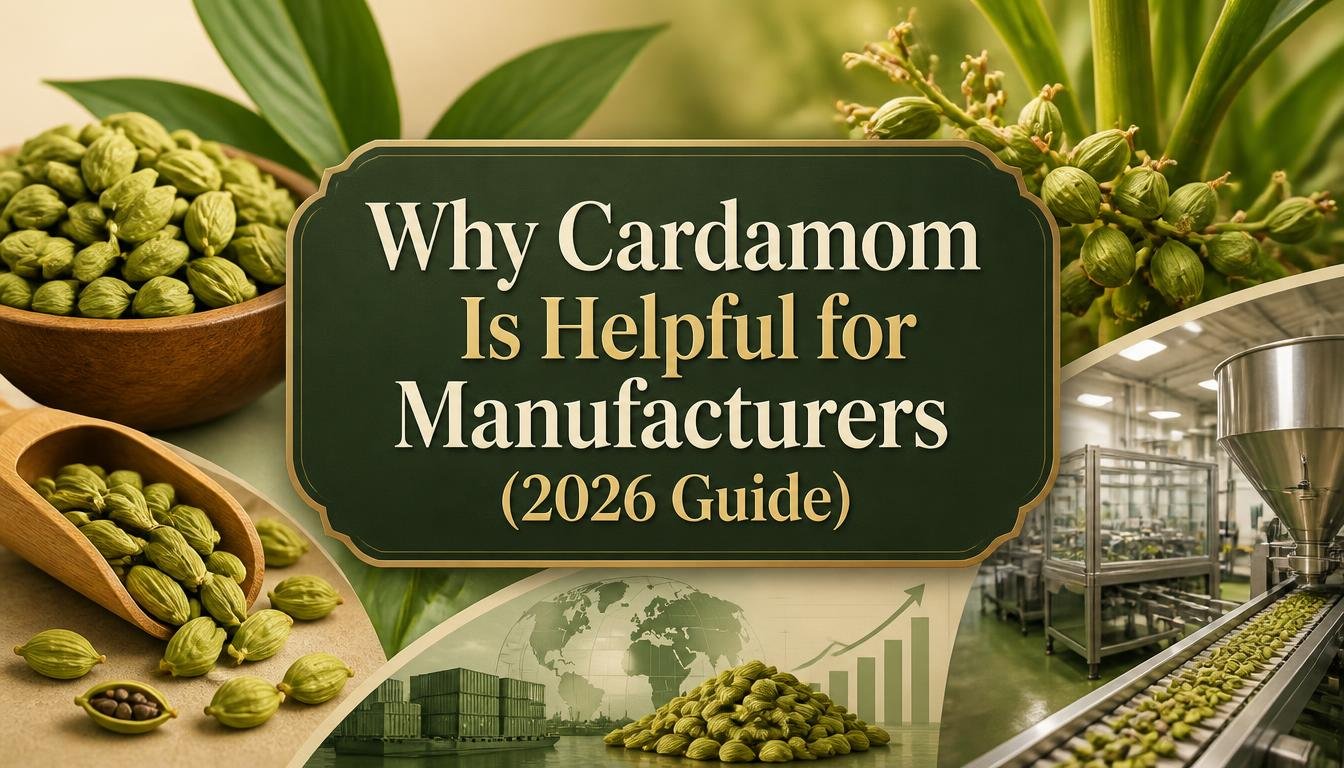
Cardamom — often called the “Queen of Spices” — is helpful for manufacturers because it commands genuine premium pricing and serves distinctly different buyer needs depending on grade: the highest grades go to premium retail and Middle Eastern coffee culture, mid-tier grades feed spice blending and food processing at scale, and a separate stream of pods goes entirely to essential oil extraction for the flavor and fragrance industry. Understanding this grading system — not just “cardamom is a nice spice” — is the actual difference between paying a fair price and overpaying, or between getting a pod suited to your application and one that isn’t.
This guide breaks down how cardamom grading works, where each grade fits, and cardamom’s less obvious second market: perfumery.
Why Cardamom Commands Premium Pricing
Green cardamom is cultivated primarily in the Western Ghats, where the region’s climate supports the plant growth and essential oil development that give Indian cardamom its reputation for strong aroma and oil content. That combination of scarcity relative to demand, labor-intensive hand-harvesting, and consistent quality from ideal growing conditions is what keeps cardamom among the more expensive spices by weight in global trade — a genuinely different price economics story than most spices in this catalog.
The Grading System That Actually Determines Price and Fit
This is the detail buyers most need to understand before sourcing cardamom in bulk. Grading is based primarily on pod size (measured in millimeters), along with color uniformity, maturity, and physical condition — and the Indian market recognizes a genuinely complex classification system with up to 25 distinct grades. For practical buying purposes, a few grades dominate international trade:
| Grade | Pod Size | Typical Buyer |
|---|---|---|
| Alleppey Green Extra Bold (AGEB) | 8mm+ | Premium retail, gift market, Middle Eastern “gahwa” coffee culture — visual perfection matters here |
| Alleppey Green Bold (AGB) | 7mm–8mm | The industrial workhorse grade — spice blending, baking, retail packaging |
| Alleppey Green Superior (AGS) | ~6mm | More budget-conscious bulk buying and grinding applications |
| Split and Panadan grades | Broken or lower-visual-quality pods | Grinding into powder where pod appearance doesn’t matter |
Buyers evaluating quotes without understanding this system risk paying premium-grade pricing for a use case (grinding into powder, for instance) where pod appearance is irrelevant and a lower grade would perform identically at a lower cost.
1. Matching Grade to Application Saves Real Money
If your product uses ground cardamom in a spice blend or baked good, appearance-driven premium grades like AGEB add cost without adding value to your finished product — AGB or lower grades deliver equivalent flavor and aroma once ground. Reserve premium grades for applications where pod appearance genuinely matters: retail gift packaging, whole-pod garnish use, or markets like Middle Eastern coffee culture where visual perfection is a real buyer expectation.
2. A Genuine Second Industry: Perfumery and Essential Oils
This is where cardamom diverges sharply from most spices in this catalog. A distinct segment of buyers — oleoresin and essential oil extractors, concentrated in Europe and the US — prioritize high volatile oil content over pod appearance entirely, since the seeds are steam-distilled into concentrated essential oil used to flavor processed foods, liqueurs, and oral care products like toothpaste and gum. Separately, cardamom serves as a recognized heart note in perfumery, valued for building spicy, oriental fragrance profiles, where buyers prioritize chemical purity above all else.
For a manufacturer or trader operating across both food and fragrance/flavor industries, understanding that cardamom serves genuinely different buyer profiles — visual grade for food and retail, oil content for extraction, purity for perfumery — is essential to sourcing the right pod for the right customer.
3. Strong, Diversified Global Demand
The USA, UAE, Saudi Arabia, Germany, and Canada are among the top destination markets for Indian cardamom, reflecting demand that spans confectionery and beverage use, Middle Eastern coffee culture, European and American flavor extraction, and fragrance applications simultaneously. That diversification across both geography and end-use gives cardamom exporters and buyers a genuinely resilient demand base compared to spices dependent on a single dominant application.
4. Genuine Versatility Across Sweet and Savory Applications
Cardamom’s flavor profile — sweet, citrusy, and spicy all at once — makes it functional across an unusually broad range of products: Nordic baked goods, Indian mithai (sweets), Middle Eastern coffee, chai and spiced beverages, and savory curries and spice blends. Confectionery and beverage applications typically require sterilized or steam-treated pods specifically to ensure low bacterial counts, a processing detail worth confirming with your supplier if your application requires it.
5. Packaging and Logistics Built Around Aroma Preservation
Because cardamom’s value is driven substantially by aroma and volatile oil content, serious exporters rely on vacuum-sealed pouches, foil-lined bags, and nitrogen-flushed containers specifically to preserve that aroma through international shipping — packaging quality here has a more direct impact on delivered product value than for many other spices, where aroma loss is a less central concern.
6. Documentation Requirements Specific to Cardamom Export
Beyond the standard FSSAI and APEDA registrations covered in our general spice guide, cardamom exporters need a CRES (Registration-cum-Membership Certificate equivalent) specifically from the Spices Board of India, along with a phytosanitary certificate and certificate of origin — documentation worth confirming explicitly with any cardamom-specific supplier, since it’s a category-specific requirement beyond general spice export documentation.
Common Mistakes When Sourcing Cardamom
- Paying premium-grade pricing for a grinding application. If pod appearance doesn’t matter for your finished product, a lower grade delivers equivalent flavor at meaningfully lower cost.
- Not specifying oil content requirements for extraction use. If you’re an oleoresin or essential oil buyer, request documented volatile oil content rather than relying on visual grading alone, since these buyer priorities are inverted from food-grade retail buying.
- Assuming a single “cardamom” price applies across grades. With up to 25 recognized grades in the Indian market, ask for a grade-specific quote rather than a single blanket price.
- Overlooking Spices Board CRES registration. This is a cardamom-specific requirement in addition to standard FSSAI and APEDA registration — verify it directly with your supplier.
- Underestimating packaging’s role in aroma retention. Standard packaging without nitrogen flushing or foil lining can meaningfully degrade cardamom’s aroma and value during a long international shipment.
How Shanti Sons Foods Supplies Cardamom
We export cardamom across multiple grades alongside our broader spices and seasoning line, with packaging suited to aroma preservation for both food-grade and extraction-oriented buyers. If you’re sourcing across multiple spice categories, our spice import and vetting guide and our piece on why bulk spices are helpful cover the certification checks and broader category context that apply here too.
The fastest way to confirm fit: specify your application (retail, grinding, or extraction), request the appropriate grade for that use case, and confirm CRES, phytosanitary, and origin documentation before scaling to a bulk order.
FAQ
What does AGEB mean in cardamom grading? AGEB stands for Alleppey Green Extra Bold, the premium grade for pods 8mm and larger, favored for high-end retail packaging and Middle Eastern coffee culture where visual perfection matters.
Do I need the highest cardamom grade if I’m grinding it into a spice blend? No — pod appearance is largely irrelevant once cardamom is ground, so a mid-tier grade like AGB typically delivers equivalent flavor and aroma at a lower cost than premium visual grades.
Why does cardamom matter to the perfume industry? Cardamom serves as a recognized heart note in fragrance formulation, particularly for spicy, oriental perfume profiles, where buyers prioritize chemical purity of the extracted oil rather than pod appearance.
What documentation is specifically required for cardamom exports from India? Beyond standard FSSAI and APEDA registration, cardamom exporters need CRES registration from the Spices Board of India, a phytosanitary certificate, and a certificate of origin.
Which countries import the most cardamom from India? The USA, UAE, Saudi Arabia, Germany, and Canada are among the top importers, reflecting demand spanning food processing, beverages, Middle Eastern coffee culture, and flavor/fragrance extraction.
Reach out to GO 4 EXPORT INDIA for consultation regarding Import and Export from India.