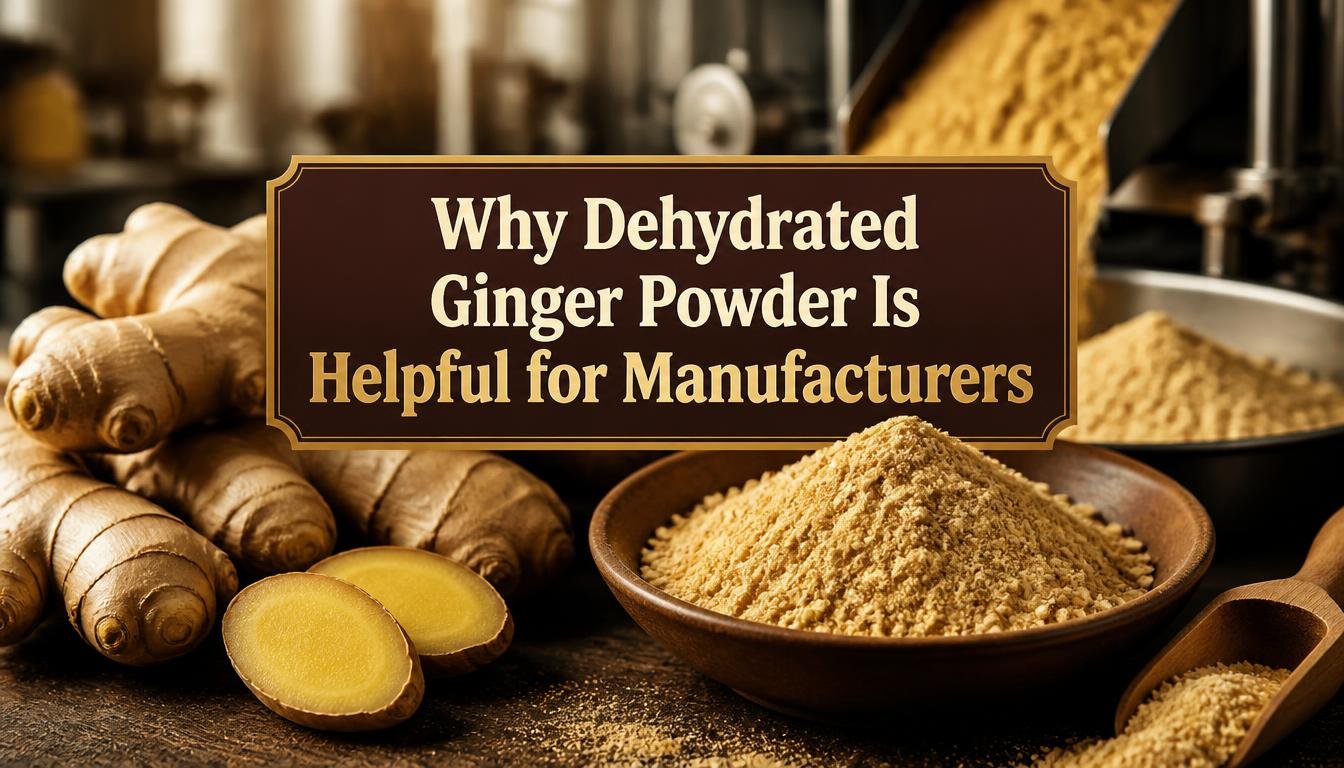
Why Dehydrated ginger powder is helpful for manufacturers? Its because it converts a highly perishable, seasonal rhizome into a shelf-stable, standardized ingredient with a genuinely concentrated flavor payload — it takes roughly 5–7kg of fresh ginger to produce just 1kg of dehydrated powder, which means the powder delivers a much higher flavor and aroma density per unit of weight and volume shipped. For tea premix, spice blend, snack, and nutraceutical manufacturers, that concentration and stability are exactly why dehydrated ginger has moved from a supporting spice into a genuine strategic ingredient category.
This guide covers what makes dehydrated ginger useful at an industrial scale, how the drying process actually changes the ingredient, and where flakes versus powder fit best.
India’s Position in Global Ginger Supply
India contributes close to half of global ginger production, giving Indian processors a genuine scale advantage in dehydrated ginger supply. The real value for buyers, though, isn’t just raw volume — it’s how consistently that ginger gets processed, standardized, and documented for international markets. Buyers increasingly prioritize origin traceability and compliance over simply chasing the lowest price, which has pushed serious Indian exporters toward tighter quality and documentation standards over the past several years.
1. Genuine Flavor and Aroma Concentration
Because dehydration removes the vast majority of ginger’s water content, the finished powder carries a much higher concentration of flavor and aroma compounds per gram than fresh ginger does. For a manufacturer formulating a spice blend, tea premix, or snack seasoning, this means a small, precisely dosed amount of powder delivers the flavor impact that would require a much larger quantity of fresh ginger — simplifying both formulation and cost calculation.
2. Long Shelf Life Without Refrigeration
Fresh ginger has a limited usable window even under good storage conditions, while properly dehydrated ginger powder, stored in a cool, dry, moisture-protected environment, holds its flavor and quality for a much longer period. This shelf stability removes cold-chain logistics from the sourcing equation and lets manufacturers hold inventory through demand cycles without spoilage pressure.
3. Consistent Potency and Flavor Batch to Batch
Fresh ginger varies significantly in pungency and flavor intensity depending on variety, growing conditions, and harvest timing. A well-processed dehydrated ginger powder, standardized and lab-tested, gives manufacturers a repeatable flavor and potency baseline — a level of consistency that matters directly for maintaining a recognizable product across production runs, especially for a brand selling in multiple markets.
4. Mesh Size and Format Options for Different Applications
Dehydrated ginger is typically available in flakes and powder, with powder further specified by mesh size — commonly in the 80 to 120-mesh range. Finer mesh (closer to 120) suits tea premixes and beverage applications where fast, smooth dissolution matters. Coarser mesh and flake formats suit spice blends and applications where a bit of visible texture or slower flavor release is acceptable. Confirm the specific mesh size with your supplier rather than assuming a standard grind fits your formulation.
5. A Genuinely Wide Range of Applications
Dehydrated ginger shows up across food, beverage, and wellness manufacturing: tea premixes, spice and masala blends, instant soup mixes, snack seasonings, bakery applications, and nutraceutical and supplement formulations. This range reflects growing demand tied to both culinary use and the broader natural-ingredients and functional-beverage trend, with the processed ginger segment (powder, oil, and flakes combined) projected to see solid annual growth through the back half of this decade.
6. A Processing Detail Worth Knowing: Gingerol and Shogaol
During dehydration, some of ginger’s gingerol content converts to shogaol, a related compound — a detail that matters for flavor and potency characterization but is a processing fact, not a health claim in itself. If your formulation or labeling references gingerol or shogaol content specifically, confirm the exact compound profile with your supplier’s lab documentation rather than assuming fresh-ginger figures apply directly to the dehydrated product.
Common Mistakes When Sourcing Dehydrated Ginger
- Assuming all mesh sizes are interchangeable. A tea premix formulation and a spice blend have very different requirements for particle size and dissolution speed — confirm the exact mesh spec for your use case.
- Not asking about sulfur dioxide or other processing aids. Some suppliers use sulfur dioxide during processing for color preservation; if you need a sulfite-free product for labeling or allergen reasons, confirm this explicitly.
- Overpaying for organic certification you don’t need. Organic dehydrated ginger commands a real premium — worth it if your product is positioned and certified as organic, but an unnecessary cost otherwise.
- Skipping lab documentation on potency. Ask for testing that characterizes flavor and aroma compound content, not just a general quality assurance statement.
- Making unsubstantiated health claims on packaging. Ginger carries a long history of traditional and culinary use, but any specific health claim on a finished product needs separate regulatory substantiation for your destination market — this is a labeling compliance question, not a sourcing one.
How Shanti Sons Foods Supplies Dehydrated Ginger
We export dehydrated ginger flakes and powder alongside our onion, garlic, and tomato lines, applying the same certification, mesh-size specification, and lab-testing process across all of them. If you’re formulating a tea premix, spice blend, or nutraceutical product, our pieces on why dehydrated tomato powder is helpful and why dehydrated onion and garlic are helpful cover the adjacent categories in the same supply chain, and our herbal powder guide covers the botanical side of our catalog if ginger is one ingredient among several in a wellness formulation.
The fastest way to confirm fit: request samples across flake and powder mesh options, test flavor intensity and dissolution against your formulation, and confirm lab documentation before scaling to a bulk order.
FAQ
How much fresh ginger does it take to make dehydrated ginger powder? Roughly 5 to 7 kilograms of fresh ginger are needed to produce 1 kilogram of dehydrated powder, reflecting ginger’s high water content before processing.
What mesh size is standard for dehydrated ginger powder? Commonly in the 80 to 120-mesh range, with finer mesh suited to tea premixes and beverage applications, and coarser mesh or flakes suited to spice blends and applications where some texture is acceptable.
How long does dehydrated ginger powder last? Properly processed and stored in a cool, dry, moisture-protected environment, dehydrated ginger powder holds its flavor and quality for well over a year, substantially longer than fresh ginger’s limited shelf window.
Is dehydrated ginger powder more concentrated than fresh ginger? Yes — removing the water content concentrates the flavor and aroma compounds significantly, meaning a smaller quantity of powder delivers a comparable or stronger flavor impact than a much larger quantity of fresh ginger.
What industries use the most dehydrated ginger powder? Tea and beverage premix manufacturers, spice blend producers, snack and bakery companies, and increasingly nutraceutical and supplement brands are among the largest users, drawing on both its culinary flavor profile and its role in functional formulations.
Reach out to GO 4 EXPORT INDIA for consultation regarding Import and Export from India.