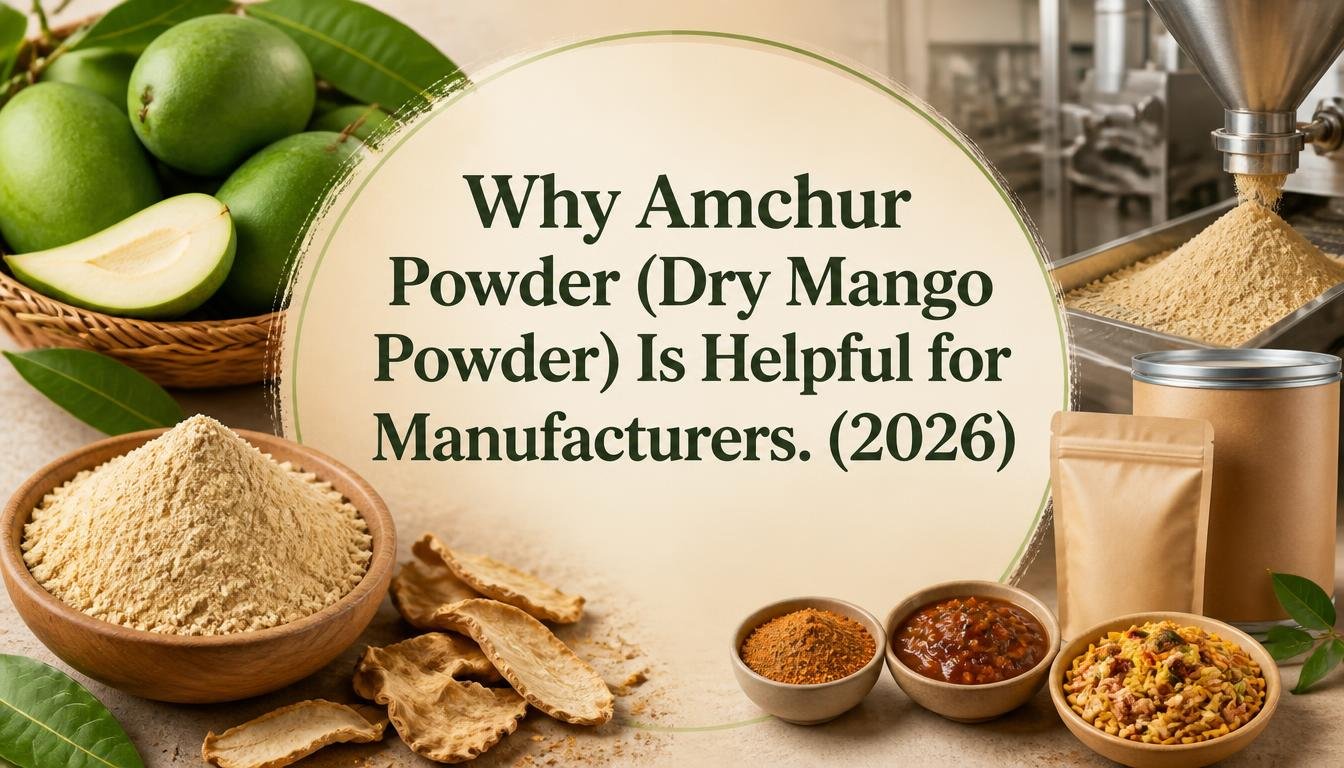
Amchur Powder (Dry Mango Powder) is helpful for manufacturers because it does something few other souring agents can: it adds real, tangy acidity to a dry formulation without introducing any moisture. Made from sun-dried, unripe green mangoes ground into a fine powder, amchur functions as a dry substitute for lemon juice or tamarind wherever added liquid would compromise texture — which is exactly why it’s a staple ingredient in dry spice blends, snack seasoning, and shelf-stable chaat masala formulations across the food industry.
This guide covers why that dry-acidity property matters at manufacturing scale, where amchur is used most, and what to check before sourcing it in bulk.
What Makes Dry Mango Powder Different from Other Acidulants
Most natural souring agents — lemon juice, vinegar, tamarind pulp — are liquid or semi-liquid, which makes them straightforward for wet formulations like sauces or curries but genuinely problematic for dry products. Adding a liquid acidulant to a snack seasoning, spice blend, or dry mix formulation introduces moisture that can affect shelf life, texture, and flow properties in the finished product.
Amchur solves this specific problem. Because it’s already a dry powder, it delivers acidity and tartness without adding any liquid to the formulation — a property that makes it functionally distinct from tamarind or citric acid in dry-mix applications, even though all three can serve a similar souring role.
1. Dry Acidity for Formulations Where Moisture Is a Problem
This is amchur’s defining functional benefit. In dry vegetable preparations, snack seasonings, and spice blend powders, any added liquid can affect texture, shelf life, or processing — amchur solves this by delivering tartness in the same dry form as the rest of the formulation. This is why amchur is a defining ingredient in products like chaat masala, dry curry powders, and snack coatings, where a liquid souring agent simply wouldn’t work.
2. Long Shelf Life Without Special Storage
Properly processed and packaged amchur, stored in a cool, dry, moisture-protected environment, holds its tartness and flavor for an extended period — a genuine advantage over fresh lemon or lime, which spoil within days to weeks. For manufacturers running production on a schedule independent of citrus harvest seasons, amchur provides consistent souring capability year-round without the supply and spoilage risk of fresh citrus.
3. Consistent Sourness and Flavor at Scale
Fresh lemon and lime juice vary in acidity and flavor intensity by fruit, season, and ripeness. A well-processed, quality-controlled amchur powder gives manufacturers a more standardized tartness level to formulate against, which matters for maintaining a consistent finished product across production runs — particularly for packaged snack and spice blend brands selling the same formulation across markets and seasons.
4. A Functional Preservative Role in Certain Applications
Amchur’s acidic profile contributes a mild natural preservative effect in some traditional applications, particularly pickles and certain spice blends, by helping create an environment less favorable to microbial growth. This is a genuine, long-documented culinary use rather than a formal food-safety substitute — worth noting to formulators, but not a replacement for validated preservation methods in a commercial product.
5. Genuine Versatility Across Formats
Amchur shows up across a wide range of products: chaat masala and other spice blends, dry curry seasoning, snack and namkeen coatings, marinade and rub formulations, chutney and pickle bases, and even as a natural meat tenderizer in some marinade applications, since its acidity has a mild tenderizing effect similar to other fruit-based acids. That range reflects how thoroughly amchur has moved from a single regional spice into a broadly useful functional ingredient across food manufacturing.
6. A Byproduct-to-Ingredient Value Story
Amchur is made from unripe, early-season green mangoes — fruit that would otherwise need to wait for ripening or risk being discarded if picked too early for fresh sale. Converting this early-harvest fruit into a shelf-stable spice gives processors a productive use for mangoes that fall outside the fresh-fruit market window, adding a genuine resource-efficiency angle to the ingredient’s supply chain.
Common Mistakes When Sourcing Amchur
- Assuming all amchur has the same tartness level. Sourness varies by mango variety and processing method — request a sample and test against your formulation rather than assuming consistency across suppliers.
- Not confirming anti-caking agent status. Some commercial amchur includes an anti-caking agent (commonly a wheat-derived fiber); if your product needs to be gluten-free or additive-free, confirm the exact ingredient list.
- Overlooking mesh size for dry-mix applications. Fine mesh disperses more evenly in a dry spice blend; coarser grinds may be appropriate for certain snack coating applications.
- Substituting amchur for tamarind at a 1:1 ratio without testing. The two have different flavor profiles and acidity levels — a direct substitution can shift the finished product’s taste more than expected.
- Making unsubstantiated health claims on packaging. Amchur carries genuine traditional culinary and nutritional associations, but any specific health claim requires separate regulatory review for your destination market — this is a labeling question, not a sourcing one.
How Shanti Sons Foods Supplies Amchur
We export amchur alongside our broader spices, dehydrated vegetable, and spray-dried fruit powder lines, applying the same certification, lab-testing, and mesh-size specification process across all of them. If you’re formulating a dry spice blend or snack seasoning, our spice import and vetting guide covers the certifications that apply here too, and our piece on why tamarind powder is helpful covers the adjacent wet-and-dry souring agent category in the same supply chain.
The fastest way to confirm fit: request a sample batch, test tartness and dispersion against your specific dry formulation, and confirm anti-caking agent status and mesh size before scaling to a bulk order.
FAQ
What is amchur made from? Amchur (also spelled amchoor) is made from unripe, sun-dried green mangoes, sliced and ground into a fine powder — the same basic process used for centuries in North Indian cuisine.
Can amchur replace lemon juice or tamarind in a recipe? Generally yes as a souring agent, though the flavor profile differs slightly, and amchur adds no liquid, which is precisely why it’s preferred over lemon or tamarind in dry formulations specifically.
How long does amchur powder last? Properly processed and stored in a cool, dry, moisture-protected environment, amchur holds its tartness and flavor for well over a year, substantially longer than fresh lemon or lime.
Does amchur contain any additives? Pure amchur is typically just dried, ground mango, though some commercial formulations include a small amount of anti-caking agent to prevent clumping — confirm the exact ingredient list if your product requires additive-free labeling.
What products commonly use amchur? Chaat masala and other spice blends, dry curry seasonings, snack and namkeen coatings, marinades, and chutney bases are among the most common applications, valued for delivering acidity without adding moisture to the formulation.
Reach out to GO 4 EXPORT INDIA for consultation regarding Import and Export from India.