
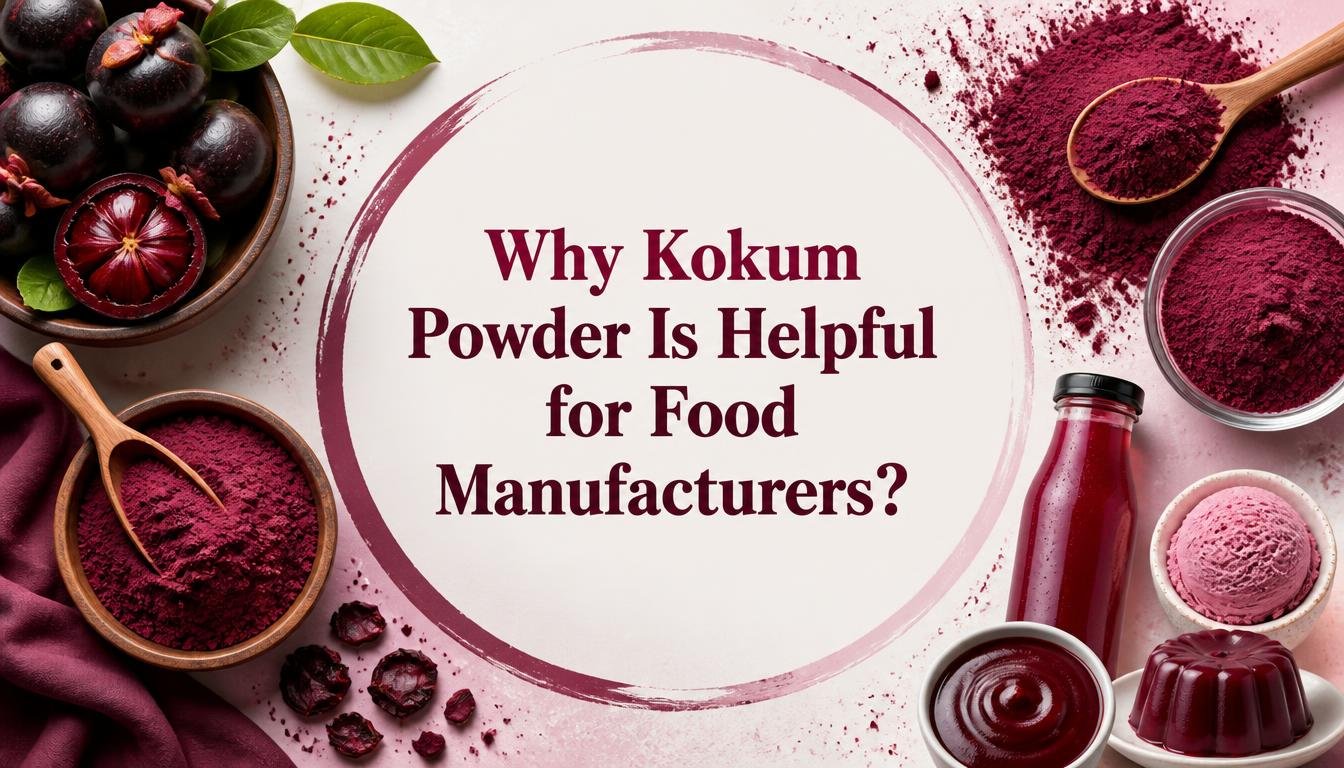
Why Kokum powder is helpful for manufacturers looking for a natural souring agent that behaves differently from tamarind or citric acid: it delivers a cleaner, more floral tartness, carries meaningfully less sugar than tamarind, and comes with a genuinely useful natural red-purple color from its anthocyanin content — a combination that positions it well for both flavor and clean-label colorant applications. Native to India’s Western Ghats, kokum has moved from a regional coastal-cuisine ingredient into a broader natural-ingredients category with real export interest.
This guide covers what makes kokum functionally distinct from other souring agents, and where it fits best in a formulation.
What Kokum Actually Is
Kokum (Garcinia indica) is a small, dark purple fruit whose dried rind is used as a souring agent in Indian cuisine, particularly along the western coast. The dried, sun-processed rind — sometimes called “black kokum” or, when combined with salt during processing, “aamsul” — is ground into a fine powder or sold as dried pieces, giving it a tangy, tart, slightly fruity and floral flavor profile.
1. A Genuinely Distinct Souring Profile
While kokum, tamarind, and amchur all serve a similar souring function, they aren’t interchangeable in flavor terms. Kokum’s tartness is generally described as cleaner and more floral than tamarind’s, without the stickiness of tamarind pulp or the fruitier sweetness of amchur. For manufacturers formulating a product where flavor differentiation matters — a distinctive beverage or sauce line, for instance — that flavor distinction is a genuine point of differentiation from more commonly used souring agents.
2. Lower Sugar Content Than Tamarind
Kokum generally carries less sugar than tamarind, which matters directly for manufacturers formulating reduced-sugar or better-for-you positioned products where a souring agent’s own sugar contribution affects the final nutritional label. Swapping tamarind for kokum in a formulation where sugar content matters is a genuine formulation lever, not just a flavor substitution.
3. A Natural Colorant with Real Functional Value
Kokum’s rind carries meaningful anthocyanin content, giving it a deep red-purple hue that food scientists have identified as a promising natural alternative to synthetic food colorants. For brands actively reformulating away from synthetic dyes toward natural colorant sources — a trend accelerating across beverages, confectionery, and sauces — kokum offers a dual-function ingredient that contributes both color and flavor in a single line item, simplifying formulation compared to sourcing a separate synthetic colorant and souring agent.
4. Long Shelf Life in Dried Form
Properly dried kokum, stored in an airtight container in a cool, dark place, holds its flavor and potency for up to about a year — giving manufacturers a stable, shelf-storable ingredient rather than one tied to fresh fruit availability, which is limited to kokum’s regional and seasonal harvest window in the Western Ghats.
5. A Genuine Point of Differentiation for Brands
Because kokum is less commonly used internationally than tamarind or citric acid, it offers brands a way to differentiate a product’s flavor and ingredient story — particularly relevant for brands building around authentic regional Indian ingredients or a broader “discover new natural ingredients” positioning that resonates with consumers seeking less commoditized flavor profiles.
6. Versatility Across Food and Beverage Categories
Kokum is used in curries, dals, chutneys, and — notably for manufacturers — a wide range of beverage applications, where its tartness and color both contribute to the finished product. Traditional preparations like kokum sharbat (a cooling beverage) point directly to its suitability for functional and refreshment-positioned drink categories, an application area seeing growing interest from beverage brands looking for natural, less commoditized flavor and color sources.
A Practical Limit Worth Knowing
Kokum is a genuinely more niche ingredient than tamarind or amchur internationally, meaning fewer suppliers offer consistent export-grade quality, and buyers should expect more variability in sourcing options and lead times than for more mainstream souring agents. Requesting a sample and confirming consistent color and flavor across batches matters more here than for a more established, widely available ingredient.
Common Mistakes When Sourcing Kokum
- Assuming kokum and tamarind are directly interchangeable. Their flavor profiles, sugar content, and color contribution differ meaningfully — test in your specific formulation rather than substituting by weight.
- Overlooking the colorant application. Buyers sourcing kokum purely for flavor sometimes miss its value as a natural colorant, which can simplify a clean-label reformulation by consolidating two ingredient functions into one.
- Not confirming moisture and storage handling. Kokum’s shelf life depends on proper drying and airtight storage — ask for the specific moisture content and storage recommendations rather than assuming standard spice handling applies.
- Assuming supply is as consistent as more mainstream spices. Kokum’s more regional, seasonal sourcing base means confirming your supplier’s consistent supply capacity matters more than for higher-volume commodity spices.
- Making unsubstantiated health claims on packaging. Kokum carries real, documented traditional use and functional compounds, but any specific health or weight-management claim requires separate regulatory substantiation for your destination market.
How Shanti Sons Foods Supplies Kokum
We export kokum powder alongside our tamarind, amchur, and broader spice lines, applying the same certification and quality-control process across all of them. If you’re formulating a beverage or sauce needing a distinctive natural souring agent, our pieces on why tamarind powder is helpful and why amchur is helpful cover the adjacent souring-agent categories in the same supply chain.
The fastest way to confirm fit: request a sample, test flavor and color contribution against your formulation, and confirm consistent supply capacity before scaling to a bulk order.
FAQ
How is kokum different from tamarind as a souring agent? Kokum generally offers a cleaner, more floral tartness with less sugar and stickiness than tamarind, plus a distinctive red-purple color from its anthocyanin content that tamarind doesn’t provide in the same way.
Can kokum be used as a natural food colorant? Yes — kokum’s anthocyanin-rich rind gives it a deep red-purple hue that has been identified as a promising natural alternative to synthetic food colorants, making it useful as a dual-function flavor-and-color ingredient.
How long does dried kokum powder last? Properly dried and stored in an airtight container in a cool, dark place, kokum holds its flavor and potency for up to about a year.
What products commonly use kokum? Curries, dals, chutneys, and a range of beverage applications — including traditional cooling drinks like kokum sharbat — are among the most common uses, making it especially relevant for beverage manufacturers seeking natural flavor and color.
Is kokum as widely available as tamarind for bulk export? No — kokum is a more regionally and seasonally sourced ingredient than tamarind, so buyers should expect more variability in supplier options and should confirm consistent supply capacity before committing to volume.
Reach out to GO 4 EXPORT INDIA for consultation regarding Import and Export from India.