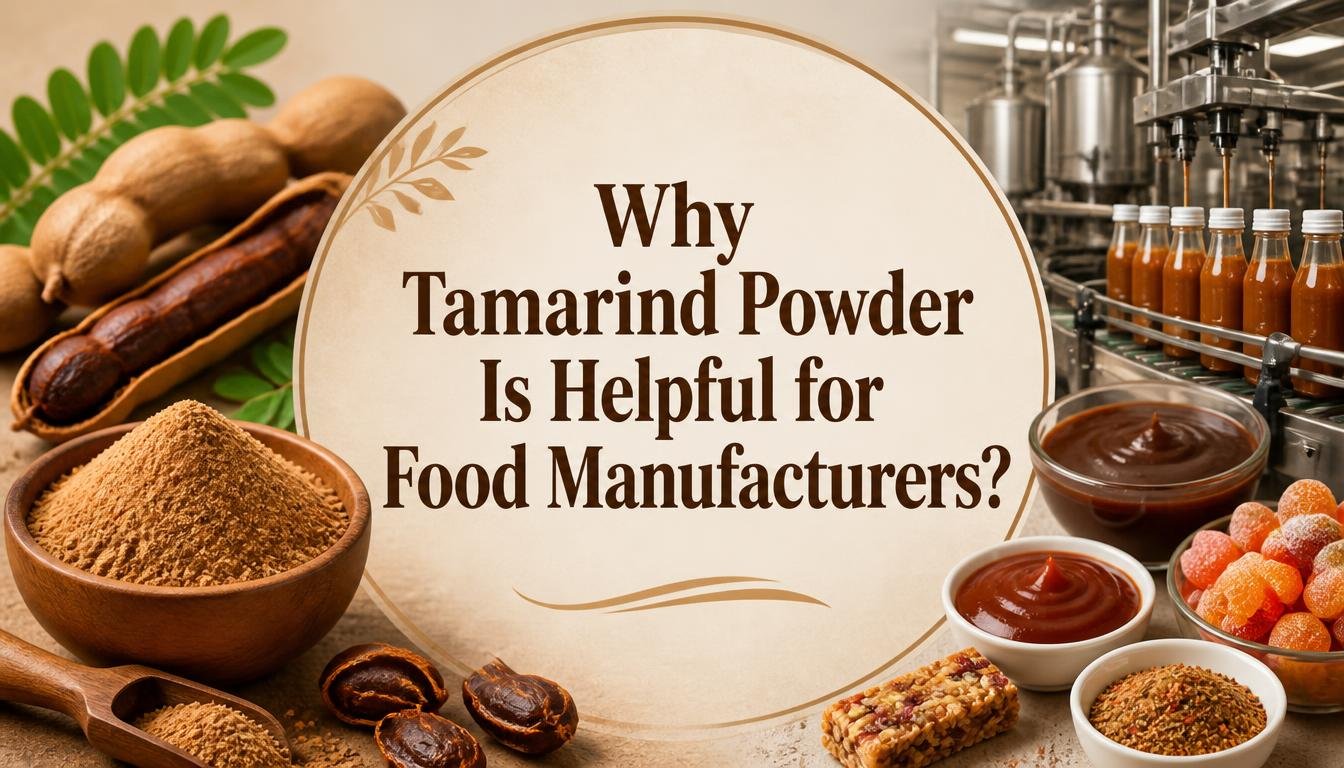
Why Tamarind powder is helpful for food manufacturers because it delivers a genuinely distinctive sweet-sour flavor profile — driven by real tartaric acid content — in a shelf-stable, easy-to-dose format, without the handling complications of working with raw tamarind pods or fibrous pulp. More than 2,400 international buyers currently source tamarind from India, and demand spans well beyond traditional cuisine into sauces, beverages, and even industrial applications through a related product, tamarind kernel powder.
This guide covers what makes tamarind genuinely useful at manufacturing scale, the difference between tamarind pulp powder and tamarind kernel powder, and what to check before sourcing either in bulk.
Two Different Products Under One Name
This is the detail that trips up first-time buyers. “Tamarind powder” can refer to two genuinely different products, and confusing them leads to sourcing the wrong ingredient entirely:
- Tamarind pulp powder (from the fruit’s pulp) — used for its sweet-sour flavor in food and beverage applications.
- Tamarind kernel powder (TKP) (from the seed) — a natural polysaccharide used industrially for its thickening, binding, and stabilizing properties, in food as well as textile, paper, and mining applications.
Both are legitimate, valuable products, but they serve entirely different formulation purposes. Confirm which one you actually need before requesting quotes — the terminology overlap is common enough that a miscommunication here is an easy, avoidable mistake.
1. Genuine, Documented Souring Power
Tamarind pulp contains real tartaric acid content, which is what gives it its distinctive tang — this isn’t just a flavor descriptor but a measurable chemical property that industrial buyers actively test for when sourcing bulk tamarind. Manufacturers formulating sauces, chutneys, and beverages rely on this consistent acid content to hit a specific tartness target across production batches, treating tamarind as what one industry source calls a genuine natural binding and souring agent rather than a novelty ethnic ingredient.
2. Long Shelf Life and Easy Handling Compared to Raw Fruit
Processed tamarind products — paste, powder, or compressed blocks — offer meaningfully more consistent quality and a longer shelf life than raw tamarind, which matters especially for international markets where fresh tamarind supply simply isn’t available locally. Powder form in particular avoids the fiber and seed removal work required when using raw pulp, saving processing time for manufacturers working at volume.
3. Genuine Thickening and Stabilizing Properties (Kernel Powder)
Tamarind kernel powder deserves specific attention here because its value proposition is different from the pulp-based product: it offers strong viscosity, high stability, and good binding strength as a natural, biodegradable thickener. In food manufacturing, this shows up in ketchups, sauces, baked goods, meat products, instant noodles, and ice cream, where TKP functions as a natural alternative to synthetic thickening agents — directly relevant to brands pursuing clean-label reformulation.
4. A Genuinely Broad Range of Food Applications
Tamarind (in pulp, paste, or powder form) shows up across sauces, chutneys, beverages, candy, spice blends, and nutraceutical formulations, with tamarind paste and spray-dried powder specifically generating higher export value than raw tamarind blocks — reflecting how much processing adds commercial value in this category. The global tamarind extract market is projected to approach $2 billion within the next decade, driven substantially by food processing, beverage, and nutraceutical demand.
5. Alignment with Clean-Label Reformulation Trends
As manufacturers move away from synthetic acidulants and thickeners toward natural, minimally processed alternatives, tamarind sits squarely in the category consumers and brands are actively seeking out. Its natural credentials — a fruit-derived acid and a seed-derived natural polysaccharide — make it a genuine substitute for synthetic additives in both the souring-agent and thickening-agent roles, not just a traditional-cuisine ingredient repositioned for marketing purposes.
6. Export-Grade Consistency and Documentation
Serious tamarind processors document tartaric acid content, moisture levels, and purity as standard buyer requirements, reflecting the fact that industrial buyers treat this as a specified raw material rather than a loosely defined commodity. Buyers should expect and request this documentation as a baseline, not an optional extra.
Common Mistakes When Sourcing Tamarind Products
- Confusing tamarind pulp powder with tamarind kernel powder. These serve entirely different functions — flavor versus thickening — and quoting the wrong one wastes time on both sides.
- Not specifying processed form. Raw blocks, defibered pulp, paste, and spray-dried powder all carry different pricing, shelf life, and handling requirements — be specific about which form your formulation needs.
- Skipping tartaric acid content testing. Ask for documented tartaric acid content and moisture level, not just a general quality claim, especially for large-volume sauce or beverage formulations where consistency matters.
- Assuming 1:1 substitution between tamarind and other souring agents. Tamarind’s flavor profile differs meaningfully from amchur, citric acid, or vinegar — test in your actual formulation before committing to volume.
- Overlooking industrial (non-food) applications when evaluating suppliers. A supplier experienced primarily in food-grade tamarind pulp may not have the same expertise in tamarind kernel powder for industrial thickening applications, and vice versa — confirm the supplier’s specific expertise matches your need.
How Shanti Sons Foods Supplies Tamarind Products
We export tamarind pulp powder alongside our amchur, spices, and dehydrated vegetable lines, applying the same certification and lab-testing standards across all of them. If you’re formulating a sauce, beverage, or spice blend needing a natural souring agent, our pieces on why amchur is helpful and why dehydrated tomato powder is helpful cover the adjacent flavor and acidity categories in the same supply chain.
The fastest way to confirm fit: specify exactly which tamarind product you need (pulp powder, paste, or kernel powder), request documented tartaric acid and moisture content, and test a sample against your formulation before scaling to a bulk order.
FAQ
What’s the difference between tamarind powder and tamarind kernel powder? Tamarind powder (pulp powder) comes from the fruit’s pulp and is used primarily for its sweet-sour flavor in food and beverages. Tamarind kernel powder comes from the seed and is used mainly as a natural thickening, binding, and stabilizing agent in food and industrial applications.
How long does tamarind powder last in storage? Processed tamarind powder or paste, stored properly, offers meaningfully longer shelf life and more consistent quality than raw tamarind, which is one of the primary reasons international buyers prefer processed forms over raw pods or blocks.
Can tamarind powder replace lemon juice or amchur in a formulation? It can serve a similar souring role, but tamarind’s flavor profile is distinct from both — testing in your specific formulation is recommended rather than assuming a direct substitution.
What industries use tamarind kernel powder outside of food? Textile mills use it as a sizing and thickening agent, paper manufacturing uses it in processing, and it’s also used in mining as a flotation agent and in some construction applications — reflecting its broad utility as a natural polysaccharide beyond food.
Which countries import the most tamarind from India? The United States, United Arab Emirates, and Australia are among the leading destinations for Indian tamarind exports, with more than 2,400 international buyers currently sourcing from India.
Reach out to GO 4 EXPORT INDIA for consultation regarding Import and Export from India.